
A transaction can surface old paint, suspect building materials, vermiculite insulation, or reports of earlier hazard work. The useful question is not simply whether a material exists. It is what is known, what remains unexamined, whether planned work will disturb it, and what professional assessment or future project allowance is reasonable before you commit.
Lead paint and asbestos have different disclosure rules, assessment methods, and work scopes. This guide helps buyers and sellers organize those questions. It does not determine whether a particular home is safe, set a negotiation strategy, or replace local legal and professional advice.
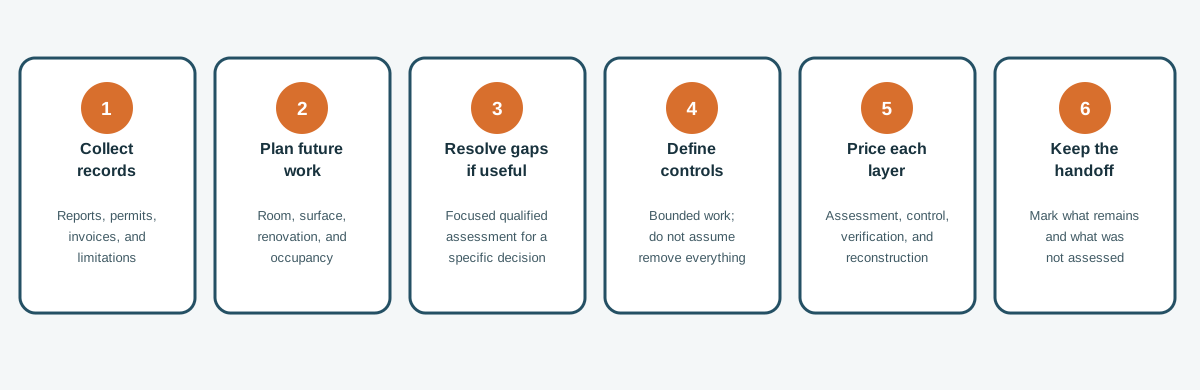
Start with records and the planned use of the home
Ask what reports, invoices, permits, notices, laboratory results, and remediation or clearance documents already exist. Request the full documents rather than relying only on a listing description or a seller’s summary. Check the date, rooms and materials covered, method, limitations, and whether later renovation may have changed the conditions.
Then list the work you may do after closing. Repainting sound walls, replacing windows, opening ceilings, changing flooring, moving plumbing, and disturbing attic insulation do not create the same assessment need. A material may be stable and left undisturbed now but become a project issue when a future trade cuts, sands, drills, removes, or demolishes it.
Keep these questions separate:
| Question | What it can answer | What it does not establish by itself |
|---|---|---|
| Is there a disclosure duty? | What information or notice a party must provide under the applicable rules. | Whether the home has been fully inspected or has no hazard. |
| Is a material present? | Whether identified samples or inspected components contain lead or asbestos. | The condition of every similar surface or hidden area. |
| Is there a current hazard? | Whether an assessment identifies a condition or pathway needing control. | A complete renovation budget or a health diagnosis. |
| What will future work cost? | A scoped estimate for a defined intervention and restoration. | A price for areas or materials the assessor did not inspect. |
Lead disclosure is not a lead inspection
In the United States, federal lead disclosure requirements cover most housing built before 1978, subject to exclusions and details in the rule. For a covered sale, the seller generally provides known lead information and available records before the buyer is obligated, along with the required information pamphlet. The buyer generally receives a 10-day opportunity to arrange a lead inspection or risk assessment; the parties may agree to a different period or waive the opportunity in writing.
The federal rule does not require every seller to test the home or pay for a buyer’s inspection. A disclosure of no known information is not the same as a negative test. The rule’s coverage and exceptions matter, and state or local requirements may add obligations. Ask the transaction professional or relevant authority to confirm how the rule applies to the property and transaction.
An inspection and a risk assessment also serve different purposes. A lead-based-paint inspection identifies painted components with lead; a risk assessment considers hazards such as deteriorated paint, dust, or soil and may recommend controls. Neither automatically maps every hidden area or prices all abatement and reconstruction. The right deliverable depends on the planned decision. See lead paint inspection versus risk assessment for that choice.
Asbestos and vermiculite need a separate records check
The U.S. federal government does not require a home seller to disclose asbestos under a general federal asbestos disclosure rule. That boundary does not prove that no state, local, contractual, or other disclosure duty applies. Ask for known reports, notices, work records, and local requirements separately from the lead paperwork.
Vermiculite insulation deserves particular care because some attic vermiculite came from a source associated with asbestos. Appearance alone cannot establish the material’s composition, and a small sample or old report may not represent all insulation or other suspect materials. Do not disturb insulation to investigate it. If planned work would affect it, ask an asbestos professional and the local authority what assessment and work controls apply. More on its precautions is in vermiculite insulation and asbestos.
Canadian buyers and sellers should not import U.S. federal transaction rules. The sources available for this guide do not establish a single Canada-wide disclosure or inspection rule covering every province and territory. Confirm the applicable local requirements and transaction documents with the appropriate regulator or qualified real-estate professional. Building age, provincial worker-protection and disposal rules, and local practice can all change the next step.
Decide whether a focused assessment is worth doing before commitment
A general home inspection can identify visible conditions and recommend follow-up, but it is not automatically a lead or asbestos survey. If a known report identifies suspect material in a room scheduled for renovation, a focused assessment may clarify the affected components and the next trade’s scope. If the material will remain intact and undisturbed, the immediate question may instead be how to document it and avoid accidental disturbance.
Before ordering work, give the assessor the planned renovation, prior records, access constraints, and the exact decision deadline. Ask what areas will be assessed, whether laboratory analysis is included, which areas cannot be evaluated, and what the report can say about adjacent or concealed materials. A negative sample applies to the sampled location and method; it does not certify every surface or hidden layer in the home.
If the transaction schedule cannot accommodate an assessment, preserve the uncertainty explicitly. The buyer and seller may need to decide how to handle access, an estimate allowance, or a later project. Those are transaction decisions for the parties and their advisers; an assessor’s report does not promise a credit, lender acceptance, or a specific contract outcome.
Turn findings into a bounded work scope
When a report identifies a concern, ask for a work description tied to the specific materials and locations. Lead work might involve stabilizing, enclosing, replacing, or removing components, followed by cleanup and any applicable verification. Asbestos work may involve leaving stable material in place, encapsulating or enclosing it, or hiring an appropriately qualified contractor for controlled removal. The method depends on condition, disturbance, future use, and local requirements.
Do not treat “hazard present” as synonymous with “remove everything.” Unnecessary disturbance can create additional work. Conversely, an approach that leaves a material in place should specify what remains, how it is protected, what future trades must know, and what would trigger reassessment. Hazard-specific choices are covered in asbestos encapsulation versus removal and lead paint control methods.
Budget assessment, intervention, and restoration separately
The transaction budget may need several distinct allowances:
- Assessment and access: professional time, sampling or laboratory analysis, opening a limited area when authorized, and a return visit.
- Hazard control: containment, worker protection, specialized labor, cleaning, packaging, transport, and disposal under applicable rules.
- Verification and records: inspection, sampling, clearance where required or specified, and a closeout report.
- Ordinary repair: replacement windows, insulation, drywall, flooring, trim, paint, or other finishes after controlled work.
- Unresolved areas: materials hidden behind finishes or outside the assessment boundary that may need a separate decision later.
There is no reliable combined “lead and asbestos” transaction price. A room’s size alone does not define the work: material type, condition, access, containment, number of locations, disposal requirements, occupied status, and finish quality can dominate. U.S. market observations for a particular lead or asbestos service should not be added together as though they estimate the home’s project. Canadian prices also should not be inferred by converting a U.S. figure.
For each quote, ask whether the assessment report is included, which materials and quantities are covered, what happens if hidden material is found, who arranges waste disposal, and whether post-work verification and restoration are separate. Compare the deliverables, not only the total.
Keep the records useful after closing
Save the original reports, sample locations, invoices, permits or notices, work plans, disposal records, photographs, and verification documents with the home’s renovation records. Mark materials intentionally left in place and the rooms or components that were not examined. Give that information to future contractors before work begins.
A useful transaction file narrows later uncertainty; it does not make an old assessment current forever. Renovation may expose new materials, and a report limited to one room cannot answer questions about another. For radon timing and testing during a sale, use the separate radon buying and selling guide. Credible information about former laboratory activity calls for the distinct authority and property-status path in former drug-lab home assessment.
Questions to resolve before you commit
- Which records are complete, and which rooms or materials were never assessed?
- Is the planned work likely to disturb a suspect component?
- What specific decision would a new assessment change?
- Which local disclosure, qualification, notification, and disposal rules apply?
- What work is included in the estimate, and what remains an allowance?
- Who will retain and pass on the records for material left in place?
The goal is a clear record of what is known, a focused plan for what remains uncertain, and a budget tied to the work that may actually follow.