
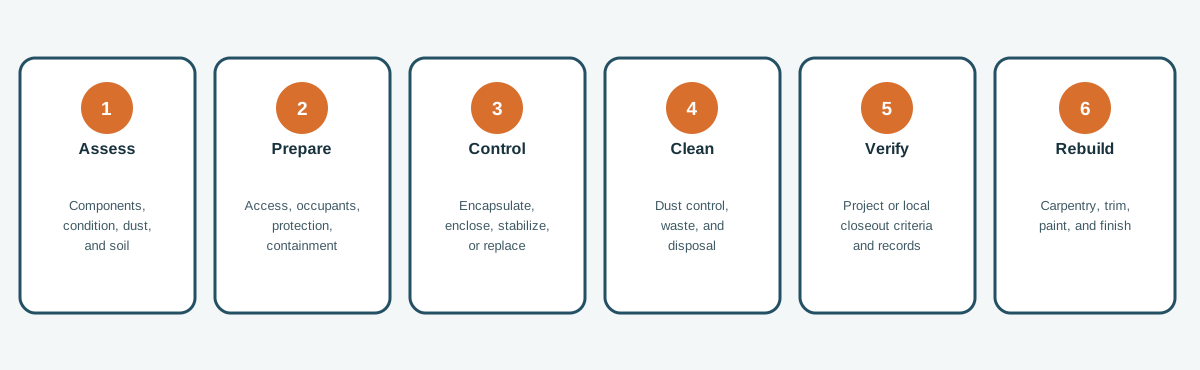
Lead-paint abatement cost depends on the hazard, the component, the control method, and the level of documentation and verification required. A quote for repainting a room is not necessarily a quote for controlling lead hazards. Compare complete scopes: assessment, preparation, containment, treatment or replacement, cleanup, clearance, temporary occupancy, and reconstruction.
A market estimate needs a boundary
Angi’s 2026 US market observations report a lead-paint removal range of about $1,478 to $5,520 and an average of about $3,499. Treat these as source-attributed U.S. market observations, not a promise or Canadian price. They may not include inspection, risk assessment, temporary housing, replacement components, dust clearance, or ordinary repairs.
The number is difficult to use without a component and area. Removing paint from a small window, replacing deteriorated trim, treating multiple friction surfaces, or controlling exterior soil can be different projects even if the paint color looks the same. Ask for quantities and assumptions rather than a single “lead abatement” allowance.
An average is not a quote for the room or house in front of you. The source’s broad estimate does not define which control method, components, clearance, relocation, or rebuild work a project included. Use it only as orientation for a U.S. market discussion, then replace it with a scope tied to the assessment and local rules. There is no comparable Canadian average established here.
Cost layers to request
- Inspection or risk assessment: The starting evaluation may identify paint, dust, soil, condition, occupants, and recommended controls.
- Work design and setup: A detailed method, occupant relocation, furniture protection, barriers, access, and notices can add time.
- Containment and dust control: The contractor may need isolation, protective sheeting, controlled access, specialized cleaning, and waste handling.
- Control method: Encapsulation, enclosure, component replacement, paint stabilization, or another method has different labor and material costs.
- Cleanup: HEPA-assisted cleaning, repeated cleaning, and cleaning adjacent surfaces may be part of the lead-safe scope.
- Clearance or verification: Dust sampling, visual checks, or other release criteria may be required by the project or jurisdiction.
- Reconstruction: New windows, doors, trim, drywall, flooring, or paint can be ordinary construction after the hazard control.
Ask which items are included in the base price and which are allowances. A low bid that excludes dust cleanup is not comparable with a bid that includes a documented lead-safe closeout.
What changes the price?
Component type is a major driver. Windows and doors have friction and impact surfaces; stairs, railings, porches, and floors may be repeatedly contacted; exterior components may require lifts, weather protection, or soil controls. The number of paint layers, substrate condition, access, and whether the component can be removed and replaced also matter.
Occupancy can change the sequence. A family may need to leave during certain work, or the contractor may need to isolate a room and provide a staged release. A child-occupied home, a rental property, and a vacant house do not have identical practical requirements.
The cause of deterioration belongs in the scope. Water intrusion, roof leaks, failing sealants, window condensation, or movement can make a fresh coating fail. Price the moisture or building repair separately so the lead control is durable.
Compare treatment with replacement
Encapsulation or enclosure can reduce immediate demolition when the paint and substrate are suitable, but it creates a maintained control layer. Replacement can provide a new component but costs more in materials, carpentry, flashing, finish work, and disposal. Removal of paint from an ornate or fragile component may be more complex than replacement; removal of the whole component may create additional structural and weatherproofing work.
The cheapest method is not always the lowest lifecycle cost. Ask how the contractor will inspect, repair, maintain, and document the controlled surface. Ask whether future window, electrical, plumbing, or siding work will disturb a retained lead-painted layer.
US and Canadian scope differences
For US work on pre-1978 homes, EPA’s RRP program can require lead-safe work practices and certified firms when painted surfaces are disturbed, subject to the program’s scope and exemptions. Abatement, inspection, risk assessment, and RRP renovation are related but distinct activities. Do not let a general painting quote imply that all EPA requirements are satisfied.
Canadian requirements and professional credentials vary by province and territory. Disposal, worker protection, and testing terms can differ. Ask the contractor and local authority what applies to the actual property, project, and occupancy.
A quote-comparison checklist
Give each bidder the same inspection or risk-assessment report and ask the estimate to show:
- Components and square footage or linear footage included.
- Paint condition and preparation assumptions.
- Containment, occupant protection, and access restrictions.
- Treatment, enclosure, or replacement method.
- Dust control, cleanup, waste handling, and disposal.
- Clearance or verification and the party who performs it.
- Moisture, structural, and finish repairs excluded or included.
- Unit prices and decision rules for concealed or additional hazards.
Keep the assessment and the work order together. Use lead paint inspection versus risk assessment to define the starting scope, encapsulation versus removal to compare methods, and lead clearance testing to understand what happens at closeout.
Small projects can still have large setup costs
A single window or door may need isolation, protected access, careful preparation, cleaning, verification, and replacement trim. A room with several components may be cheaper per square foot but more expensive overall because it has more friction surfaces, furniture, floor area, and finish work. Exterior work can add lifts, weather, soil, landscaping, and access controls.
Do not use the visible area as the only quantity. Ask whether the estimate includes paint layers, adjacent surfaces, window troughs, underlayment, dust in the work pathway, and damaged substrate. Ask whether a child-occupied room or a tenant’s belongings changes the sequence. These details can affect cost more than the amount of new paint.
For a multi-room project, request a base scope and separately priced alternates when the assessment identifies more than one acceptable control. That lets the owner compare the immediate work with the cost of extending it to other components without treating an unassessed room as already included. If work is phased, ask whether setup, cleaning, and verification repeat at each phase and whether the same release criteria apply. A staged plan may reduce disruption, but it can also add return trips; the quote should show that tradeoff instead of assuming phasing is automatically cheaper.
Red flags in a cost proposal
Be cautious when a proposal:
- promises “lead-free” without defining the component and method;
- includes sanding, scraping, or stripping without a dust-control plan;
- omits assessment or treats one swab as a complete hazard map;
- has no occupant, containment, cleanup, or waste assumptions;
- says clearance is “included” without naming who performs it; or
- hides moisture, carpentry, or reconstruction behind one allowance.
Ask for a change-order rate for concealed damage and for a written release condition. A complete quote may be higher because it includes controls that an ordinary painting quote does not. The comparison should be based on the risk and the finished, usable room.
Preserve the value of the work
At closeout, keep the assessment, work plan, component list, products, photographs, contractor credentials, cleaning records, clearance or verification, and surfaces that remain lead-painted. Those records reduce the cost of future repairs because the next contractor can avoid guessing. They also prevent a later owner from interpreting a new finish as proof that the underlying hazard was removed.
Make the work sequence part of the budget
For an occupied home, the order of work can change both price and disruption. A room-by-room plan may reduce the area out of use at one time, while a larger coordinated project may avoid repeating setup and mobilization. The better choice depends on the assessment, household needs, contractor controls, and how many connected surfaces are affected; it is not a universal cost-saving rule.
Ask bidders to price the same sequence and state when occupants, pets, furniture, and adjacent rooms can return to normal use under the applicable plan. If windows, trim, or other components will be replaced, coordinate the lead-control scope with carpentry and finish work so a second crew does not disturb an area that has not been released. Keep temporary accommodation and ordinary repairs separate from the hazard-control estimate unless the contract explicitly includes them.
Where the assessment identifies several possible controls, ask for the cost and maintenance implications of each acceptable option. A retained encapsulated component may reduce immediate demolition but creates a documented surface to preserve during future work. Replacement may reduce future management of that component but adds material, carpentry, disposal, and finish costs. The comparison should cover the full defined scope and closeout, not just the contractor’s base labor charge.