
Radon can become a time-sensitive transaction question because a buyer may need information before an inspection deadline, while a seller may need to document an existing system or decide whether to address a result before listing. The transaction does not change what a valid measurement means. It changes the schedule, records, parties, and legal questions around the measurement.
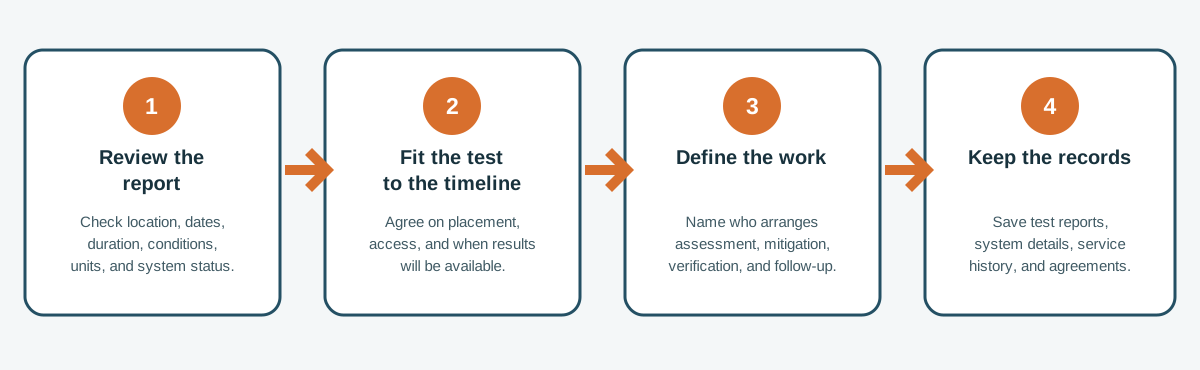
Review an existing result, not just the number
Ask for the complete report and check:
- the room and level where the device was placed;
- the start and end dates and total duration;
- the device, laboratory, or professional provider;
- the units and interpretation used;
- whether the area was a normal occupancy space;
- whether unusual weather, vacancy, renovation, or ventilation conditions were noted;
- whether a mitigation system was operating during the measurement.
A result from a crawl space, furnace room, storage room, or infrequently used area may not answer the same question as a result from the lowest lived-in level. A short result may be useful for a deadline but should not automatically be described as an annual average. If the report lacks basic context, ask the testing provider or a qualified radon professional whether a new measurement is needed.
Fit the test to the closing timeline
A short-term test can provide timely information, while a long-term test generally better represents changing conditions. The contract, local practice, and applicable guidance determine what a transaction accepts. The buyer and seller should agree who places the device, who has access, how interference is prevented, and how the report is delivered.
Do not move the detector, alter ventilation, open windows unusually, or change occupancy to influence the result. Record placement and collection dates. If the home is vacant, under renovation, or has a newly installed mitigation system, tell the provider because those facts affect interpretation.
In Canada, Health Canada recommends a long-term measurement of at least 91 days for decisions about the Canadian guideline and recommends testing in the lowest level with a normal occupancy area. In the United States, use the current EPA and state-program guidance for the measurement and the action framework.
Keep the national guidance separate
EPA’s US framework uses 4.0 pCi/L, or 150 Bq/m³, and notes that lower levels still carry risk. Health Canada recommends corrective action when the average annual level in a normal occupancy area exceeds 200 Bq/m³ and recommends lowering it as much as practicable. These are separate national public-health frameworks, not a single North American legal threshold.
Do not convert a Canadian result into an EPA action statement or use the US framework to characterize a Canadian transaction without explaining the difference. A real-estate form, lender, inspector, or local program may use additional requirements that are outside public-health guidance.
If the result is elevated
An elevated result can lead to several negotiated paths:
| Possible path | Questions to resolve |
|---|---|
| Mitigate before closing | Can a qualified provider assess, install, test, and document the system within the available time? |
| Credit or price adjustment | Does the agreement clearly assign the future scope and cost, and is local advice needed? |
| Escrow or repair commitment | Who controls the work, what standard is used, and what result closes the obligation? |
| Additional testing | Will a longer or better-controlled measurement change the decision, or only delay it? |
| Accept and plan after closing | What will the new owner test, document, and budget for, and what local duties apply? |
These are transaction options, not universal legal requirements. A public-health recommendation does not by itself establish a seller disclosure duty, lender rule, insurer requirement, or contractual remedy. Consult current local real-estate or legal professionals for those questions.
Evaluate an existing mitigation system
Ask the seller for the original test, design or installation record, suction points, fan and indicator information, warranties, service history, and post-installation test. Look for a clear explanation of which foundation areas are covered. A running fan and visible pipe do not prove that the occupied level has a low radon concentration.
Health Canada recommends retesting active systems every five years. A buyer may also need a current test after a basement conversion, addition, ventilation change, or other major alteration. Radon system maintenance describes the records and warning signs that make a service assessment more efficient.
New construction and passive features
New homes may include radon-resistant features such as a gas-permeable layer where appropriate, sealed sheeting, sealed foundation openings, and a vent pipe designed for later activation. Those features can make mitigation easier, but they do not prove the finished home’s radon level. EPA recommends testing new homes after occupancy, even when radon-resistant construction was used. See radon-resistant new construction for the construction planning decision.
Documentation to retain
The buyer or seller should keep the full report, not only a summary line. Retain device or provider information, room and level, test dates, units, mitigation records, service documents, warranties, and any agreement about future work. If a repair or test is completed between offer and closing, preserve the invoice and final report together.
Documentation supports a better decision but is not a substitute for current requirements. An old result can be valuable evidence of history while still being too old, too short, or poorly located for the current transaction.
Planning after closing
If the home is purchased before a long-term test or mitigation verification is complete, put the next measurement on the maintenance calendar. Test the lowest future lived-in level after a basement or addition project. Budget separately for testing, design, installation, electrical work, finished-surface restoration, and follow-up testing; radon mitigation cost explains why those layers differ.
The sound transaction question is not “Does this house have a radon number?” It is “What was measured, where, for how long, under which country’s guidance, and what decision does the current evidence support?”
Budget the next step instead of negotiating from one number
A transaction report is evidence for a decision, not a complete mitigation estimate. If the result is elevated, the next cost may be a qualified assessment, a design, installation, electrical work, post-installation testing, or finish restoration. If a system already exists, service or a new measurement may be the relevant cost instead. Ask for the professional’s scope before treating an online range or a seller’s old invoice as the amount needed at this property.
The timing of the work can change the price. A contractor may be able to route pipe through unfinished space before a renovation, while a finished room may require protection and patching. A home with a mixed foundation or crawl space can require more evaluation than a single accessible slab. Those are project conditions for a local provider to price; a transaction deadline does not make them disappear.
If the parties agree that work will occur after closing, document who will arrange the test, which contractor or qualification is acceptable, what result or report closes the task, and who pays for follow-up if the first design does not work as expected. Those terms belong in the transaction documents and require local professional advice. Public-health guidance does not dictate a credit, escrow, repair obligation, or lender decision.
For a seller, retaining the system design and post-installation result can be more useful than presenting a fan as proof. For a buyer, a recent full report plus a clear work plan provides a stronger basis for the next budget decision than a single uncontextualized reading.
Review the file as a buyer or seller
A seller can make a transaction smoother by assembling the full measurement report, mitigation design, warranty, service history, and any post-installation result before listing. A buyer should compare those records with the current foundation and planned occupancy. A report should not be summarized as “clear” if it was short, collected in a non-occupied area, or performed before a major change.
If the system has been operating for years, ask whether the last test falls within the applicable public-health or local recommendation. If the seller cannot locate the report, a buyer may need a new measurement or a provider’s assessment. The decision and timing belong to the parties and local transaction professionals; the absence of a record does not itself establish a legal violation or prove a high level.
For an elevated result, separate four questions in the budget: what assessment is needed, what mitigation is proposed, what testing verifies it, and who pays for any follow-up. A transaction agreement should state who arranges each step and which documents close it. Avoid a vague promise to “fix radon” that does not define the test, work boundary, or result record.