
Asbestos abatement cost is the cost of a controlled project, not simply the number of square feet removed. The same material can produce very different quotes depending on its condition, location, access, planned disturbance, containment, waste route, verification, and the work needed after abatement. Compare the scope behind each number before comparing the number itself.
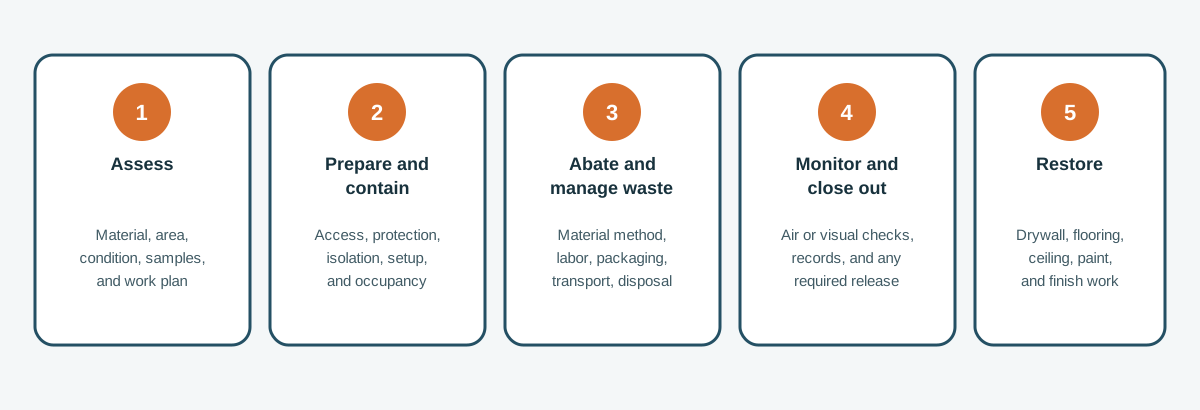
A US market observation, not a universal price
Angi’s 2026 US market observations report a common indoor asbestos-removal range of about $1,216 to $3,283. That is a source-attributed US market observation, not a legal fee, Canadian price, or guaranteed project total. The range may not describe a large attic, whole-house project, difficult access, or a project that includes reconstruction.
Do not convert that figure into a per-square-foot allowance and assume it will hold. A small bathroom can have a high minimum charge because of travel, setup, containment, sampling, and disposal. A larger, accessible area can have a different unit cost but a much larger total.
Separate the cost layers
Ask the estimator to identify each of these layers:
- Assessment: Inspection, sample collection, laboratory analysis, work planning, and inaccessible-area review may happen before the abatement quote.
- Preparation: Moving occupants, protecting retained finishes, shutting down or isolating systems, and preparing access can be separate.
- Containment: Barriers, isolation, pressure control where required, worker decontamination, and protection of adjacent areas add labor and materials.
- Abatement: The method and labor depend on whether the material is friable, damaged, bonded, overhead, confined, or attached to a substrate that must also be removed.
- Monitoring or verification: Air monitoring, visual inspection, clearance, or other closeout requirements vary with the project and jurisdiction.
- Waste: Packaging, transportation, disposal fees, manifests, and documentation are not interchangeable with ordinary construction debris.
- Restoration: Subfloor, drywall, ceiling, insulation, trim, paint, roofing, or mechanical restoration usually needs its own allowance.
The quote should say whether it covers only the defined material or also demolition around it. “Asbestos removal” is too broad to compare without a material, location, quantity, condition, method, and boundary.
Why access and condition matter
Sound material in a simple, accessible work area may require a different plan from crumbling insulation in a ceiling cavity or pipe insulation around active equipment. Height, occupied rooms, narrow access, weather exposure, fragile finishes, and the need to keep a home partly operational can increase setup and coordination.
Material condition also affects the decision, not just the labor. Damaged or friable material may need prompt controls. An intact material that will remain undisturbed may be managed in place, enclosed, or encapsulated when a qualified professional and local rules support that approach. Removal can cost more initially but may avoid repeated controls when a renovation will otherwise disturb the same area.
Disposal and local rules can change the quote
US federal asbestos rules apply to defined renovation and demolition contexts, and state, tribal, and local requirements can add obligations. EPA’s large-scale residential demolition guidance describes inspection and handling expectations for projects covered by the applicable rule; it is not a universal private-home price list. In Canada, requirements vary by province or territory. Ask who is responsible for notification, worker qualifications, transport, disposal, and records.
If a contractor treats suspect waste as ordinary debris, the quote is not ready to accept. Ask for the intended disposal route and what documentation will be returned to the owner. Do not infer that a contractor can legally use the same process in another jurisdiction.
Rebuild costs are easy to miss
Abatement may expose damage that was hidden by the material. Removing flooring can reveal a deteriorated subfloor; opening a wall can require insulation and drywall; removing pipe insulation can affect mechanical access; attic work can require replacement insulation and air sealing. Keep abatement, source or structural repair, and finish work as separate line items so a change order is understandable.
Also ask what the quote excludes: testing, design, permits or notifications, furniture removal, temporary housing, HVAC cleaning, electrical work, painting, and final documentation. An inexpensive abatement proposal can become expensive when every excluded item is needed to return the room to service.
How to compare bids
Give every bidder the same assessment, drawings, photographs, material quantities, and access assumptions when possible. Compare:
| Scope question | Why it affects the total |
|---|---|
| What material and area are included? | A quote for visible flooring may exclude adhesive, underlayment, or concealed layers. |
| What controls are included? | Setup, isolation, protection, cleanup, and worker facilities are real labor. |
| Who handles waste? | Transport and disposal are jurisdiction-sensitive costs. |
| What proves closeout? | Monitoring, clearance, and records may be required or separately priced. |
| What happens if more material is found? | A defined unit rate or decision path is safer than an open-ended change order. |
The lowest total is not automatically the lowest-risk project. Choose a contractor whose scope matches the assessment and who can explain how the material, occupants, waste, and reconstruction will be controlled.
The practical decision
Budget first for a qualified assessment when the material and scope are uncertain. Then compare management in place, encapsulation or enclosure, and removal as lifecycle choices—not just as competing labor prices. A safe project may cost less by avoiding unnecessary disturbance, or more because it includes controls and restoration that an ordinary demolition quote omitted.
Use asbestos testing before renovation to define the scope, encapsulation versus removal to compare strategies, and asbestos discovered during renovation to plan a stop-work and rescoping allowance.
Questions that prevent a misleading allowance
Ask the estimator:
- Is the quantity based on an assessment, measured plans, or a visual guess?
- Does the price include every layer that will be disturbed, including adhesive, backing, insulation, or substrate?
- Are setup, containment, worker facilities, protection, cleanup, transport, and disposal included?
- What is the minimum charge and what conditions trigger additional mobilization?
- Who pays for testing, air monitoring, clearance, and a failed result?
- Does the scope include temporary relocation, contents, HVAC, or only the exposed material?
- What unit price applies if the material continues behind a wall or floor?
- Which trades restore the room, and what finish standard is assumed?
Put the answers into the contract. A detailed allowance is useful even when the final quantity is uncertain because it gives the owner a way to evaluate a newly discovered condition. Avoid accepting a quote that uses a broad contingency as a substitute for a defined decision path.
Keep health and legal questions separate
An estimate cannot determine whether an occupant has been exposed or whether a project complies with every local requirement. It only describes proposed work. Use a qualified professional and the responsible authority for health, worker, notification, disposal, and release questions. Keep a US market figure in its narrow context and obtain local pricing for the actual material and address.
When management in place is the lower-cost option
If an assessment finds stable material outside the planned disturbance, the owner may avoid a large abatement and rebuild bill by documenting it, restricting access, and designing around it. That choice still has costs: the assessment, recordkeeping, future contractor communication, periodic condition checks, and possibly a premium when a later project must work around the material.
Removal may be better value when the material will be exposed repeatedly, when the home is being opened for a larger renovation, or when future access would require rebuilding the same containment. Ask the professional to compare immediate cost with the cost and disruption of a second project. A decision to remove should be based on the material and future disturbance, not on a generic preference for “cleaning everything out.”
The initial mobilization can matter as much as the measured area. For a small isolated job, setup, containment, travel, laboratory coordination, and disposal minimums may dominate. If several confirmed materials will be disturbed in the same project, ask whether one coordinated scope can reduce repeated setup without expanding the work beyond the assessment. Keep each material and work boundary identifiable in the contract.
Schedule and occupancy assumptions
Ask whether the price assumes one continuous work period or separate visits. Phasing can keep more of the home available, but repeated mobilization and renewed containment may add labor. A vacant-property schedule can reduce some coordination needs while still requiring access, utilities, weather protection, or restoration planning. Compare bids using the same access and occupancy assumptions.
If the abatement is one stage of a renovation, coordinate the start and finish points with the general contractor. The environmental contractor should identify when the defined area is released for other trades and which materials remain untouched. A gap between abatement, verification, and rebuilding may add storage, protection, or schedule costs. Put those handoffs and any expected standby charges in the proposal so a low base price does not conceal a costly sequence.
What the final package should contain
At closeout, request the assessment and sample results, work area and method, photographs, worker or contractor information where required, waste and disposal records, monitoring or clearance documents, warranties, and a map of material that remains. The package should distinguish abatement from ordinary demolition and reconstruction.
That record has financial value. It helps future contractors price the correct boundary, prevents accidental disturbance, and lets a buyer distinguish a controlled material left in place from an uninvestigated assumption. Do not accept a final invoice as the only proof that the defined work was completed.