
An inspection and a risk assessment answer different questions. An inspection is primarily about where lead-based paint or lead hazards are located. A risk assessment goes further: it evaluates the condition of paint and dust or soil hazards, identifies how exposure could occur, and recommends controls. The right scope depends on whether you are screening a property, planning work, responding to deteriorated paint, or trying to make a home safer for a particular occupant.
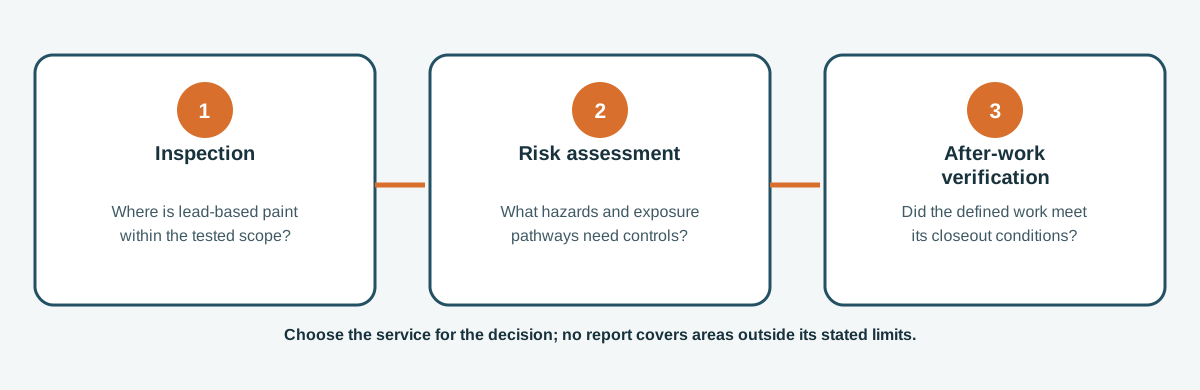
What an inspection tells you
An inspection is useful when you need a systematic inventory of painted components and a determination of which surfaces contain lead-based paint under the method used. It can support a purchase decision, renovation planning, property records, or a later risk assessment.
Ask the inspector to identify:
- rooms and exterior areas examined;
- building components and paint layers evaluated;
- testing method and its limitations;
- locations that were inaccessible or not sampled;
- components that are positive, negative, or inconclusive; and
- whether the report is intended for renovation, occupancy, sale, or another purpose.
An inspection does not automatically say that a home is safe to occupy. A painted window with friction damage, deteriorated porch paint, contaminated dust, or bare soil can create a practical exposure issue even when the owner already knows where lead paint is.
What a risk assessment adds
A risk assessment uses the information about lead paint and examines its condition and the pathways by which people can be exposed. It may consider deteriorated surfaces, impact and friction areas, dust, soil, maintenance, occupants, and the activities that create dust. The report should connect each hazard to a recommended control and a way to verify the work.
EPA describes risk assessment as a process that determines the existence, severity, and location of lead hazards and recommends ways to control them. It is more decision-oriented than an inventory. It can be the better starting point when paint is peeling, a child is present, renovation is planned, or the owner needs a prioritized lead-safe work plan.
Which scope fits the situation?
| Situation | More useful starting point | Why |
|---|---|---|
| Buying or documenting an older home | Inspection, possibly followed by risk assessment | First establish where lead paint is present and what was not tested. |
| Peeling paint or recurring dust | Risk assessment | Condition and exposure pathways matter, not just paint location. |
| Planned disturbance of painted components | Inspection plus renovation-specific planning | The contractor needs the work area, controls, and legal requirements. |
| Child-occupied home with uncertainty | Risk assessment | Prioritization should account for occupants and practical exposure pathways. |
| Post-abatement release | Clearance or project-specific verification | This is not the same as the initial inspection. |
These labels do not replace a local professional’s scope. Some jurisdictions use different terms, credentials, or required combinations. Ask what the report is legally and practically allowed to support.
What neither report should promise
Neither document can guarantee that no lead exists anywhere in the building if areas were inaccessible, concealed, or outside the scope. A report should state its limitations and avoid turning a sample result into a conclusion about every similar-looking surface. Paint can differ by component, layer, renovation date, and location.
Do not use a consumer swab or a single spot test as a substitute for a defined professional evaluation when a renovation, purchase, deteriorated paint, or child exposure is at stake. A screening result may be useful background information, but it does not create a complete hazard map.
Match the report to the next decision
Before hiring, describe the actual decision: “Can I renovate this window?”, “Which hazards need control first?”, “What must be repaired before a child occupies the room?”, or “What records should I give the contractor?” Ask the professional to define the building age and areas, surfaces, dust or soil sampling, report format, and recommendations needed to answer it.
For US work on pre-1978 homes, the EPA Renovation, Repair and Painting program can require firms to use lead-safe practices when disturbing painted surfaces, with important scope and exemption details. A lead inspection is not the same thing as RRP firm certification. Canadian requirements and professional terms vary by province and territory.
Turn findings into a work order
The useful output is not just a positive or negative list. It should identify the component, condition, control method, preparation, occupant restrictions, cleanup, and verification. Give the report to the contractor before the estimate is finalized and ask the contractor to price lead-safe setup and cleanup explicitly.
Use lead paint encapsulation versus removal for control strategies, renovating a home with lead paint for work planning, and lead clearance testing for post-work verification. If the project is cost-driven, lead paint abatement cost explains the layers that should appear in the estimate.
Keep health decisions separate
An assessment can help prioritize building controls, but it cannot diagnose an occupant or determine a personal medical response. If a child or adult may have been exposed, seek advice from a healthcare or public-health professional. Use the building report to control the source and work area, not to make a medical promise.
Use the report’s limitations to plan the next inspection or work control. An explicit untested area is more useful than a broad conclusion that leaves the contractor guessing.
Before work begins, confirm that the contractor’s priced boundary matches the assessment’s tested boundary. If the contractor will disturb an untested component, pause the estimate and resolve that gap through the appropriate professional or lead-safe work requirement.
When a past report needs another look
Treat an assessment as a record of the components, conditions, and access that were in scope on its date—not as a permanent authorization for later work. Revisit the decision when a new renovation reaches an untested layer or room, paint has deteriorated, water damage changes a surface, a component is replaced or opened, or the planned disturbance extends beyond the report’s boundary.
Give the qualified professional and next contractor the earlier report, its limitations, and the current work description. They can decide whether the existing information still supports the work plan or whether a focused update is needed. That comparison keeps a technically complete earlier report from being mistaken for a complete scope for a changed renovation.
Choose the report by the work decision
The two services can lead to different estimates, so ask providers to state what the report will let the owner decide.
| Decision | Service question to discuss |
|---|---|
| A contractor will disturb painted components | Would a lead inspection identify which components are painted with lead so the work plan can be priced? |
| Paint is deteriorating or dust/soil is a concern | Would a risk assessment evaluate the condition and recommend controls beyond identifying paint? |
| A home is changing use or a child may be exposed | What surfaces, dust, soil, and occupant conditions should the assessment include? |
| A renovation is already defined | Which tested components match the demolition plan, and what untested areas remain? |
The report should state its date, building areas, methods, samples, inaccessible components, and assumptions about occupancy and future disturbance. A lead inspection is not automatically a hazard-control plan, and a risk assessment is not automatically a renovation work order. The owner may need a separate quote or lead-safe renovation scope after the professional interprets the findings.
A negative or limited result should be read against the planned work. If a contractor will remove an untested window, scrape a different layer, or open a wall outside the report boundary, the existing assessment may not answer that project question. Conversely, testing every painted surface may be unnecessary when the renovation affects only a defined component and the selected professional says a narrower scope is adequate.
Ask how the report changes the price: number of components, lab analysis, access, dust controls, surface preparation, cleanup, clearance, and reconstruction can be separate. Keep U.S. program requirements attached to U.S. work and verify Canadian provincial or territorial practice locally.
Use the assessment result to set priorities
A report may identify several surfaces but not require the owner to address everything at once. Ask the professional to rank the findings by condition, contact or friction, planned disturbance, occupancy, and the control options available. This helps the owner phase work without confusing a paint inventory with a complete abatement obligation.
If the inspection finds lead paint in a component scheduled for replacement, the renovation estimate should price the required work controls and cleanup. If a risk assessment identifies deteriorated paint or dust in a frequently used area, the next project may include source correction, stabilization or replacement, and clearance. The correct scope depends on the report and local rules, not on the color or age of the paint alone.
Keep the priority list with the contractor’s bid and note which components remain untreated or untested. A later change in room use, water damage, or renovation boundary can alter the sequence. The record lets the owner ask whether the earlier assessment still answers the current question before paying for a broad repeat visit.