
An official notice, recorded property status, or credible information about former clandestine laboratory activity creates a different decision from ordinary indoor-air testing. The next step is to find out what is actually documented, which local authority controls the property, and what professional assessment and closeout the authority will accept. No general checklist can declare a specific home ready for occupancy.
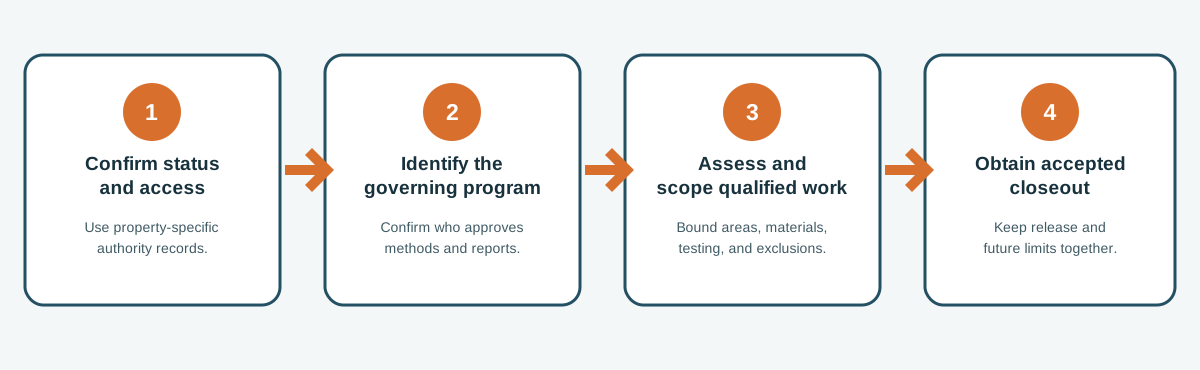
This guide covers residential properties with identified or credibly suspected former methamphetamine or fentanyl laboratory activity. Drug use, storage, sale, and manufacture are different circumstances. An odor, neighborhood history, allegation, or consumer screening result alone does not establish that a laboratory operated at a particular address.
Do not enter or disturb a property under official control
If law enforcement, fire officials, or another authority has restricted access, follow that direction. Do not enter to collect belongings, inspect containers, test surfaces, operate ventilation, or begin renovation. Contact the authority responsible for the scene or the local health/environmental program about the property’s current status and the conditions for access.
An active or recently discovered laboratory may involve hazards beyond residue on surfaces. Emergency response and removal of immediate hazards come before a residential remediation estimate. A later environmental project begins only after the responsible authority releases the relevant area for that work. The EPA’s 2021 document is voluntary guidance; it is not a national law or a universal residential cleanup standard.
Verify what the property record actually says
Request the official notice, inspection or investigation report, order, property declaration, remediation plan, completion document, and any clearance report. Confirm the address and dates, areas examined, chemicals or activity considered, sampling methods, qualifications of the people who performed the work, and limitations. A short transaction statement such as “remediated” may omit important boundaries.
Some jurisdictions maintain public lists or registers of properties with a particular official status. Their coverage and updates vary. A property not appearing on a list does not prove that it has no relevant history, and an unverified registry entry is not itself a lab confirmation. Ask the agency whether it has records that are not publicly searchable and whether any order or release remains in force.
State examples illustrate why local confirmation matters. Utah publishes a specific decontamination and clearance process. Oregon has its own program, property records, and conditions for some owner-involved work. Those rules cannot be applied to another state or a Canadian property. Do not use a local registry or clearance criterion as a universal North American rule.
Identify the governing program before hiring
Ask the health, environmental, law-enforcement, or building authority which program controls the next step. Confirm whether the owner needs an approved assessor, remediation contractor, laboratory, work plan, or post-work report. Qualification and acceptance rules may differ by jurisdiction and by property status.
The sequence may include an initial assessment, an authority-reviewed work plan, removal or cleaning of affected materials, confirmation testing, and written closeout. Not every property follows the same sequence. Some sources support a state-specific pathway; they do not establish the requirements elsewhere. Before signing a contract, confirm who will review the scope and what documents will be accepted as evidence of completion.
What a qualified assessment needs to establish
The assessor should define the known history, contaminants of concern, accessible and inaccessible areas, materials and contents included, and the proposed sampling or inspection rationale. Ask how the professional will distinguish a lab-related condition from later occupancy, ordinary product use, or another source. The report should explain its method and limits rather than turn a few samples into a claim about the entire house.
Potential project elements can include building finishes, porous contents, cabinets, floor layers, ductwork, plumbing interfaces, or waste. Their inclusion depends on site history and assessment findings. The article does not supply sampling locations, surface limits, chemical handling instructions, cleaning formulas, or a consumer test. Those decisions belong to qualified professionals and the governing program.
Drug manufacture, drug use, and drug storage should not be collapsed into one assumption. A reported use event may call for a different assessment than a lab investigation; the responsible authority can clarify the basis for its concern. Likewise, a screening result is not automatically an official finding or a clearance result.
Compare estimates by stage, not by one cleanup total
The available sources do not establish a representative U.S. or Canadian remediation price. A government program fee, a selected state service allowance, or a contractor quote from one property does not predict another home’s cost. Ask for separate scopes and assumptions for:
- records review and qualified assessment;
- an authority-reviewed plan, when applicable;
- removal, cleaning, containment, and waste handling;
- contents decisions and temporary storage or disposal;
- confirmation sampling, laboratory analysis, and any repeat work;
- building systems or concealed areas included or excluded;
- finish reconstruction, permits, and restoration; and
- temporary accommodation, schedule delays, or access restrictions.
An estimate should identify rooms and materials, quantities, the basis for access, the party who selects the laboratory, and what happens if results are not accepted. Ask whether a failed or inconclusive check means additional sampling, more treatment, removal of materials, or a new work plan, and how that affects the price. A broad contingency without a decision path makes bids difficult to compare.
Keep ordinary renovation work visible. Removing affected drywall or flooring may leave a separate carpentry, plumbing, electrical, or finish project. A contractor who prices only the environmental work may not include rebuilding to a usable room. Conversely, an ordinary remodel bid is not a substitute for required hazard controls or authority closeout.
Buying, selling, or returning to the home
Before purchase, verify any official order, current occupancy restriction, completed-work records, and the authority that can confirm status. A seller’s report may be useful, but a buyer should understand its scope and whether it satisfies local requirements. Disclosure and title-record obligations vary; the absence of a public listing is not proof of a complete history.
If remediation occurred, request the work plan, laboratory information, results, photographs, waste records, and written release or closeout. Confirm that the documents identify the same address and affected areas. Do not equate a contractor’s invoice, an odor-free room, or a negative consumer test with official release.
For a Canadian property, the available Canadian technical review is from 2012 and does not establish a current national regulatory program or common clearance criterion. Contact the relevant province, territory, municipality, or public-health authority for current requirements. Do not borrow a U.S. state rule, numeric criterion, or owner-work option.
Preserve the closeout record
Keep the authority’s correspondence, assessment, approved plans, contractor qualifications, laboratory and sampling reports, waste documentation, invoices, and final release in the permanent property file. Tell future contractors what work occurred and which areas or materials remained outside the project. If renovation changes an area or opens concealed spaces, ask the responsible program or qualified professional whether the earlier closeout still covers the planned work.
The most useful budget is a sequence of verified stages with clear decision points. Until the authority, assessment boundary, and accepted closeout are known, no national price, registry search, or general air test can resolve what this property needs.
Match the evidence to the property’s status
Different information should lead to different questions. The table helps prevent an allegation, an old invoice, and an official restriction from being treated as equivalent evidence.
| Information available | What it may establish | Next question |
|---|---|---|
| Current authority notice or order | A specific agency concern, restriction, or required process for the named property. | Who controls access and what work or release steps remain? |
| Earlier remediation and closeout file | Work was documented for identified areas, dates, methods, and stated criteria. | Do the current plans and proposed renovation remain inside that boundary? |
| Public property listing | The property has a status under that program’s definitions and records. | Is the listing current, and what does the responsible office say about the actual order? |
| Neighbor report or general history | A lead for records inquiry, but not confirmation that the subject home was used as a laboratory. | Is there a property-specific record or qualified referral? |
This distinction matters economically. Starting cleanup before confirming the official scope can pay for work that will not satisfy the program; treating a missing listing as proof that no history exists can leave the buyer or owner without the records needed for a later decision. Ask the authority to resolve property identity and status before comparing remediation proposals.
Questions for the authority and assessor
- Is there an active restriction, order, or official property designation?
- Which program controls access, assessment, work-plan approval, and closeout?
- What history and contaminants are actually documented?
- Which rooms, materials, contents, and systems are inside the scope?
- Who performs and accepts confirmation testing?
- What is excluded from the environmental quote and left for reconstruction?
- What documents establish completion, and who can verify them later?
When the property history is credible but incomplete, make the uncertainty explicit and obtain the local professional direction before committing to occupancy, renovation, or a price allowance.