
Vapor intrusion describes chemical vapors moving from contaminated soil or groundwater through the ground and into a building, often through openings or pathways in the foundation. A homeowner may hear about it through a site notice, a regulator, a qualified consultant, or a documented investigation. The useful next step is to understand what is being investigated at this property, who is coordinating the work, and what a proposed building system will and will not address.
This guide applies to a defined contaminated-site concern. Living near a gas station or industrial property by itself does not establish that vapor is entering a home. Nor does a generic indoor-air panel, a radon result, or an odor identify a subsurface source.
Start with the notice or referral
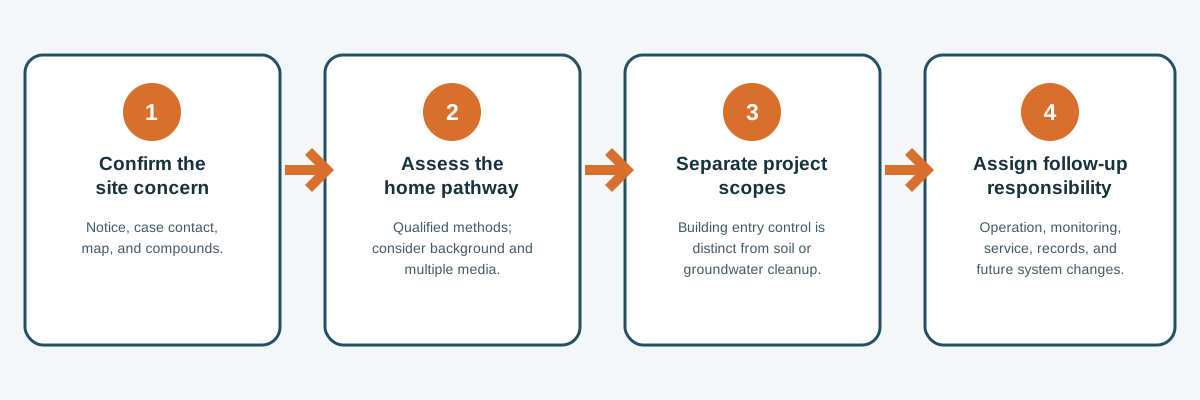
Keep the notice, case number, site map, consultant letter, and any proposed access agreement together. Contact the agency or program named in the notice to confirm whether the home is inside the investigation area, what contaminant or pathway is under review, and whether the proposed next step is voluntary, program-coordinated, or part of a specific order. A distance from a site is not a substitute for the case-specific information.
Ask who will answer questions and how the project will report results. The roles may include an environmental agency, the source-site owner, a consultant, a homeowner’s own professional, a landlord, or an insurer. Do not assume that any one party is legally responsible for payment or that a program will reimburse privately commissioned work. Get the scope and responsibility in writing before granting access or signing for future operating costs.
How this differs from radon and ordinary indoor sources
Radon is a naturally occurring radioactive gas and has its own measurement and mitigation guidance. Vapor intrusion concerns other chemicals associated with a documented subsurface source. Household products, building materials, attached garages, stored fuels, and outdoor air can also contribute compounds to indoor air. Those background sources can complicate interpretation even when a nearby contaminated site is known.
For that reason, one indoor detection cannot by itself prove that the contaminant came from the subsurface. A qualified investigation may compare indoor conditions with outdoor air, soil gas, sub-slab conditions, groundwater data, building construction, and the known site history. Which lines of evidence are needed depends on the chemicals, geology, site model, building, and decision being made. EPA’s technical guide is a professional assessment resource; it is not a homeowner sampling recipe or a universal residential rule.
What an assessment should resolve
Before authorizing sampling, ask the assessor to describe the question in plain language: Is the work checking whether a vapor pathway exists, identifying a compound, evaluating current conditions, designing a mitigation system, or confirming performance after installation? The scope should identify the home areas and media, methods selected, timing and building conditions, laboratory and reporting, and what a result can establish.
The report should discuss uncertainty and competing sources. A result may be affected by weather, ventilation, building pressure, product use, season, or the location and timing of a sample. A nondetection in one place or period does not automatically exclude every pathway. If an agency is coordinating a multi-property study, ask how its results relate to this home’s foundation and occupancy.
Do not order a broad VOC panel solely because the property is near a known site. It may measure compounds that have nothing to do with that site and miss the question the investigation is meant to answer. A selected local program, such as EPA’s New Jersey homeowner sampling resource for Pompton Lakes, is an example of a site-specific response, not a national homeowner entitlement or generic test protocol.
Building mitigation and source cleanup are different projects
If the investigation supports a building response, a professional may propose a system intended to reduce vapor entry or indoor accumulation. That building mitigation does not necessarily remove or remediate the contaminated soil or groundwater beneath or beyond the property. The responsible program may need separate source control, monitoring, or cleanup work.
Ask for the design basis, affected foundation areas, discharge or exhaust concept, electrical and access requirements, monitoring plan, service responsibilities, and performance check. A vapor-intrusion system may share broad concepts with soil-gas control, but do not copy a radon fan or layout into a chemical-vapor project without a qualified design. The contaminants, compatibility needs, site data, and applicable program criteria can differ.
An interim system may be selected while the source investigation continues. Clarify who owns it, who pays for energy and service, how a failure is reported, how often performance is checked, and what event allows the system to be changed or retired. An installed fan alone is not proof that the site issue is resolved.
Read the estimate by project stage
There is no representative North American homeowner price established by the available evidence. A program expenditure, public grant, or one site’s contractor invoice is not a comparable estimate for another property. Request a project-specific breakdown that separates:
- records review and environmental assessment;
- sampling, laboratory analysis, and follow-up visits;
- mitigation design and engineering;
- system equipment, installation, electrical work, and finish restoration;
- monitoring, reporting, routine operation, and service;
- source cleanup or groundwater work, if separately proposed; and
- access, temporary accommodation, or other property-specific costs.
The estimate should state which areas and contaminants it covers, what happens if results conflict, what work is excluded, and who authorizes change orders. A low initial assessment charge may not include further sampling or design. A building-system quote may not include source remediation, long-term monitoring, or maintenance. Compare deliverables and responsibility before totals.
Agree on access and future responsibility
If a program or consultant requests access, ask for the purpose, locations, schedule, restoration terms, data recipient, and whether the results will be shared with the owner. If the homeowner hires an independent consultant, ask how that consultant’s work will coordinate with the agency’s site model and accepted methods. A sample that cannot be interpreted alongside the site data may not resolve the concern.
Clarify whether an agency, source owner, or property owner is expected to operate and maintain any system. The answer may depend on local law, agreements, funding, and the exact site. Do not treat an environmental program’s public activity or a professional recommendation as a guarantee that another party must pay.
Keep a record for renovation or sale
Retain the notice, investigation plan, lab reports, building drawings, mitigation design, operating instructions, service history, and written responsibility agreements. Tell future contractors about foundation work or system routes before they cut, seal, or alter the area. A later renovation, basement conversion, HVAC change, or new occupancy may affect assumptions in the original assessment and should be discussed with the responsible program or qualified professional.
For ordinary indoor-air concerns without a documented contaminated-site trigger, see indoor-air-quality testing. For a radioactive soil-gas question, use radon testing and the separate radon mitigation guidance.
Agree on the sequence and handoff
The work is easier to price when each stage has a named decision maker and a written handoff. Ask the agency or program to identify which questions it will answer and which remain with the owner or a private consultant.
| Stage | Decision to settle | Record to request |
|---|---|---|
| Site definition | Is this address part of the investigation, and which source and compounds are relevant? | Case contact, map, notice, and current site description. |
| Home assessment | Which media and building areas will be evaluated, and how will background sources be considered? | Scope, methods, limitations, laboratory, and interpretation plan. |
| Building response | Is a system an interim measure or the long-term building solution? | Design basis, covered areas, operation, monitoring, and service terms. |
| Follow-up or sale | Who can accept results or change the system after ownership or building conditions change? | Closeout criteria, responsibility agreement, and maintenance history. |
If two parties commission separate work, have them agree on the question and data format before sampling. Otherwise, one report may not fit the program’s case model and the owner may pay for repeat work. Keep any private consultant’s written scope aligned with the agency’s stated methods, but ask for an independent explanation of findings when the owner needs a separate decision.
Questions to settle before approving work
- What specific site concern places this home in the investigation?
- Which authority or program is coordinating, and what is its role?
- What question does each proposed measurement answer?
- How will indoor results be distinguished from products or outdoor background?
- Does the estimate cover assessment, mitigation, source cleanup, or only one stage?
- Who will own, operate, service, and eventually retire a building system?
- What property records and future changes should be communicated?
The cost and design become more understandable once the site trigger, assessment purpose, building scope, and continuing responsibility are written down. Until then, no generic distance, sensor reading, or radon rule can supply the missing site-specific decision.