
A shared-property resilience proposal can cross several boundaries at once: association-owned building features, exclusive-use areas, and work on privately owned homes or lots. A program or contractor may describe one coordinated project, but owners still need to know who has authority over each part, what approval is required, how the money is raised, and who maintains the result.
This guide focuses on those shared-property decisions. Wildfire is the evidence-backed example used here; program requirements and cost assumptions for other hazards should not be inferred from it. For physical mitigation methods, use the relevant hazard and building-system guidance and qualified local professionals.
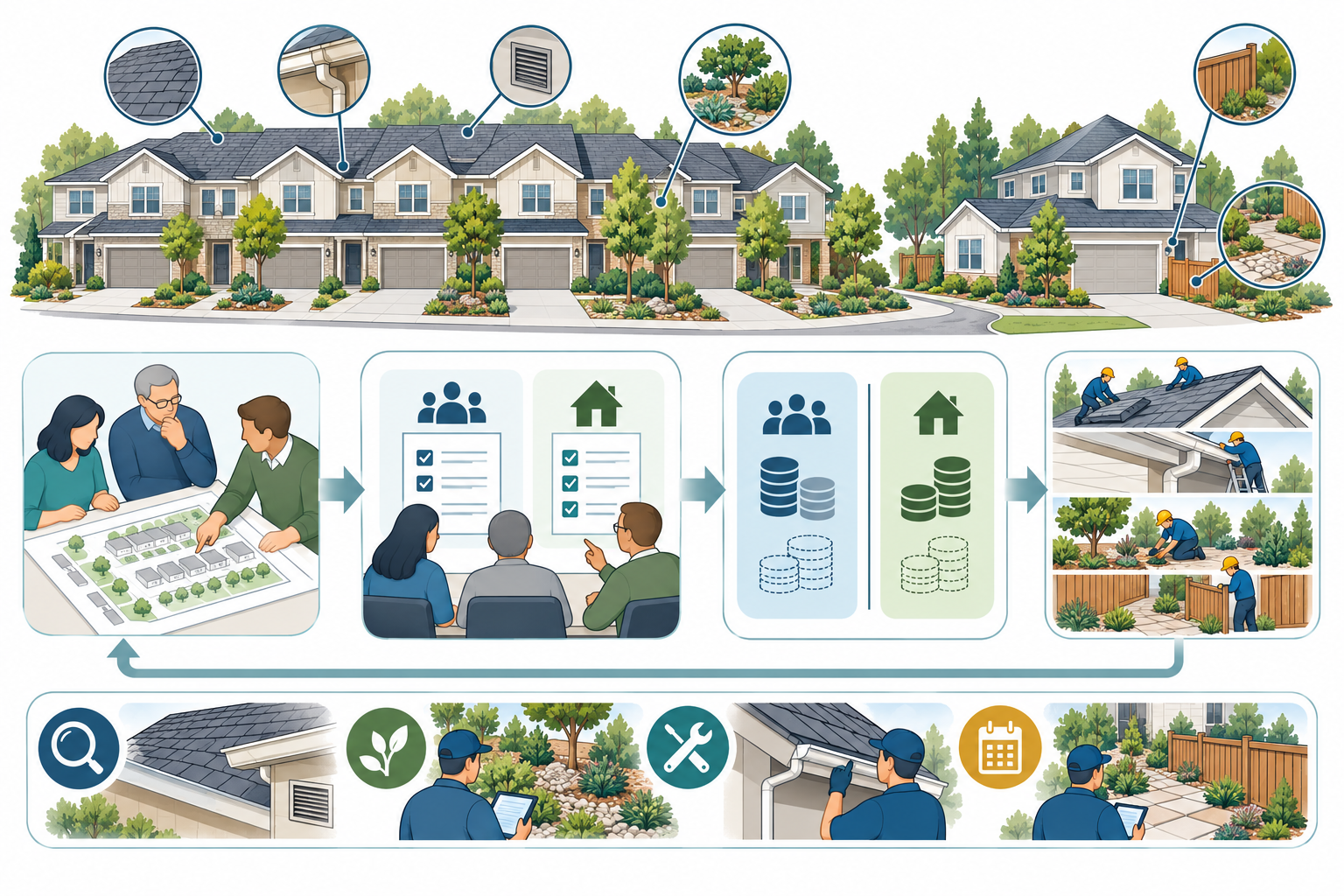
Start with a defined project
Ask the board or managing entity to describe the proposed outcome, properties and components included, professional assessment, alternatives considered, schedule, and work that would be outside the proposal. A phrase such as “harden the community” is too broad to approve or budget. The proposal should say whether it covers a whole building, several buildings, common grounds, individual homes, or a combination.
Separate the investigation and planning phase from construction. The association may first need a qualified assessment, a scope, an estimate, and an explanation of which work is shared and which is owner-specific. That first phase can have its own cost, approval, and funding decision. Do not treat a program inquiry, preliminary assessment, or conceptual plan as authorization to enter private property or start construction.
Map control before estimating owner shares
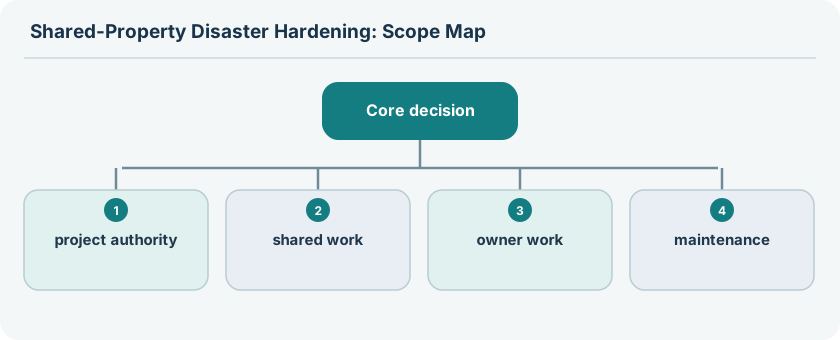
Make a component list and identify the property interest, approval path, payer, and future maintainer for each item. The same proposal can include different kinds of work.
| Part of the proposal | What to identify before approval |
|---|---|
| Common building or shared infrastructure | Who owns or maintains it, who may contract for work, and which association approval applies |
| Limited or exclusive-use area | Whether use rights differ from ownership, and who controls access, alterations, routine care, and capital work |
| Private unit or lot | Whether the owner must consent, arrange, or pay for individual work and how it connects to the shared project |
| Ongoing operation | Who inspects, maintains, documents, renews, or corrects work after construction |
Check the declaration or plan, bylaws, maintenance matrix, rules, easements, prior alteration agreements, and any applicable local requirements. Record the exact provision relied on. A program’s eligibility criteria can show what that program requires, but they do not establish an association’s legal authority to approve work, use reserves, enter a unit, or charge an owner.
Separate a legal duty from a voluntary target. Local law, code, an order, or a documented safety obligation may require particular action. A voluntary certification or community program is a choice to participate under its own terms. Ask the association to identify which category applies to each part of the proposal. Do not describe a voluntary program as a legal requirement or assume that participation settles an owner’s allocation.
For example, IBHS describes Wildfire Prepared Multifamily as a voluntary program for eligible managed properties. Its FAQ includes some owner-occupied attached condominium and HOA properties when the managing entity has authority over exterior features such as the roof, structure, and landscape. The managing entity applies, and the designation is for the property rather than an individual unit. That is a program-specific eligibility rule, not a general statement about every condo or HOA’s powers. IBHS’s separate Wildfire Prepared Neighborhood program works at a community scale; ask which pathway fits before budgeting around either one.
Build a whole-project budget
There is no defensible universal installed-price range for shared-property hardening based on the available evidence. Scope, property layout, condition, professional requirements, approvals, owner participation, local rules, and program terms differ. Request a property-specific budget with assumptions and exclusions instead of applying a per-unit price from another development.
Ask the project team to separate at least these cost layers:
- assessment, design, engineering, program consultation, and any required legal or insurance review;
- common work by building, site, or phase, with quantities and scope boundaries;
- owner-specific work, optional upgrades, and any connection between a private feature and the shared project;
- permits, inspections, access, temporary protection, contractor mobilization, disposal, and restoration;
- application, evaluation, or renewal fees if a voluntary program is selected;
- contingency for concealed conditions, scope changes, timing, and escalation;
- recurring inspection, maintenance, compliance, administration, and eventual replacement.
Have the estimate label what is fixed, allowance-based, optional, or still unknown. State who can approve a change order and how owners will be told if the project grows. If a quote combines common and private work, ask for separate line items so the association can identify its obligation and each owner can see the basis for any requested contribution.
Program costs are not a substitute for a construction estimate. IBHS says the Multifamily program has a nonrefundable application fee per structure and that mitigation costs vary with the structure and landscaping conditions; the FAQ does not provide a representative installed-cost range. It also says work may be phased, but a structure cannot receive a designation until all requirements for the chosen level are complete. Treat those statements as current terms of that program, and confirm them again before applying.
Separate project cost from owner cash exposure
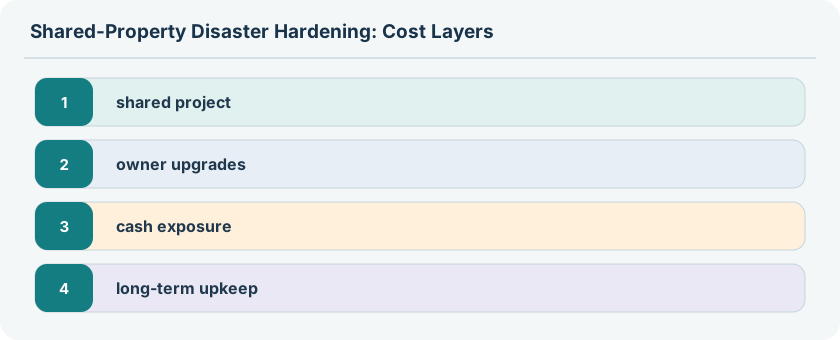
Use four numbers in the board’s explanation:
- Gross project budget: the full approved scope, including planning, construction, access, fees, contingency, and future work that is part of this decision.
- Confirmed funds: money that is currently available and may lawfully be used for this purpose, such as an approved reserve withdrawal, budget allocation, or awarded assistance.
- Unconfirmed sources: grant applications, hoped-for insurance consideration, donations, or other support that has not been approved or received.
- Owner cash obligation: the amount and timing each owner may owe under the governing documents, approved funding decision, and applicable law.
Do not count a possible grant or insurance benefit until eligibility, award, timing, and conditions are confirmed. Borrowing spreads cash needs but adds interest; an assessment concentrates owner payments, while higher fees may spread them. Each method changes timing and total cost; the governing documents determine each unit’s share.
Owners can compare the proposal with the reserve-study and future repair guide, the special-assessment guide, and how associations fund major repairs. Those guides explain the general funding tools; they do not determine whether a particular resilience project is reserve-eligible or how its cost must be divided.
British Columbia’s 2027 FireSmart Community Funding and Supports program guide describes one local example: First Nations and local governments are eligible applicants, while ordinary strata corporations are not. Approved applicants may offer local rebates for eligible work on strata common property and individually owned strata properties. The application window is October 1–December 31, 2026, funding permitting; ask the relevant local applicant about its rules and awards.
Compare coordinated, phased, and scheduled work
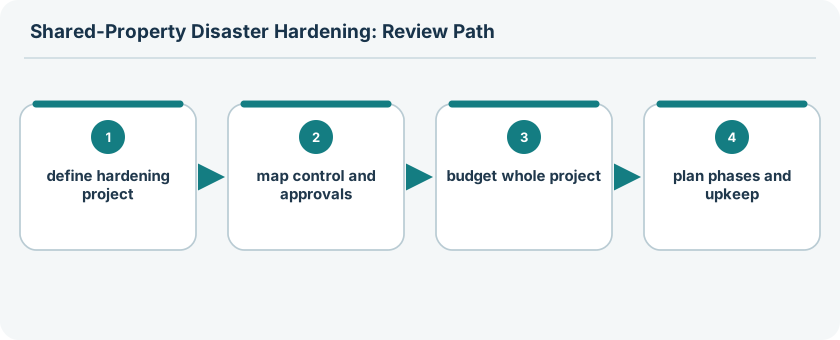
Coordinating a shared project can reduce repeated design, access, and mobilization, and may let the association address common and private work in one plan. It can also create a larger up-front decision, require more owners to participate, and make timing depend on approvals across the property. Ask the project professional to explain which coordination savings are included in the estimate rather than assuming the combined project is automatically cheaper.
Phasing can spread owner cash needs and let the association address buildings or components in sequence. It may also mean repeat mobilization, longer periods of inconsistent work, added administration, and later prices that are uncertain. A phase plan should say what each phase accomplishes, which funding supports it, what remains incomplete, and whether the property receives any intended program status only after later phases finish.
An upcoming roof, exterior, landscape, or common-area replacement may offer a chance to coordinate resilience work with planned construction. Compare the incremental cost and disruption with a separate project, and confirm that the original scope, warranty, reserve plan, approval, and allocation still apply. See the guides on roof and exterior responsibility and major structural repair costs when those shared components are involved. The two schedules may not align; the board should state which drives timing.
Before a vote or approval, ask for the alternatives: proceed as one project, divide it into phases, coordinate it with scheduled replacement, or defer while another assessment or design is completed. A comparison should include total project cost, owner cash by date, disruption, unresolved work, program conditions, and the risk that later costs or requirements change.
Assign upkeep before approving the work
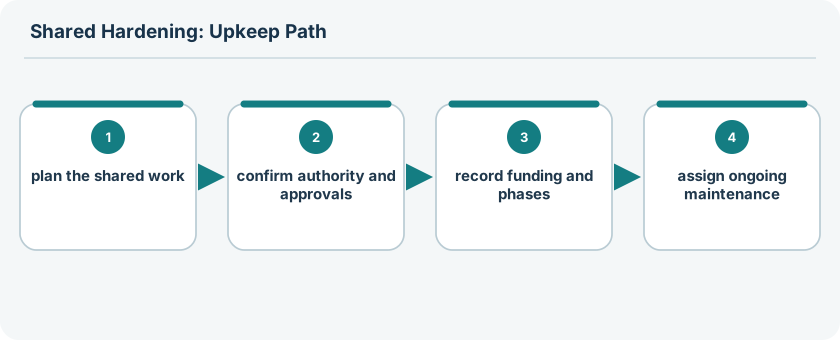
The initial construction decision is only part of the ownership cost. Put the continuing duties in the proposal or agreement:
- who inspects the completed work and how often;
- who pays for routine maintenance, repairs, and eventual replacement;
- how the association records completion, warranties, and any program status;
- what owners must do to preserve shared compliance, if applicable;
- who handles a failed inspection, changed condition, or required correction;
- what happens if a unit is sold, leased, altered, or transferred to a new owner.
IBHS states that a Multifamily designation lasts three years, has annual review requirements, and leaves the managing entity responsible for maintaining compliance. That ongoing obligation belongs in the association’s budget and operating plan if it participates. The current FireSmart BC Local FireSmart Collective Program describes a different community process: creating a profile, completing a collective assessment, developing an action plan, tracking progress, and renewing participation annually. These examples have different scopes and terms; neither gives every association a universal maintenance duty or funding source.
Keep the final scope, approval, cost allocation, inspection records, warranty, maintenance schedule, program documents, and owner agreements together. A later buyer or manager should be able to see what was completed, what remains, who maintains each part, and whether any obligation continues after transfer.
Verify insurance and resale effects
Ask the association’s broker and each affected owner to review the actual policy wording. Do not promise a premium reduction, coverage, or better eligibility because work is completed or a designation is earned. IBHS says insurance discounts are not guaranteed and vary by insurer and state. Ask the insurer what it will consider, whether the association or owner must provide records, and when the answer takes effect.
For a sale or refinance, preserve the approved project scope, funding decision, assessment notices, remaining phases, insurance communications, and continuing maintenance obligations. A project may affect future fees or owner records even if no individual contractor invoice is sent. Buyers should review those records with the condo purchase exposure guide, and owners should keep any alteration agreement alongside the condo renovation approval guide.
An owner review checklist
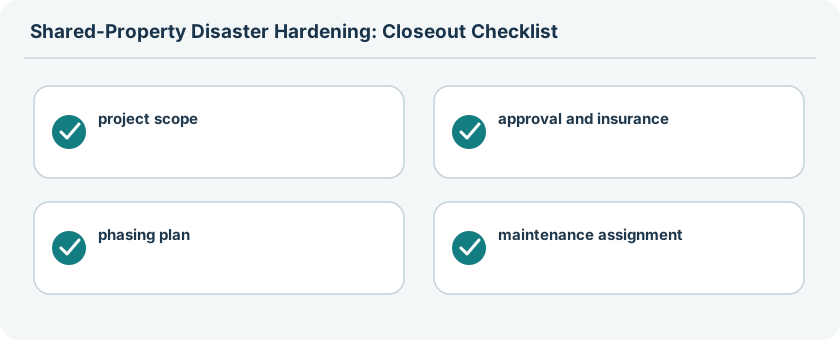
Before approving or contributing to a shared hardening proposal, ask the board or managing entity for:
- A defined scope, assessment, alternatives, and a list of common, exclusive-use, and private work.
- The governing-document sections and local requirements that authorize each action.
- Any required owner vote, notice, access consent, permit, or professional sign-off.
- Separate budgets for planning, common work, owner work, access, fees, contingency, and ongoing care.
- The gross cost, confirmed funds, unconfirmed support, financing terms, and owner payment schedule.
- The reason to coordinate, phase, combine with scheduled replacement, or defer the work.
- The person responsible for inspection, maintenance, renewal, compliance, and transfer records.
- Written statements from the relevant insurers about coverage or potential discounts.
If a key answer is missing, ask the association to identify the unresolved decision and who will supply it before the next approval or payment milestone. The practical question is not only what work is proposed. It is whether the project has clear authority, a complete cost path, an owner-share basis, and a funded plan for the years after installation.