
A reserve study, reserve fund study, depreciation report, or similar capital plan is a forecast of future repair and replacement obligations. It is most useful when you read the component inventory, condition, timing, cost assumptions, current funding, and planned contributions together. It is not a guarantee that the property will avoid an assessment or that the listed cost will match the next contractor quote.
For an owner or buyer, the goal is to understand which obligations may reach the unit through fees, an assessment, borrowing, an owner assignment, or a delayed project.
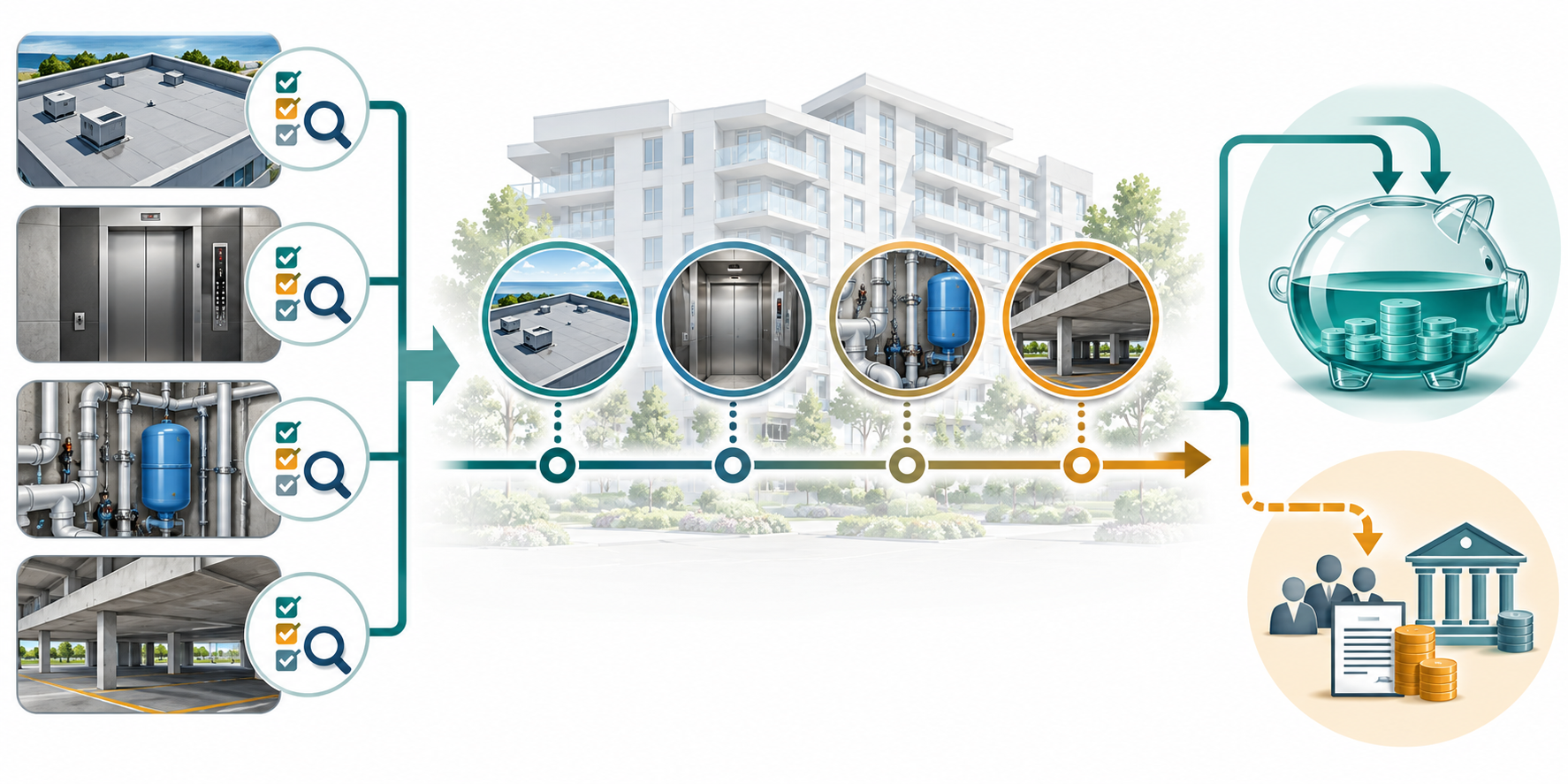
Start with the report’s scope
First identify what property the report covers, when it was prepared, who prepared it, and which components were included. A British Columbia example projects maintenance, repair, and replacement costs over 30 years and can include structure, exterior, roofs, windows, HVAC, plumbing, electrical, parking, utilities, landscaping, balconies, patios, and other shared assets. The listed inventory is not complete for every strata.
Check whether the report covers the whole development, a phase, a building, or only common property. A townhouse owner may need to ask whether private lots, limited common property, roads, retaining elements, drainage, or owner-maintained components were included. Missing scope can be as important as a low reserve balance.
Read the component inventory
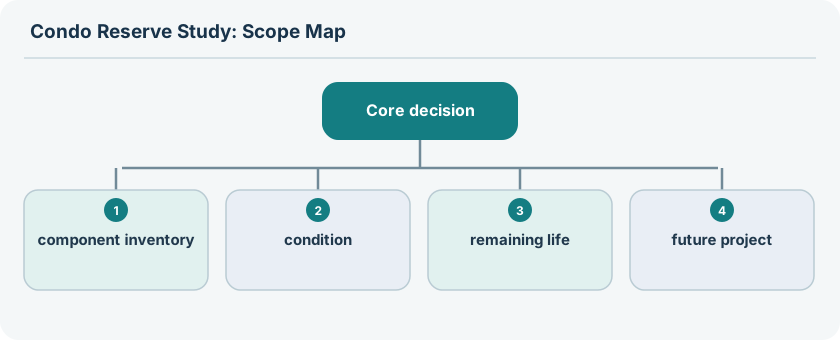
Make a list of the long-lived components and match each one to its responsibility:
- roof and exterior walls;
- windows, doors, balconies, patios, and waterproofing;
- structure, parking, retaining elements, and site drainage;
- plumbing, electrical, fire-safety, HVAC, and shared utilities;
- roads, landscaping, irrigation, gates, elevators, or other infrastructure.
For each component, ask whether it is common property, limited common property, an owner responsibility, or subject to a separate maintenance agreement. The report may identify a component without deciding every legal duty. Compare it with the declaration, plan, bylaws, maintenance matrix, and alteration agreements.
Examine condition and remaining life
A remaining-life estimate is an assumption based on observed condition, age, service history, environment, and expected performance. It should not be read as a promised failure date. A component can need work earlier because of water intrusion, defective installation, unusual exposure, or a changed standard. It can also last longer than a conservative planning assumption.
Look for the report’s condition rating, inspection limitations, exclusions, photographs, and recommendations. Ask whether the author inspected concealed areas, tested systems, or relied on records. A reserve report may identify a need for an engineering investigation without establishing the cause or safe repair method.
Follow the timing and cost assumptions
For each major project, record the expected timing, estimated project cost, inflation or escalation assumption, contingency, and current funding path. A cost estimate may exclude design, engineering, testing, permits, access, temporary protection, financing, disposal, taxes, or finish restoration. The report may use a planning-level estimate rather than a contractor bid.
Do not compare an old estimate directly with a current quote without checking the scope and date. A lower estimate does not necessarily mean the quote is excessive; a higher estimate does not necessarily mean the work is unavoidable. Ask what changed: condition, quantities, access, code requirements, labor, materials, project timing, or scope.
Read the funding model, not only the balance
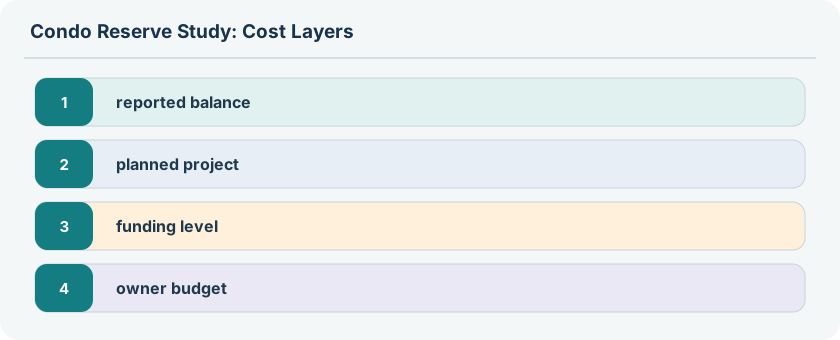
A reserve balance has meaning only beside the upcoming obligations and future contributions. Review the report’s funding model, projected contributions, reserve withdrawals, fee increases, borrowing assumptions, and possible assessments. Some models aim to maintain a cash minimum; others plan for a target balance or a schedule of contributions. There is no universal “safe percentage funded” that settles every property.
A property can have a large balance and an even larger near-term project. It can have a modest balance with projects scheduled much later and a credible contribution plan. It can also have an apparently comfortable balance while important components are missing from the inventory. Focus on the relationship between condition, timing, scope, and funding.
For U.S. condo loans sold to Freddie Mac, the project review can also depend on when the mortgage application was received. Under its March 2026 bulletin, applications received on or after August 3, 2026 require the project budget to include the reserve study’s highest recommended allocation, not an allocation based on baseline funding. For applications received on or after January 4, 2027, the minimum capital-expenditure and deferred-maintenance reserve allocation rises from 10% to 15% of annual budgeted assessment income. These are Freddie Mac seller/servicer requirements, not a universal legal funding test. Ask the actual lender which rules apply and read the study’s assumptions rather than treating a percentage as a stand-alone measure of adequacy.
Warning signs that require follow-up
Ask for more information when:
- a major component is absent from the inventory;
- the condition and timing do not match recent leaks, failures, or inspection findings;
- a project is repeatedly deferred;
- the report’s scope excludes an area that affects your unit;
- the funding model assumes a fee increase, loan, or assessment not yet approved;
- estimates lack visible assumptions or exclude related work;
- meeting minutes describe a project not reflected in the report;
- an owner alteration changes a component’s maintenance responsibility;
- insurance, structural, electrical, or life-safety issues are discussed without a defined investigation.
These are questions, not proof of a defect or financial failure. The report is a decision aid that tells you where to investigate further.
Turn the report into an owner budget
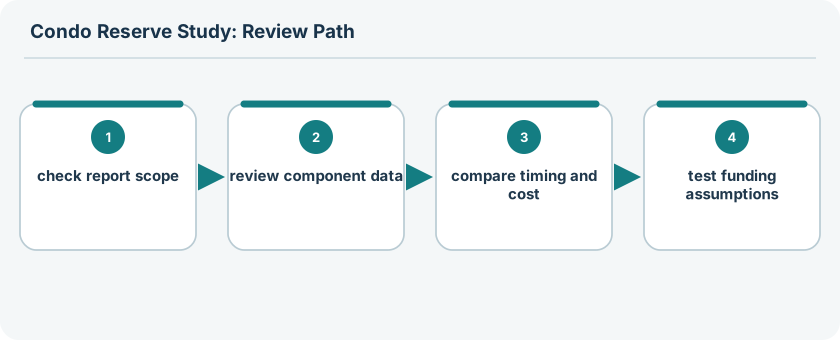
Separate predictable recurring costs from uncertain capital exposure. List your monthly fee, scheduled fee changes, current assessment installments, owner-maintained components, insurance deductibles, likely alteration obligations, and the shared projects that may require additional contributions. For a purchase, model a conservative cash reserve for the issues identified in the documents without pretending to predict an exact assessment.
Ask how your unit factor, ownership share, or contribution proportion is applied. The report may estimate the association’s total project cost, while the declaration or local rules determine how the owner share is calculated.
Questions for the board, manager, or report author
Request written answers to:
- What components were included and excluded?
- Which listed components are assigned to individual owners?
- Which projects are approved, proposed, funded, deferred, or only forecast?
- What assumptions drive timing, useful life, and cost?
- Does the estimate include engineering, permits, access, restoration, and contingency?
- How do current contributions compare with the recommended funding plan?
- What happens if the project arrives earlier or costs more?
- Are there recent inspections, claims, or alterations that change the report?
A reserve or depreciation report is valuable because it makes assumptions visible. It becomes misleading when treated as a pass/fail certificate or a promise. Where the report raises structural, insurance, financing, or legal questions, have the current records reviewed by the appropriate local professional.
Test the plan against actual conditions
Compare the reserve or depreciation report with the building’s current component list and recent inspections. Look for roofs, windows, balconies, garages, elevators, plumbing, electrical, boilers, chillers, paving, retaining walls, fire systems, and other assets that may not be fully visible from a unit. Ask when each report was prepared and what has changed since it was issued.
Review actual reserve contributions and withdrawals against the recommended schedule. Note projects that were postponed, combined, or paid from a different account. A report can be internally consistent while the building’s funding plan has fallen behind it.
Scenario planning
Ask the manager or board to show the effect of three scenarios: the planned project proceeds on schedule, the estimate increases, and the project is delayed. For each, record reserve balance, expected assessment, fee change, borrowing, and projects that would move. This is more useful than treating the reserve balance as a standalone score.
If a project is already in design or procurement, request the current bid, contingency, exclusions, and funding resolution. A reserve recommendation is not the same as an approved project, and an approved project is not the same as paid work.
Buyer and owner records
Buyers should read the report with minutes, budgets, assessments, insurance information, and engineering records. Owners should retain notices and track how their unit’s share is calculated. Ask whether a future owner receives the benefit of the repair while the current owner pays the assessment, and document that allocation in the transaction.
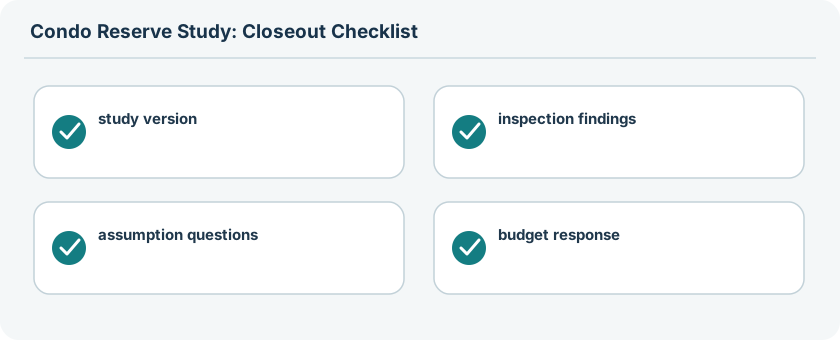
At closeout, update the component’s expected life, maintenance interval, warranty, and next inspection date. A good reserve file connects the original recommendation to the work actually performed and the funding that remains for the next cycle.
A reserve review worksheet
For each major component, write down current condition, estimated useful life, next inspection, projected replacement year, estimated cost, reserve contribution, committed spending, and the source of the estimate. Mark whether the item is association-wide, limited to a building, exclusive use, or subject to an owner alteration.
Then ask what is not included. Reports may exclude utilities, interiors, owner improvements, emergency work, code upgrades, access, inflation, or project management. The omission may be reasonable, but it should be visible when owners estimate exposure.
At the next annual review, compare the worksheet with actual invoices, new inspections, and current bids. Update the plan after a major repair instead of leaving an obsolete useful-life assumption in place. Buyers can use the same worksheet to understand whether their expected ownership period overlaps with a major replacement.
A reserve report becomes useful when it is connected to real decisions: what will be inspected, what will be funded, who will contribute, what happens if the estimate changes, and how completion will be verified.
Example: a reserve plan after a new inspection
If a new inspection finds faster deterioration than the reserve report assumed, update the component condition, timing, estimate, contribution, and funding gap. Note whether an assessment, fee change, loan, or project deferral is proposed. Tell owners what is known, what is estimated, and what decision is pending.
At completion, replace the old useful-life assumption with the actual repair date, warranty, maintenance interval, and next inspection. A reserve plan is valuable when it changes with evidence rather than remaining a static report.