
Water testing is usually a smaller cost than buying the wrong treatment system, but “a water test” is not one universal product. The price depends on the laboratory, sample method, number of analytes, turnaround time, collection service, and whether the test is a routine baseline, an event response, or a treatment-verification sample. A broad panel can be poor value if it is unrelated to the property’s geology or land uses; a cheap baseline can be poor value if a known contaminant is omitted.
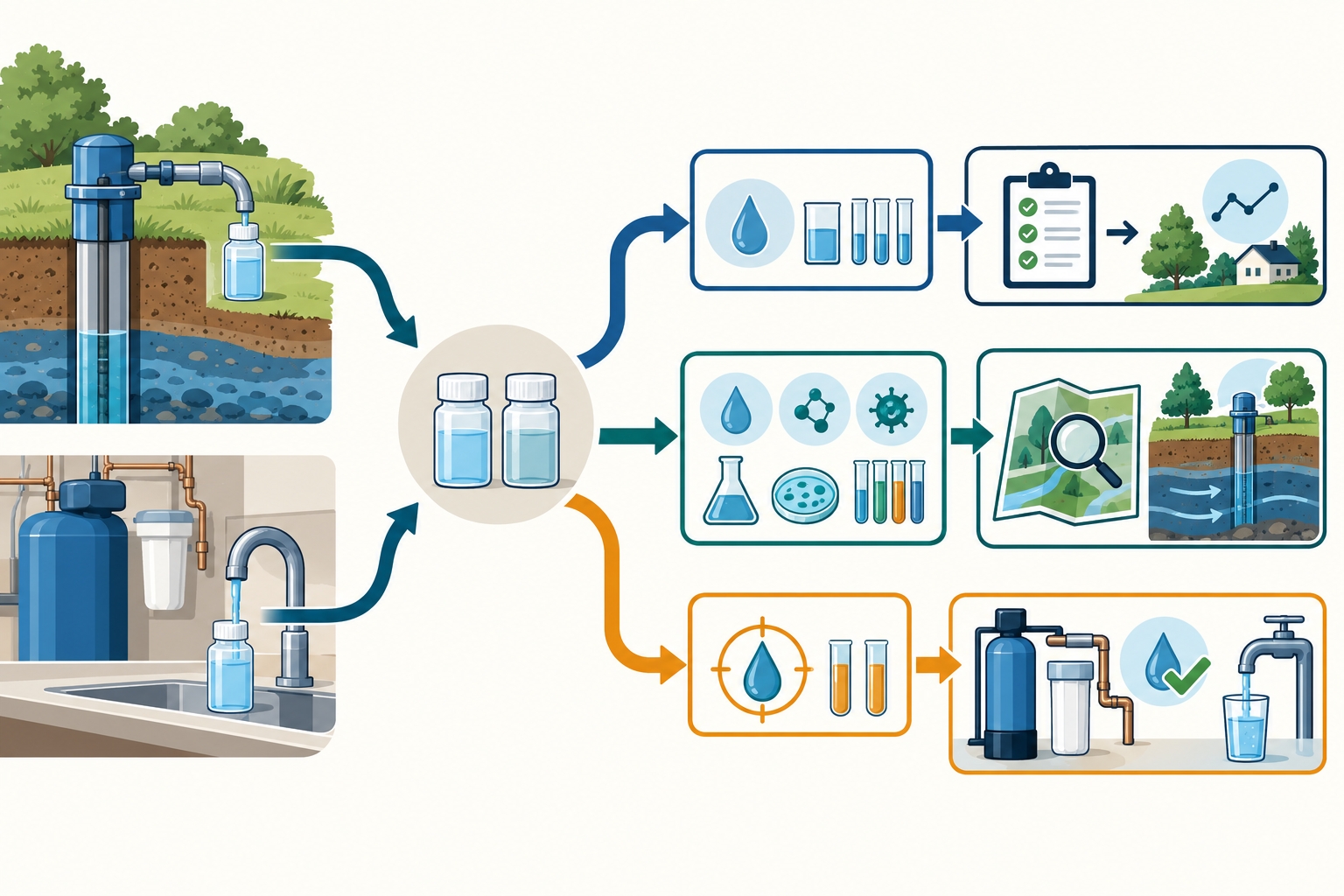
Why testing comes before treatment
EPA and CDC guidance supports routine testing of private wells for a baseline group such as total coliform bacteria, nitrate, total dissolved solids, and pH, with local additions when conditions warrant. Health Canada directs Canadian owners toward testing and interpretation under the applicable provincial or territorial guidance. These are starting points, not an exhaustive panel for every property.
Treatment choice depends on the contaminant, concentration, water chemistry, flow, household exposure, and condition of the well. Taste, odor, staining, or a sales diagnosis can suggest a question but cannot establish which device will work. Testing the raw water also creates a reference point for checking treated water later.
Three levels of testing
Routine baseline: A recurring panel that follows current local public-health or environmental guidance. In the US, the evidence supports the common baseline listed above. Alberta provides one provincial Canadian example of at least annual bacterial testing and routine chemical analysis every three to five years, while directing owners to their Regional Health Authority for current sampling and laboratory instructions. That schedule is not Canada-wide.
Expanded chemistry: Additional measures selected for regional geology, nearby agriculture, fuel or industrial activity, corrosion, hardness, iron, manganese, sulfur, or other observed conditions. The right panel is property-specific. An expanded package can cost more because it requires more laboratory methods and interpretation, not merely a larger bottle.
Contaminant-specific or confirmatory testing: A targeted test after a screening result, event, or known risk. Arsenic, nitrate/nitrite, PFAS, microbial contamination, and other consequential findings should be handled with an appropriately certified or accredited laboratory and current authority guidance. Confirmation may be needed before designing or approving treatment.
Radiological parameters are a conditional testing question
Radiological testing is not a universal annual panel for every private well. In Canada, Health Canada’s guidance describes gross alpha and gross beta measurements as screening tools; when a screen warrants follow-up, radionuclide-specific analysis is needed to interpret the result. A screening exceedance does not by itself show that every individual radionuclide guideline has been exceeded. Ask the provincial or territorial authority or a qualified laboratory whether local geology, an earlier result, or another property-specific concern justifies screening, and which confirmatory analytes and sampling point are appropriate. The quote should separate the screening panel from any specialized follow-up analysis. US owners should check their state or local health authority for the applicable recommendations.
What the laboratory quote may contain
Read the quote as a small scope of work. It may include sample bottles, courier or drop-off, laboratory analysis, reporting, interpretation, rush service, and a sampling visit—or only the analytical fee. Some programs subsidize selected tests, but eligibility, analytes, and dates change. The private-well assistance guide explains what to confirm before relying on local testing access or reimbursement.
Ask whether the price is per sample or per panel, whether a second sample is discounted, how long the result takes, which laboratory certification or accreditation applies, and whether the report identifies detection limits and methods. A low headline price can exclude the collection visit or the additional analysis needed to interpret an unusual result.
When to test outside the routine schedule
Additional testing may be sensible after flooding, construction, well repair, a change in taste, odor, or color, a nearby land-use event, or a result that suggests contamination. CDC also identifies household changes such as pregnancy or a child joining the household as reasons to discuss testing. Follow the current local authority’s advice for health-sensitive situations.
After a flood or suspected microbial event, do not use a routine price comparison as permission to resume normal drinking-water use. Public-health guidance may call for inspection, disinfection, a safe interim source, and follow-up testing. The sequence and return-to-use conditions are not universal.
Event-selected testing also has dedicated recovery budgets for a flooded well and a well affected by wildfire. Those guides separate the lab panel from sample collection, interpretation, temporary water, physical repairs, and follow-up visits.
Before-and-after treatment testing
The raw-water result is not the same as proof that a device works. Health Canada guidance emphasizes testing water entering and leaving treatment and matching certification to the specific contaminant. A post-installation sample may be part of commissioning, while ongoing verification may be warranted when the contaminant is consequential or the device’s performance depends on changing media.
Include these future tests in the treatment budget. A system that looks inexpensive at installation can become a poor economic choice if verification is difficult, the test is never repeated, or media exhaustion is not detected.
Three scenarios
Routine owner: A local laboratory panel covers baseline indicators and the household keeps a record of dates and results. The cost is predictable but should be repeated according to local guidance.
New owner or unusual water: The owner pays for a baseline sample, a broader chemistry panel selected for the site, and possibly a follow-up test. This is often more useful than buying a softener or filter from appearance alone.
Treatment or event response: The budget includes an initial test, professional source inspection or disinfection where directed, post-work testing, and possibly repeat confirmation. The final cost reflects a sequence, not one laboratory invoice.
US and Canada
US and Canadian testing systems differ in laboratories, public-health authority, sampling requirements, and available programs. Health Canada provides national guidance but provinces and territories implement their own policies. Alberta’s sampling workflow is a useful example of why local instructions matter; it does not establish a Canadian standard price or panel.
Do not convert a US laboratory price into CAD and present it as a Canadian estimate. Ask local authorities which laboratory is accepted for the decision you are making, especially for a real-estate transaction or a health-sensitive result.
Questions to ask before ordering
- What decision will this test support: baseline, diagnosis, treatment design, or confirmation?
- Which analytes are included, and why do they fit this property?
- Is the laboratory certified or accredited for the work?
- Who collects the sample, and what handling rules apply?
- Are rush fees, courier, interpretation, or a second sample excluded?
- What result would trigger retesting, source inspection, disinfection, or treatment?
- If treatment is installed, what will be tested at the inlet and outlet and how often?
The best testing budget is not the longest list. It is the smallest responsible sequence that answers the actual question, respects local guidance, and prevents a much larger purchase from being based on a symptom or sales pitch.
A practical testing decision tree
If the goal is routine ownership, follow the current local baseline and keep results over time. If the goal is buying a home, combine the physical well inspection with a current laboratory sample and ask who pays for follow-up if the result is abnormal. If the goal is treatment design, test the raw water broadly enough to prevent a device from being selected from one incomplete indicator.
If the trigger is a flood, repair, construction, or sudden quality change, ask the authority whether the sample should be taken before or after flushing and whether an inspection or disinfection comes first. Sampling point and handling can change what the result means. Do not compare a mail-in consumer kit with a certified laboratory sample as though they support the same decision.
Make test quotes comparable
Record the analytes, sample count, collection method, laboratory credentials, detection limits, turnaround, interpretation, rush charge, and follow-up terms. A package with more analytes is not necessarily more informative if it lacks the contaminant relevant to the property. Conversely, a result that is close to a decision boundary may require a confirmatory sample or authority interpretation rather than a cheaper repeat ordered from a different laboratory.
Use testing as a staged expense. Spend first on the result that separates the plausible decisions, then add targeted analysis when the first result warrants it. This avoids both under-testing before an expensive treatment purchase and paying for a large panel with no clear use.
Treat the result as a project input
Testing is most useful when the homeowner decides in advance what each possible result will change. A routine result may support ordinary monitoring. A result showing a possible microbial issue may trigger authority contact, source inspection, professional disinfection, and follow-up sampling. A chemistry result may justify a treatment design, but the design may still require flow, pressure, hardness, pH, or other information before a device can be selected. Write that decision path into the testing request so a laboratory package is not mistaken for a complete diagnosis.
The sampling point matters as much as the analyte list. A raw-water sample, a kitchen tap, a treated outlet, and a sample after a repair answer different questions. If treatment is already installed, ask which inlet and outlet samples are needed and whether the lab or authority specifies flushing, preservation, delivery time, or chain-of-custody requirements. A cheaper sample that cannot support the intended comparison may create a second fee and delay.
Local testing access and draft Canadian guidance
The Eastern Ontario Health Unit offers no-charge coliform and E. coli testing to eligible private households in its service area, but the service does not include chemical or mineral tests. Its page requires the EOHU bottle and limits sample drop-off to posted weekday windows; verify current collection details before planning around the service. This is one local bacteria-testing route, not a free Ontario-wide panel.
Health Canada’s September 2026 residential premise-plumbing document is still a public-consultation draft, with comments due November 24, 2026. It proposes general well-water testing every two years and periodic accredited-laboratory checks of water entering and leaving treatment. These are draft recommendations, not final Canadian guidance or a substitute for provincial and territorial instructions.
Keep results with the well record, including the date, location, laboratory, panel, detection limits, and any interpretation supplied by the responsible authority. Trend information can show whether a change is persistent, seasonal, event-related, or associated with a repair. It does not replace current testing, but it makes the next quote more targeted and helps prevent a sales recommendation from becoming the first source of information about the water.