
A nitrate or nitrite result should lead to current health-authority guidance, confirmatory testing where advised, and a treatment or source decision based on the measured water—not a generic filter purchase. Treatment cost depends on concentration, other chemistry, household exposure, point-of-use versus whole-home scope, pretreatment, verification, and recurring media or membrane work. Because this is health-sensitive, the article does not replace local public-health advice.
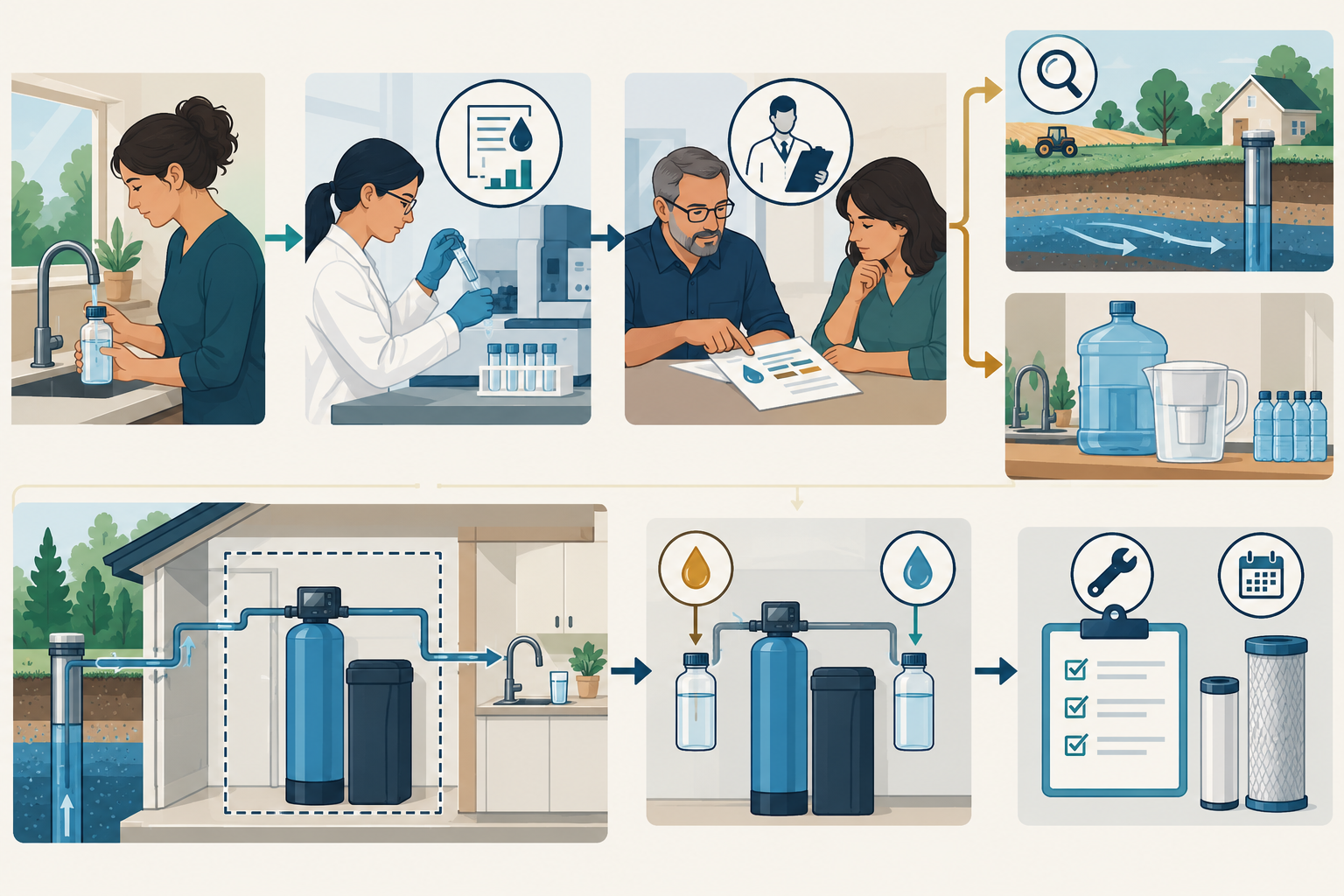
Confirm and interpret the result
Use an appropriately certified or accredited laboratory and confirm which analyte, sample point, result, and reporting basis apply. Health Canada evidence emphasizes source-water testing, general chemistry, possible bacterial co-contamination, device effectiveness, and periodic influent and effluent testing.
Nitrate or nitrite can be associated with land use, septic systems, agriculture, or other conditions, but a result does not prove one cause. Investigate the source without assigning blame. A wellhead, casing, drainage, septic, or nearby land-use issue may need its own professional scope.
Treatment scope
Point-of-use treatment can be economical when the immediate objective is treated drinking and cooking water at defined outlets and the device is certified for the result. Whole-home treatment treats all incoming water and costs more through flow capacity, plumbing, pretreatment, and maintenance. The correct scope depends on current authority guidance and the intended exposure reduction.
Residential options may include RO, ion exchange, or distillation in applications supported by authoritative and product evidence. Health Canada identifies NSF/ANSI 58 RO as a certification context for examples including nitrate and nitrite, but the exact product claim must be checked. A softener, sediment filter, or UV unit should not be presented as a nitrate solution without a matching claim.
Installed cost structure
Budget for confirmatory or expanded testing, design, the treatment device, pretreatment, storage, drain, plumbing, electrical work, installation, commissioning, and post-treatment testing. A current US specialist orientation places installed RO around $1,000–$4,800, but that range is not nitrate-specific and not a Canadian benchmark.
Whole-house treatment can require higher capacity and more complex controls. POU treatment may need a dedicated faucet, storage tank, drain, and filters. If raw water contains sediment, hardness, iron, or another issue, pretreatment can be required and changes the total.
Source correction and alternative water
If investigation finds a correctable source pathway, repair can be more valuable than filtering indefinitely. If the source cannot be corrected or the treatment cannot be verified reliably, an alternate drinking-water supply or new source may enter the decision. A new well still needs testing and does not guarantee a different nitrate result.
Follow current authority advice for interim water use, especially where vulnerable household members are involved. Do not turn an article cost range into a health threshold or a universal “safe” decision.
Verification and ownership
Test water entering and leaving the treatment system and repeat testing at the interval appropriate to the result, device, and authority. Include laboratory fees in the ownership model. Filters, membranes, resin or media, electricity, service, reject water, and replacement equipment recur according to use and chemistry.
Three scenarios
Focused drinking-water treatment: Defined outlets, a certified POU device, suitable pressure and drain, and a verification plan. The lower treated volume may reduce capital and operating cost.
Whole-home requirement: The objective affects more than drinking water or the authority and professional design call for POE. Flow, pretreatment, plumbing, and lifecycle costs dominate.
Unresolved source: The result is confirmed but the cause, chemistry, or treatment claim is uncertain. Spend on the right testing and investigation before approving a device with no measurable performance plan.
Quote checklist
- What exact result and concentration are being addressed?
- Which outlets and household uses receive treated water?
- What certification and contaminant claim applies?
- Are bacteria and other relevant chemistry included in the design review?
- What pretreatment, pressure, storage, drain, electrical, and plumbing work is included?
- What are the testing, filter, membrane, media, service, and replacement costs?
- What current local authority instructions apply while treatment is pending?
The available price evidence is US-oriented. Do not convert it into CAD. A responsible nitrate/nitrite budget pays for an appropriate test, a defensible treatment boundary, certified performance, and repeated verification—not just a box installed under a sink.
Keep source investigation in the budget
Nitrate or nitrite treatment can reduce exposure while the source question is investigated, but it does not explain why the result occurred. Ask whether the wellhead, casing, drainage, septic system, agricultural activity, or other land-use factor is relevant to the site. Do not state that one neighboring activity caused the result without evidence, and do not omit a source correction that could reduce recurring treatment cost.
If treatment is selected, write down which water is treated, how it is tested, and what happens when the device is bypassed or exhausted. The household needs a practical way to use the correct outlets while maintenance is underway. Include additional sampling, service, and an alternate water arrangement where current authority guidance calls for it.
Compare staged options
A staged plan may start with confirmatory testing and source inspection, use a certified POU treatment for a defined interim or long-term boundary, and later reconsider POE, source correction, or a new well. The right sequence depends on the current result and authority direction. This is often more economical than installing a whole-home system before the contaminant, source, and flow requirements are understood.
Keep verification affordable
Ask whether the proposed device has a practical sampling point and whether its replacement indicator is measurable. A treatment system that is technically capable but too expensive to test or maintain can be a poor long-term choice. Include a reserve for repeat testing after source work, equipment replacement, and changes in household demand.
Treat the quote as a monitored system
The proposal should identify the sample point, treated outlets, certification or performance claim, pretreatment, pressure, bypass, maintenance signal, and response when the system is out of service. That information helps a homeowner compare a lower-cost POU design with a larger installation without confusing price with coverage. Retain the original result and follow-up reports for future service or sale.
Separate urgent protection from the permanent design
If the result requires immediate caution, temporary bottled or delivered water can buy time for confirmatory testing and design. Price that bridge separately from the treatment system. It may be inexpensive for a short procurement period but burdensome for a large household, and it does not solve bathing or other non-drinking uses. The provider or local authority should clarify which uses are affected while the result is being resolved.
For the permanent comparison, show the treated volume, expected replacement interval, testing plan, and consequence of a missed service. A lower installation price can become the higher ownership cost if cartridges are difficult to obtain or verification is too expensive to perform. The best quote makes continued confidence in the result part of the system rather than an afterthought.