
A positive bacteria or E. coli result is a corrective sequence, not a single filter purchase. Follow current public-health instructions for safe water use, confirm what the laboratory result means, inspect the well and possible contamination pathway, disinfect when directed, retest, and address recurrence. Costs can range from testing and a focused wellhead correction to repeated disinfection, casing or source work, and continuous treatment.
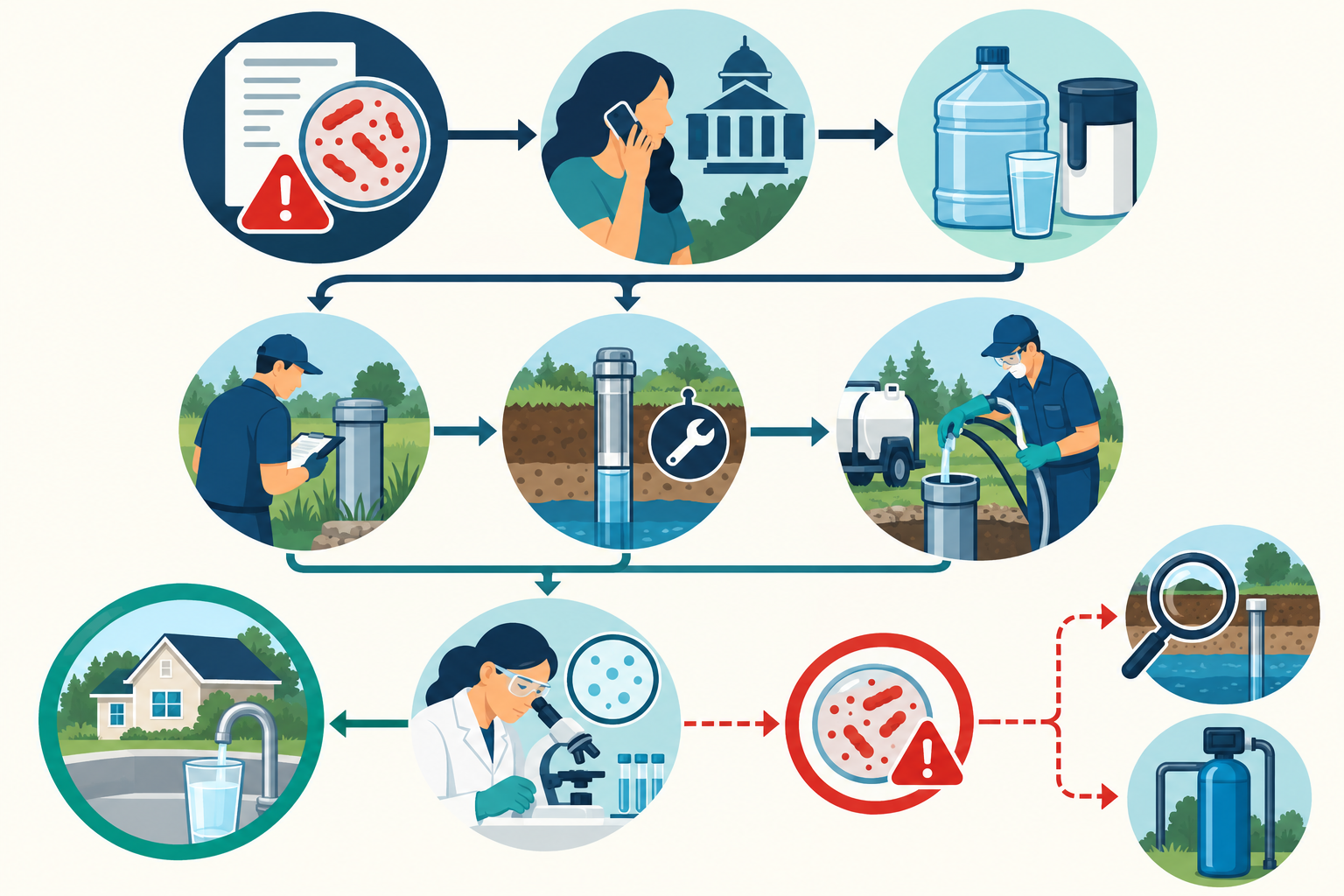
Treat the result as a decision trigger
CDC distinguishes total coliforms as an indicator of a possible contamination pathway and E. coli or fecal coliforms as an indication of fecal contamination; the result does not identify every harmful organism. Use the current authority and laboratory report to interpret the actual sample. Do not infer that a clear or odor-free sample is safe.
Until the responsible authority establishes the applicable interim and return-to-use guidance, use an alternate safe water source as directed. Do not boil, disinfect, or reconnect treatment equipment based on this article alone. Local instructions can depend on the organism, event, well construction, household, and follow-up result.
The corrective cost sequence
Interpretation and confirmation: Laboratory consultation or a follow-up sample may be needed. Budget the sample, laboratory, collection, and possible rush or courier fee.
Source inspection: A professional examines the wellhead, cap, seal, casing, drainage, flood history, repairs, septic or surface-water pathways where relevant, and accessible pump or plumbing. A positive result does not prove which pathway caused it.
Source correction: Repairing a cap, seal, casing, drainage or other confirmed pathway can be more valuable than repeatedly treating the water. The correction may require excavation, well work, site drainage, or a separate septic or property investigation.
Disinfection: Professional shock disinfection may be recommended after contamination, flooding, or some repairs. Cost depends on well geometry, access, flushing, equipment protection, and follow-up testing. The disinfection article covers that service separately.
Retesting: The water must be sampled according to authority guidance. One negative result may not resolve a recurring or event-related problem; the required sequence is local and health-sensitive.
Continuous treatment: If the source cannot be corrected or contamination returns, a certified UV or other treatment barrier may be evaluated. It adds equipment, pretreatment, electricity, monitoring, lamps, sleeves, service, and testing. It does not make a damaged wellhead acceptable.
What can make the budget small or large
A focused, accessible wellhead issue with a defined test and one professional correction is a different budget from a flooded, deep, damaged, or undocumented well. Remote travel, pump access, casing work, contaminated discharge, temporary water, repeated samples, and restoration can exceed the treatment product cost.
The full quote should separate the initial result, inspection, source correction, disinfection, laboratory work, temporary supply, treatment, and maintenance. Do not compare a one-time shock price with a complete corrective plan.
Three scenarios
Single event: A result follows flooding or a repair. Authority guidance directs inspection, disinfection when appropriate, and testing before normal use. The cost is a sequence with an uncertain final number.
Localized pathway: The wellhead or drainage is visibly compromised. Repair and follow-up testing may be more economical than repeated treatment.
Recurring result: The result returns after correction and disinfection. Investigate the source, construction, season, and adjacent conditions; then compare continuous treatment, a new or alternate source, and ongoing testing. Do not assign a cause without evidence.
UV and other ongoing barriers
UV may be considered for a documented microbial treatment objective, but the exact certification, flow, pretreatment, lamp condition, alarm, and power requirements matter. Sediment or turbidity may require filtration first. A POU device and a whole-house system protect different outlets and uses. Match the scope to the authority and treatment professional’s design.
Quote and authority questions
- What exactly did the laboratory report, and is confirmation advised?
- What interim water-use direction applies now?
- What source pathways were inspected and what was actually found?
- Are repair, disinfection, laboratory testing, temporary water, and restoration separate?
- What result and timing establish return to normal use?
- If contamination recurs, what is the next investigation or treatment?
- Does a proposed device have a certified claim for this result and flow?
EPA, CDC, and Health Canada agree on testing and treatment logic but local response details vary. Ontario, Alberta, British Columbia, and US states have different owner and laboratory contexts. Obtain current local guidance and pricing; do not convert a US service estimate into CAD. The financially responsible choice is the complete corrective path that removes or controls the source and proves the result afterward.
Use the result to prioritize spending
The first dollars should reduce the uncertainty that changes the safety response: authority contact, appropriate sample interpretation, inspection, and temporary water. The next dollars should correct a confirmed pathway or carry out directed disinfection. Only then can a permanent UV or other treatment decision be compared responsibly. This order prevents a homeowner from paying for a continuous device while a damaged wellhead or flood pathway remains.
If the result is negative after treatment, keep the laboratory report and method with the well record. If it remains positive or returns, do not simply repeat the same service. Compare the source, construction, season, neighboring conditions, treatment, and sampling process with the authority or qualified professional. A repeated event changes the economic decision from a one-time repair to an ongoing exposure-control problem.
Budget the household’s actual use
List drinking, cooking, ice, bathing, and other uses that the authority or professional says matter. A POU system may lower cost only if the household uses the treated outlets reliably. A whole-house system may be justified by the treatment objective but carries higher flow, power, pretreatment, and maintenance costs. The quote should state that boundary and the plan for outages and maintenance bypass.
Keep the laboratory reports, authority instructions, inspection findings, disinfection record, and follow-up results together. That record changes the economics of the next event: a provider can distinguish a new contamination pathway from a persistent one rather than repeating the first service blindly. It also gives a future owner or reviewer the information needed to understand what the treatment actually covers.
Compare a one-time response with continuing control
A one-time corrective sequence is priced around a particular result or event: laboratory follow-up, inspection, source correction, professional disinfection, and confirmation. Continuing control is priced around an ongoing treatment barrier and its pretreatment, power, monitoring, replacement parts, service, and verification. Keep those scopes separate when comparing quotes. A lower initial price may simply omit future tests or the work needed if the result returns.
Use the follow-up record to decide whether the household is still solving the same problem. If the source was repaired and testing remains clear, recurring treatment may add cost without solving a demonstrated need. If contamination returns or the source cannot be corrected, ask the authority and qualified provider to compare ongoing treatment with further investigation or another supply. Include protected outlets, downtime and temporary water, and the five- or ten-year maintenance burden rather than comparing only the first service invoice.
The comparison should also identify what failure looks like. A one-time response ends with the authority’s applicable testing and return-to-use direction; a continuing barrier needs a way to detect an alarm, power interruption, exhausted component, or failed verification result. Price the response to those events before accepting a device as the cheaper alternative. The least expensive safe path is the one whose source, treatment boundary, and follow-up responsibility are all clear.
Keep the corrective record usable
Record the original result, sample point, authority direction, inspection findings, repair, disinfection, follow-up result, and any ongoing treatment. This is not just paperwork: it tells the next provider whether the household is facing a new event or an unresolved pathway. It also keeps a one-time corrective budget from quietly becoming an untracked recurring expense.
Use low, expected, and difficult cases rather than one response price. The low case may be a documented one-time event with accessible equipment. The expected case includes inspection, professional service, laboratory follow-up, and temporary water. The difficult case includes recurrence, a compromised wellhead, repeat testing, or a continuing barrier. This model keeps the first quote from being mistaken for the total exposure.
For an isolated result with an identifiable source, the economic path may be inspection, correction, professional disinfection, and follow-up testing. For a recurring result or a source that cannot be corrected promptly, compare that path with an ongoing barrier and its testing, power, pretreatment, service, and failure response. Do not select the ongoing system from the laboratory result alone; its suitability depends on the source, flow, equipment, and authority or professional guidance.
The quote should state what is covered during an outage and what the household does if an alarm, lamp, filter, or test result indicates that treatment is not functioning. Temporary water, repeat laboratory work, and a second visit can be material costs. Including them makes the apparent difference between disinfection and continuous treatment easier to evaluate.