
No water, low household pressure, and an intermittent supply can have very different causes. The first paid service is usually a diagnostic visit, not an automatic pump replacement. A current US specialist orientation puts pump repair service calls in a broad market range and reports an average complete pump replacement around $1,898, but those figures do not diagnose your system and do not establish Canadian pricing.
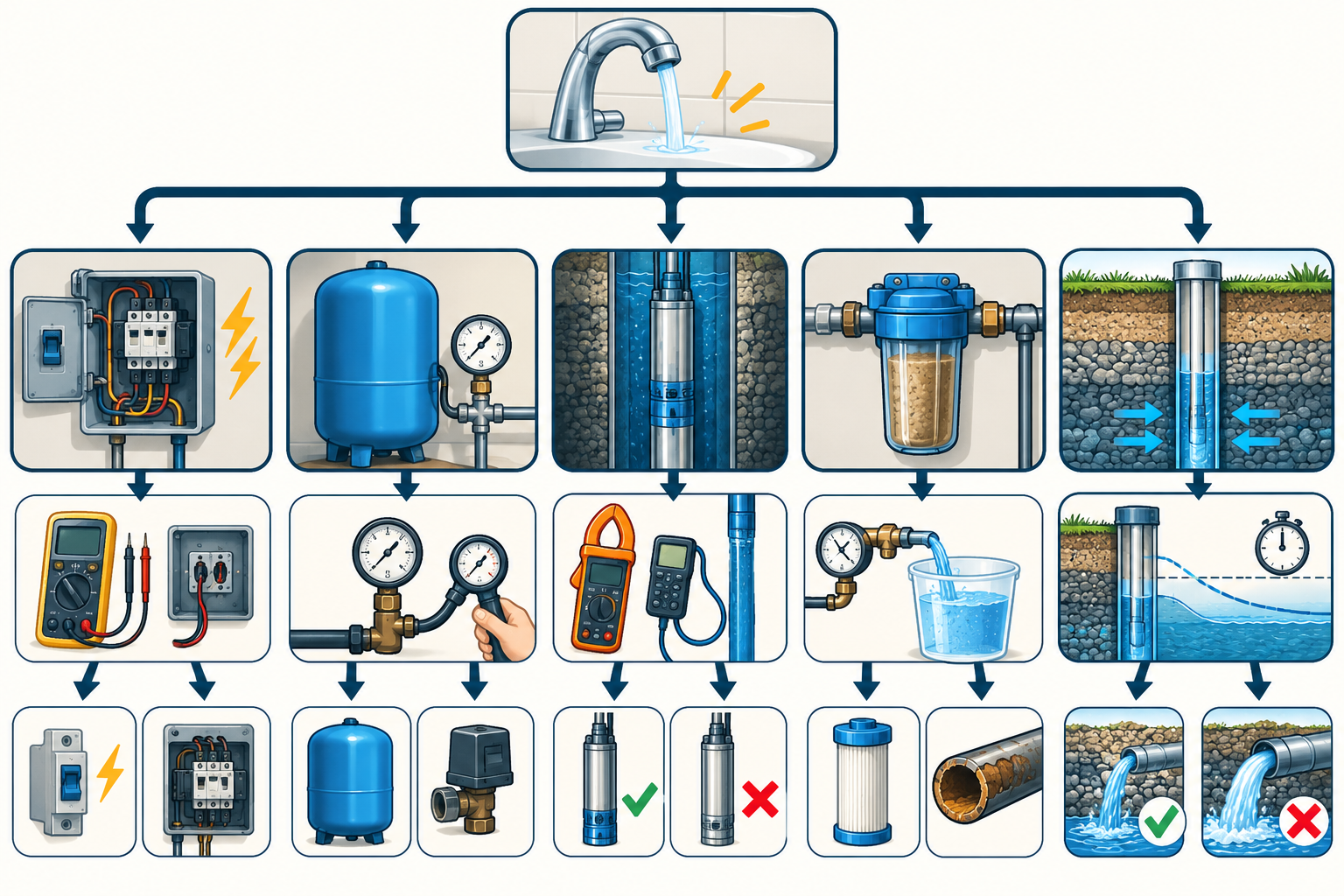
Separate pressure, flow, and yield
Pressure is the force available at fixtures. A pressure-tank, switch, controller, restriction, or leak can affect it.
Flow is how much water reaches a fixture over time. Pipe size, filters, valves, pump performance, and pressure can affect it.
Well yield is the sustainable production of the source. A low-yield well can provide adequate daily volume but fail when showers, laundry, irrigation, or other peak uses overlap. Penn State Extension describes storage and demand management as distinct responses to that production-versus-timing problem.
Those distinctions are why a new pump does not automatically solve every low-pressure complaint. A stronger pump may also be inappropriate if the well cannot supply it or if the restriction is elsewhere.
What a technician is diagnosing
A professional visit may review power and controls, the pressure switch or controller, pressure tank behavior, gauges and valves, visible leaks, pump operation, well recovery, and the history of the symptom. Some checks require access to equipment, records, or the well itself. Wet electrical equipment, pressure, lifting, and contaminated water make this service unsuitable for improvised troubleshooting.
The output should connect the symptom to a next scope: an accessible control repair, pressure-tank replacement, pump repair, pump replacement, leak or pipe work, low-yield assessment, or broader well rehabilitation. Ask for the diagnosis in writing before approving a larger package.
The main cost branches
Control or accessible component: A failed switch, controller, gauge, valve, or other accessible part can produce a relatively focused repair. The bill may include the service call, diagnostic time, replacement component, testing, and a return visit.
Pressure tank: A failed bladder or corroded tank can cause cycling, poor pressure behavior, or loss of usable drawdown. Replacement is a separate scope from a bulk storage tank and does not automatically increase household pressure.
Pump repair: A fault may be repairable when the pump does not need to be removed or when the problem is in controls or associated wiring. If the pump must be pulled from a deep well, labor and access can make replacement the more practical comparison.
Pump replacement: The quote can include pulling the pump, new pump and drop pipe, cable, controls, pressure tank, testing, and disposal. Depth and access are major drivers.
Low-yield or declining source: If the pump and pressure side are operating but the source cannot keep up, the next scope may be yield testing, storage, rehabilitation, deepening, or a new well. This is a larger decision than a service call.
Power or electrical fault: The well equipment may be healthy while the supply or control circuit is not. Electrical diagnosis and repair belong with the appropriately qualified trade; do not treat line-voltage work as a homeowner test.
Emergency versus scheduled service
After-hours mobilization, no-water urgency, difficult access, temporary water arrangements, and repeat visits can raise the cost before the repair is known. Ask whether the emergency fee is credited toward the work, whether parts are stocked, and what temporary stabilization is included. A scheduled visit may allow the technician to bring records, the correct equipment, and a second specialist, but delaying can be inappropriate when the system is leaking, contaminated, flooded, or causing property damage.
Three scenarios
Minor branch: The technician finds a control or accessible pressure-side fault. The quote is a service call plus a defined part and commissioning, with no pump pull.
Typical branch: The pump or tank requires replacement, but the wellhead and access are straightforward. The total includes equipment, labor, fittings, electrical or control work, and a clear test of the repaired system.
Difficult branch: A deep pump must be pulled, the well recovers slowly, access is restricted, or symptoms indicate a source problem. Several scopes may be required, and the first invoice may be diagnosis rather than the final project.
When water testing enters the decision
Test when the well has flooded, been repaired, developed a change in taste, odor, or color, or has a suspected contamination pathway. Low pressure alone does not prove a water-quality problem, but opening or disturbing the system can create a reason to follow local testing guidance. If the household has a positive bacteria or other health-sensitive result, follow public-health instructions rather than treating the pressure repair as the whole solution.
When an event changes the branch
If drought, an outage, freezing, flooding, or wildfire came before the symptom, record that history before assuming the pump failed. A pressure loss can be an equipment fault, a change in well production, or an event-related damage or water-quality question. Price the professional diagnosis and temporary supply separately from any repair that the inspection confirms. For event-specific recovery scope, see the guides for a flooded private well and wildfire-affected well; return-to-use advice and testing decisions must come from the relevant local authority.
How to use the diagnosis
Ask the provider to state what was observed, what was not accessible, what measurements support the conclusion, and what would change the recommendation. A useful quote separates diagnosis already performed from proposed repair, equipment, related plumbing or electrical work, restoration, testing, and future options.
Do not compare a pump-only total with a system quote that includes a tank and controls. Do not compare storage against a pressure tank. Do not approve deepening or a new well because the pump is old unless the source-production question has been evaluated. The decision is ready when the symptom has been translated into a confirmed system branch and the remaining uncertainty has a priced next step.
US and Canadian cost context
The available market observations are US-oriented. Canadian labor, emergency service, equipment availability, and travel distances can differ materially. Obtain a local CAD diagnostic quote and verify provincial or territorial requirements where work affects the well, electrical system, or water quality. The broadest useful budget is often the diagnostic fee plus a reserve for the most plausible branch—not an unsupported single repair number.
Information to give the technician
Record whether every fixture is affected, whether pressure changes as the pump runs, whether the problem is sudden or gradual, whether the pump cycles unusually, and whether a flood, freeze, repair, outage, or treatment change came first. Note the well’s records, pump type, pressure-tank information, and recent invoices. These observations help the provider price the diagnostic path without turning the homeowner into the person responsible for electrical or pump testing.
What changes the urgency
No water after an electrical event, visible leaking, flooding near the wellhead, damaged equipment, or suspected contamination needs a conservative professional response. A gradual decline may allow a scheduled yield and pressure assessment, but it still deserves attention when the household is relying on temporary workarounds or the pump is cycling abnormally. Emergency pricing buys mobilization and risk management; it does not guarantee that the first visit contains the final repair.
Budget the branch, not the symptom
Ask the technician to divide the visit into a diagnostic stage and an authorized repair stage. The first stage should establish whether the symptom is on the electrical, control, pressure, pump, piping, or source side and should state what could not be tested safely. The second stage can then use a defined allowance for an accessible repair, a pump pull, a tank replacement, or further yield investigation. This structure gives the owner a stopping point when the initial evidence points to a much larger project.
The household’s timing affects the economic choice. A scheduled visit may reduce after-hours travel and provide time to obtain records or parts, while an active leak, flood, contamination concern, or loss of water for essential occupancy may justify faster service. Temporary water, a second trip, and restoration can matter more than a small difference in the service-call fee. Include them when comparing proposals.
Give the provider a short operating history: when the problem began, whether all fixtures are affected, what happens during simultaneous use, whether power or weather changed, whether the pump cycles abnormally, and whether recent construction or well work occurred. These observations do not diagnose the system, but they help separate a pressure complaint from a supply complaint and make the paid diagnostic time more productive.
Do not let a symptom choose the equipment
A pressure gauge reading can be useful evidence, but one reading does not establish well yield or pump capacity. A new pressure tank cannot repair a failed pump, and a larger pump cannot create groundwater. If treatment equipment is also present, a clogged filter or bypass position can change flow. Ask the technician to identify the branch that is confirmed, the branch still uncertain, and the lowest-cost next test that separates them.