
An arsenic result is a test-and-treatment decision, not a product-shopping prompt. The laboratory result, arsenic form, concentration, household use, raw-water chemistry, and intended exposure reduction determine whether point-of-use or whole-home treatment is appropriate. Because the decision is health-sensitive, use current public-health guidance and a certified or accredited laboratory; this article provides economic structure, not medical advice.
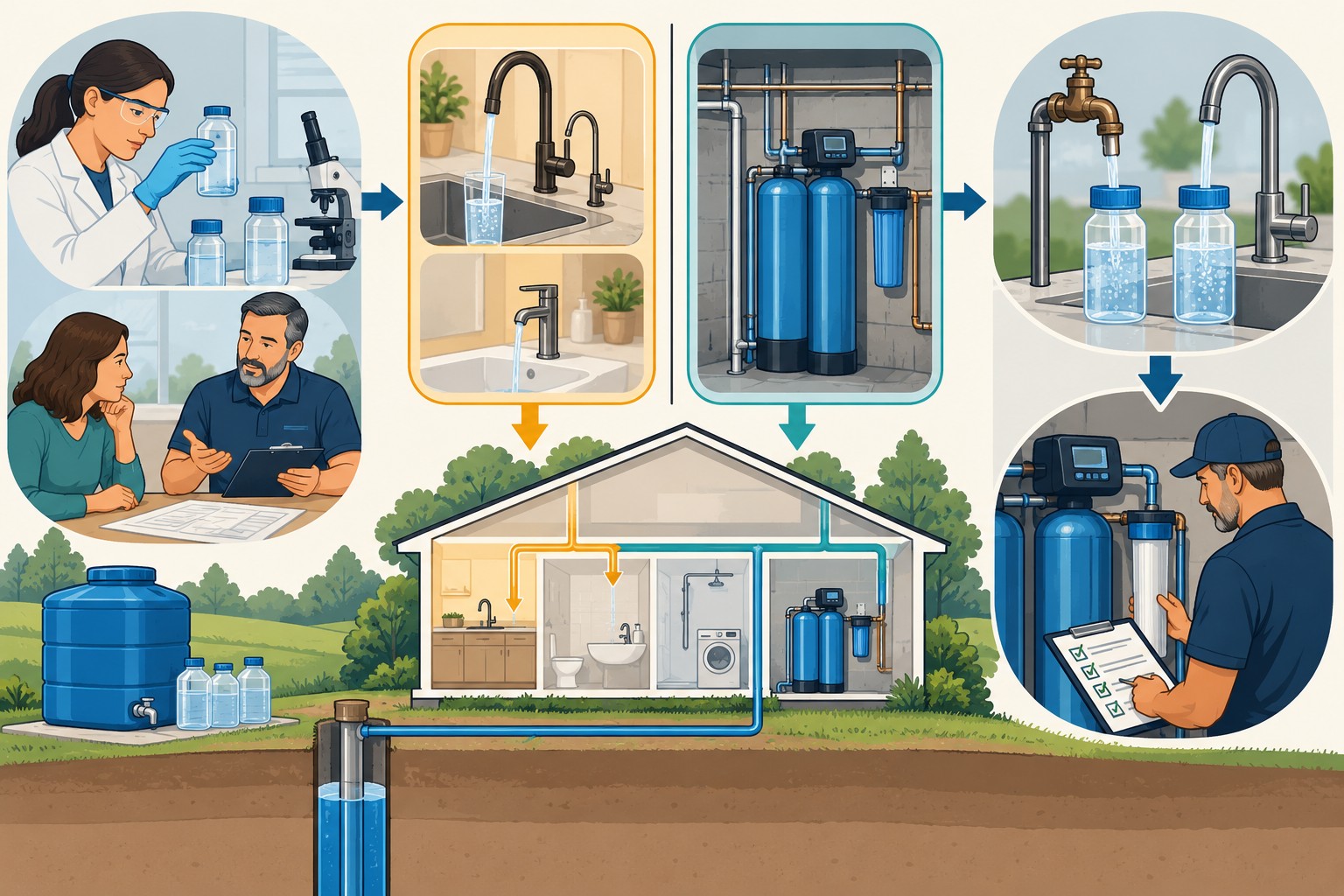
Start with the result
Confirm the sample, laboratory, analyte, and result with the appropriate health or environmental authority. Arsenic form can affect treatment selection. Appearance, taste, and odor cannot establish that arsenic is present or identify a suitable device.
The next questions are not only “How much is a filter?” but “Which water is being treated, what claim is certified, and how will performance be checked?” Health Canada guidance says treatment should follow testing and source investigation, and that certification must match the specific contaminant.
POU or whole-house treatment
Point-of-use treatment can focus the investment on drinking and cooking outlets when that is the responsible exposure boundary and the device is certified for the result. Whole-home or point-of-entry treatment treats all water entering the house and may be considered when the broader use or plumbing context requires it. It costs more in equipment, flow capacity, plumbing, pretreatment, and maintenance.
Do not assume that whole-house is safer or that POU is always enough. The authority and treatment professional must connect the result to the exposure and system objective. Count refrigerators, ice makers, and other drinking-water outlets in a POU scope.
Treatment approaches and cost structure
Residential approaches can include certified RO, adsorption or filtration media, and distillation where appropriate. The correct technology depends on arsenic form, concentration, competing chemistry, flow, and the actual product claim. A general filter or generic RO label is not proof.
The installed budget may include confirmatory testing, design, pretreatment, equipment, storage, plumbing, drain, electrical work, bypass, commissioning, and treated-water testing. A current US specialist orientation places many installed RO systems around $1,000–$4,800, but that is technology and market context, not an arsenic-specific or Canadian price.
Pretreatment can be necessary to protect the treatment stage or manage related chemistry. Whole-house systems can also need higher flow capacity, a booster, larger media, or an alternate treatment train. Ask which line addresses arsenic and which line is only protection or convenience.
Certification and verification
NSF explains that certification is not a ranking and does not mean a product reduces every contaminant. Check the exact arsenic claim, form, concentration, flow, capacity, and operating conditions for the proposed device. Manufacturer literature can describe a model; it does not replace an independently relevant certification or authority guidance.
Test treated water according to the treatment professional and authority. Include inlet and outlet samples, follow-up frequency, detection limits, and what happens when media or membranes are exhausted. A treated tap that tastes better is not verification of arsenic reduction.
Ongoing cost
Budget filters, membranes, adsorption media, pretreatment, service, electricity, water used or sent to drain, replacement equipment, and periodic testing. The cost can be higher than installation when the household uses significant volume or the raw water shortens media life. Compare a five- or ten-year ownership model rather than only the equipment price.
Treatment versus another water source
An alternate drinking-water supply or a source correction may be part of the comparison, especially when treatment is difficult, recurring, or not reliably verifiable. A new well does not automatically solve arsenic; a changed source still requires testing. Do not imply that a deeper well, bottled water, or a device is the correct health decision without current authority guidance.
Three scenarios
Defined POU objective: Confirmed result, limited treated outlets, certified device, manageable pretreatment, and clear verification. The lower installation volume may make POU economical.
Whole-home treatment: The result and use case require POE. The budget grows through flow, plumbing, pretreatment, power, equipment, testing, and maintenance.
Uncertain or complex chemistry: Additional testing, authority consultation, or a staged design is needed before equipment. A low quote without a certified claim is not a saving.
Questions to ask
- What exact laboratory result and arsenic form support the design?
- Which outlets or uses receive treated water?
- What certified reduction claim applies to the exact device?
- What pretreatment, flow, pressure, drain, and electrical work is included?
- How will inlet and outlet water be tested?
- What are media, membrane, service, and replacement costs?
- What interim or alternate water advice applies while the decision is being made?
US prices must not be mechanically converted into CAD. Obtain local pricing and current public-health guidance. For arsenic, the most economical system is the one with a defensible exposure boundary, a matching certified claim, and an affordable verification plan.
Make the treatment proposal auditable
Ask the provider to identify the laboratory result, arsenic form, design concentration, flow or treated-volume assumption, product certification, pretreatment, expected capacity, and sample points. If the proposal uses adsorption media, RO, or another technology, the exact claim and operating conditions should be visible. A generic “arsenic filter” label does not answer those questions.
If the water is treated only at a POU outlet, label that outlet and include all drinking-water connections in the household plan. If the system is POE, ask why treating every gallon is needed and how the design handles bathing, laundry, irrigation, storage, and maintenance bypass. Neither scope is automatically correct without an exposure and use analysis.
Compare risk over time
The ownership model should include confirmatory and periodic tests, media or membrane exhaustion, pretreatment, service, electricity, reject water, and replacement. A lower installed price can be a poor choice if performance cannot be verified or parts are unavailable. If an alternate water source is considered, compare its recurring cost and convenience with treatment rather than treating it as a free fallback.
Treat changes as new decisions
A well repair, deepening project, new treatment stage, change in household demand, or altered source can change the treatment load. Re-test rather than assuming the original arsenic design still applies. Retain the original and follow-up results so the next provider can see whether the system is treating the same water under the same conditions.
Keep the result, coverage, and verification linked
A defensible treatment proposal connects three records: the laboratory result, the outlets and uses the system covers, and the testing plan that will show whether it works. A point-of-use proposal should identify the faucet, refrigerator, or ice maker included. A point-of-entry proposal should state the flow and uses it is designed to cover. Keep the result, design assumptions, certification information, installation record, and inlet/outlet results together so a later sample can be compared with the same source and treatment boundary.
That chain also gives maintenance spending a clear purpose. If the raw-water result, treated volume, or device changes, an old verification result may no longer establish current performance. Ask the provider to identify the next sample point and the event that triggers retesting, such as media exhaustion, a source change, or a service intervention. Paying for a clear verification plan is part of buying a defensible treatment outcome, not just an optional paperwork add-on.
When comparing proposals, place the three records beside the cost lines: what was found, what is being treated, and how the result will be checked later. A quote that lists equipment but leaves the covered outlets, operating assumptions, or verification method unstated is not yet a comparable arsenic-treatment scope. Clarifying those points may add design or testing cost, but it reduces the risk of paying for a system whose claim cannot be demonstrated in this household.
Set a conservative decision boundary
The article can help organize a treatment budget, but the property-specific decision requires current public-health or environmental guidance, appropriate laboratory work, and a device claim that matches the arsenic form and concentration. Do not let a sales package substitute for that sequence. If the result, species, exposure boundary, or verification method is unresolved, spend on clarification before committing to a permanent installation.
Avoid comparing a treatment quote with a generic laboratory or product claim. The relevant comparison is a tested result, a defined covered use, a device or process suited to that result, and a practical way to confirm performance later. If any part is missing, reserve the budget for design and verification instead of treating the lowest equipment total as the lowest-risk option.
An arsenic quote should identify the raw-water result and the outlets the proposed system covers. A POU design may protect drinking and cooking at selected fixtures, while a POE design carries the cost of treating every fixture and meeting the home’s flow and pressure conditions. Neither scope should be judged by equipment price alone. Include installation, pretreatment, sample ports, media or membrane replacement, disposal, and the cost of periodic confirmation.
If a household is considering an alternate water source, compare the recurring purchase or delivery burden with treatment and testing. Temporary water may be appropriate while the design is reviewed, but it is not evidence that a permanent treatment claim works. The economically sound proposal makes the performance claim and the follow-up decision visible.