
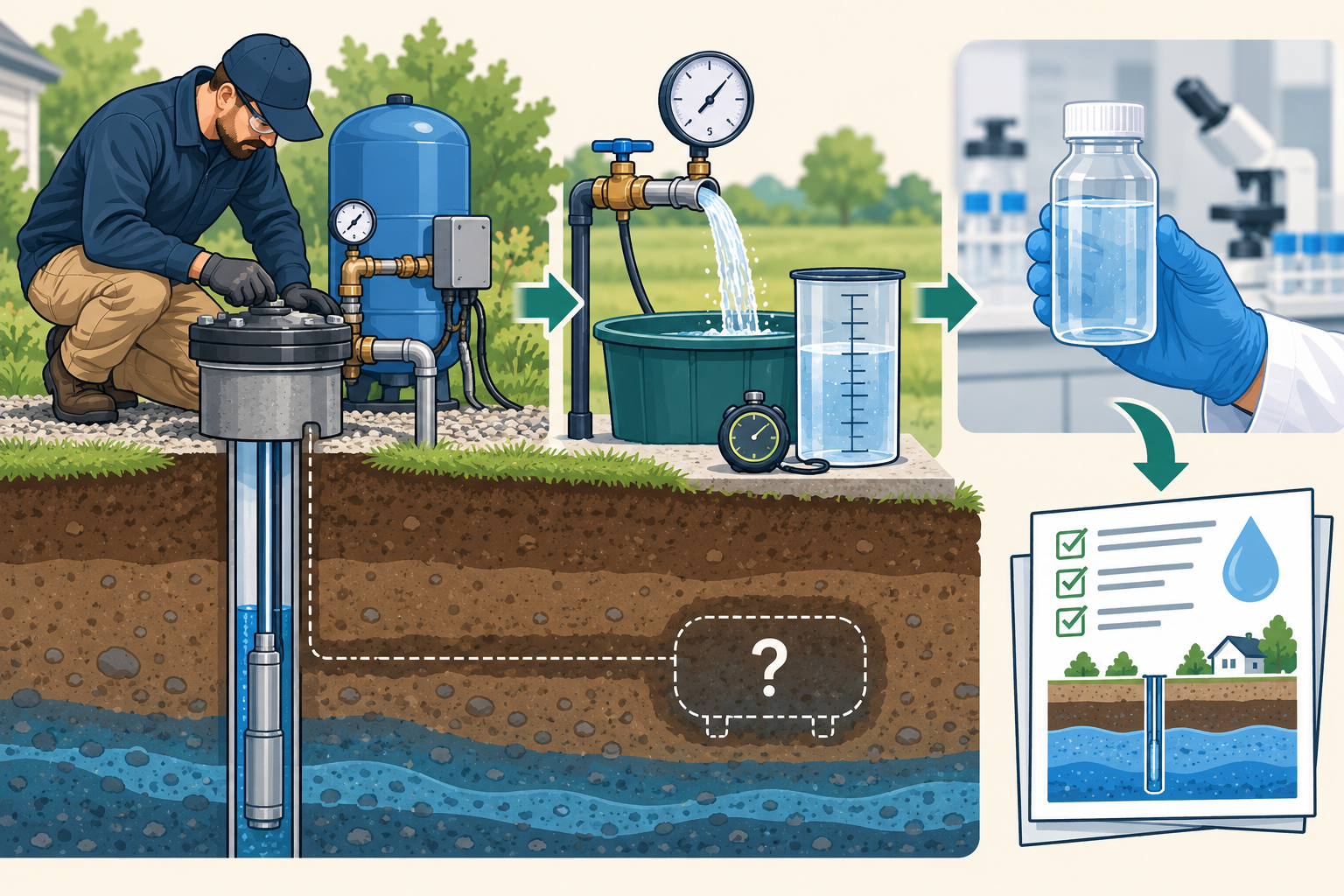
A professional well inspection is a system check, not automatically a laboratory water test and not a guarantee that an underground defect has been found. Current US specialist orientation places well inspections roughly around $150–$900, with $300–$600 described as a common range. Depth, access, pump visibility, location, and add-on testing can move the price. The source is not a Canada benchmark, and “well inspection” is not a standardized package everywhere.
What you are buying
The value of an inspection is a clearer picture of the system before you buy a property, approve a major repair, or treat a declining well as a replacement candidate. A useful scope normally identifies the wellhead and accessible components, records the pump and pressure equipment, observes operation where safe and feasible, considers flow or yield, and documents limitations.
The inspector may review construction records, well depth, pump information, previous test results, maintenance history, and visible drainage around the wellhead. If records are missing, the inspection may tell you that uncertainty remains rather than prove that the well is sound.
Inspection is not water-quality testing
The physical system can operate while water quality is unacceptable, and a clean-looking wellhead does not prove that the source is safe. Laboratory testing is a separate service with its own sample, panel, laboratory, and interpretation costs. EPA and public-health guidance support routine testing and additional testing after events, repairs, or changes in water quality.
For a home purchase, price the inspection and laboratory sample separately unless the provider clearly includes both. For an existing owner with low pressure or declining supply, the inspection may also need a yield or performance assessment. For a contaminated result, start with the appropriate public-health or environmental guidance rather than using a general inspection as a substitute.
What changes the inspection price
An accessible, above-grade wellhead and visible pressure equipment are a simpler assignment. A buried, obstructed, remote, deep, or poorly documented system takes more time and may require coordination before a meaningful conclusion is possible. Pump access matters because the inspector may not be able to evaluate the pump itself without specialist work.
Yield testing is also more than turning on a tap. A well’s yield describes its sustainable production, while a household can experience a peak-demand shortage even when daily production is adequate. Penn State Extension describes low-yield systems as situations where storage, demand management, or a booster arrangement may address timing rather than create a new source.
Common inspection layers
Basic condition check: Visible wellhead, cap or seal, casing condition, drainage, pressure tank, gauges, controls, accessible piping, records, and obvious leakage or corrosion.
Performance check: Observed pressure behavior, flow observations, pump cycling, recovery or yield information, and a discussion of what the test can and cannot establish. Exact test methods and acceptable results depend on the system and jurisdiction.
Expanded diagnosis: A camera, deeper pump assessment, additional measurements, or specialist testing when the basic inspection identifies a problem. These are not automatic inclusions and should be priced as decision-triggered additions.
Transaction package: Written findings, limitations, records, water-test coordination, and information useful to a buyer, seller, lender, or insurer where the applicable transaction rules call for it. Local legal requirements must be checked locally.
Three practical scenarios
Existing owner, no obvious symptom: An annual or periodic check can document condition, records, drainage, pressure equipment, and changes since the last visit. The useful output is a baseline and a list of items to monitor.
Buyer evaluating a rural home: Budget the physical inspection, laboratory water testing, record review, and any yield or flow assessment as separate lines. An inexpensive visual check can be poor value if the system’s records are missing or the pump cannot be meaningfully assessed.
Owner with declining production: Start with performance and yield information, not just a new pump quote. A pump can be healthy while the source is producing less, and a well can have adequate daily volume but fail when multiple fixtures operate. A specialist may recommend camera inspection or rehabilitation evaluation after the initial diagnosis.
What an inspection cannot promise
The inspector cannot see every underground condition from an above-grade visit. A yield test is a measurement under defined conditions, not a guarantee for every season or peak-demand pattern. A passing result does not eliminate the need for water-quality testing, and a single result does not establish long-term performance.
A report should state the equipment observed, the tests performed, the duration and limits of any yield assessment, records reviewed, inaccessible areas, and recommended follow-up. “Inspected” without a scope is not a useful comparison point.
Questions for the provider
- Does the fee include a written report and photographs?
- Is the pump tested, or only the accessible pressure equipment?
- Is water sampling included, and which laboratory and panel are used?
- What kind of yield or flow assessment is included?
- Are records, well depth, casing, and pump information reviewed?
- Which camera, excavation, electrical, or laboratory add-ons could be triggered?
- Are local licensing or qualification requirements applicable?
- What findings would require a separate repair, rehabilitation, or treatment quote?
Use the report to decide what to price next. If the issue is water quality, move to testing. If it is pressure, move to diagnosis and pump or tank scopes. If it is source production, compare low-yield options. If the system is being replaced or decommissioned, verify the local requirements separately.
US and Canadian context
The published US range helps establish order of magnitude only. Canadian inspection practice, terminology, lab arrangements, and transaction expectations vary by province, territory, and provider. Obtain a local CAD quote and ask which authority or professional standard governs the assignment. The cost of an inspection is easiest to justify when it prevents an unpriced pump, source, treatment, or abandonment problem from appearing after closing.
Match the test to the decision
For a purchase, the important question is whether the system can support the intended occupancy and whether known defects have a priced path. Ask for the well record, pump depth and model, production information, prior laboratory results, repairs, and any restrictions on access. A report that says “pressure good today” does not establish seasonal yield, water quality, or the cost of a future pump pull.
For an existing owner, the inspection should compare current performance with a useful baseline. If the symptom is intermittent, capture when it occurs, what fixtures are operating, whether the pressure tank cycles, and whether drought or recent work changes the pattern. The provider may recommend a longer or more specialized test; that is a decision about reducing uncertainty, not automatically an upsell.
Match the inspection to the decision deadline
The right scope also depends on when the information is needed. A buyer making an offer may first need a bounded condition report and a current water sample, with a specialist yield test as a contract condition if the records or symptoms justify it. An owner planning a repair may need more performance data before asking for a pump or rehabilitation quote. A seasonal owner may value a test under the conditions in which the property actually operates rather than a single visit during a quiet period.
Ask the provider to identify what can be observed during the appointment and what requires a separate authorization. A written limitation is useful: inaccessible equipment, unknown well depth, missing construction records, and a short observation window can all leave important questions open. Price those questions separately instead of assuming the basic inspection answered them.
The report should connect each finding to a next decision. A sound pressure system with weak recovery points toward source-yield analysis; a good yield result with unstable pressure points toward controls, tank, pump, or plumbing diagnosis; and an abnormal laboratory result belongs in a water-quality response. This branching structure is the economic value of the inspection. It keeps the homeowner from paying for a replacement before knowing which part of the system is actually limiting service.
How to read the report economically
Separate findings into immediate correction, monitoring, and further investigation. A damaged cap or poor surface drainage may have a relatively focused next scope. A low recovery rate may lead to storage or source work. A missing record may not be a physical defect, but it increases the uncertainty carried into a purchase and should affect the contingency or follow-up plan.
When comparing inspectors, compare deliverables: measurements, photographs, records reviewed, limitations, laboratory coordination, yield method, and written recommendations. The lowest fee is useful only if it answers the same question. A real-estate inspection can identify a risk; it does not replace a licensed well contractor, laboratory, engineer, or authority where those are required.