
A flooded well can create several separate costs before a household can rely on the water again: temporary supply, qualified inspection, event-selected sampling, a repair or professional disinfection when indicated, and follow-up. A disinfection invoice is only one possible line in that budget. The condition of the well, pump, wiring, wellhead, nearby contaminant sources, and local authority instructions determine which steps apply. No evidence supports a universal flood-recovery total or one return-to-use rule for every well.
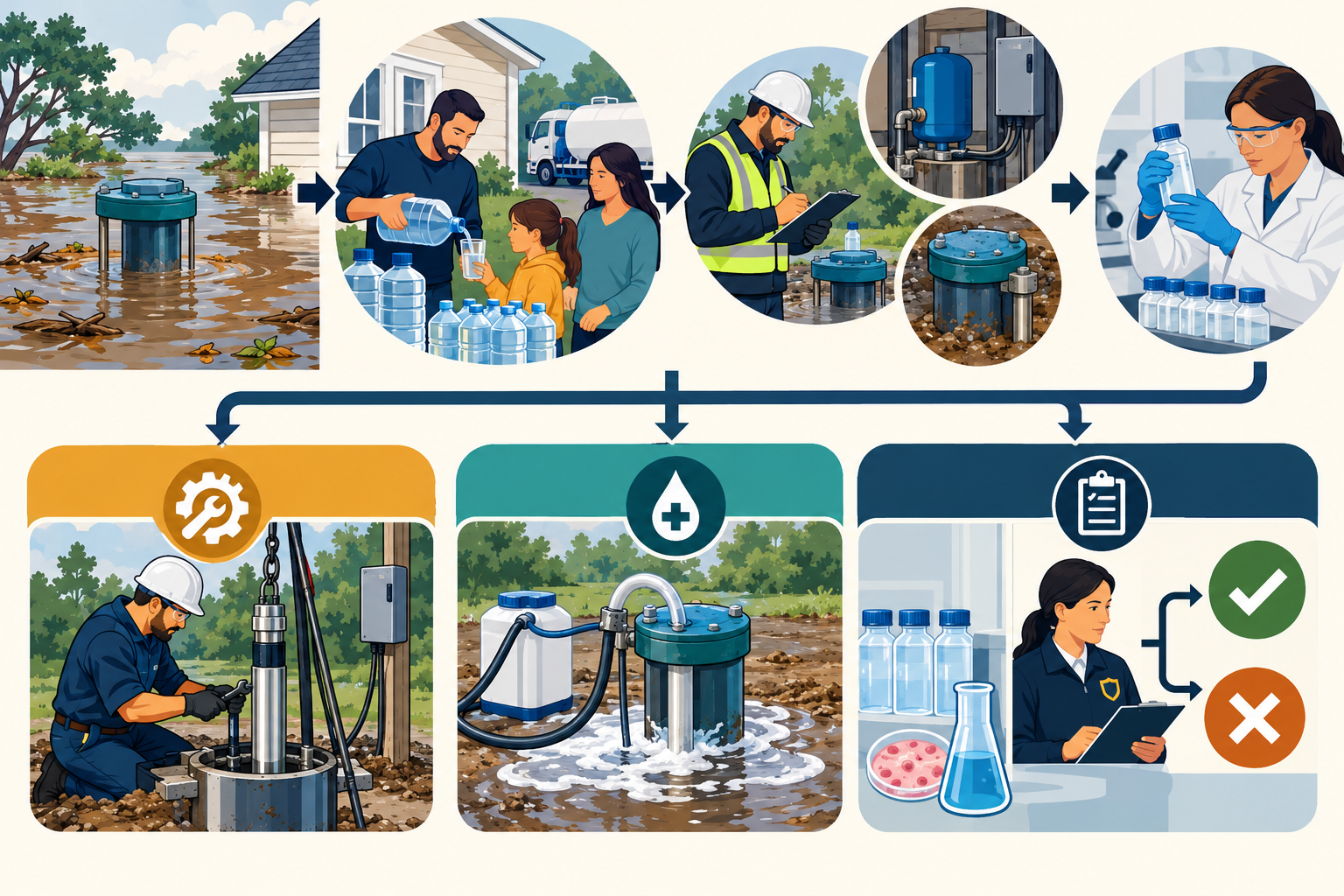
Keep water use and equipment decisions with local authorities
If floodwater reached the well or its equipment, use current local public-health advice about drinking, cooking, bathing, and other uses. Health Canada advises owners not to use flooded-well water and not to turn on a wet pump until a licensed well contractor has assessed the well and wiring. EPA likewise organizes post-flood response around inspecting the well and pump, considering disinfection, and sampling/testing. Those sources describe response priorities; the responsible local authority and qualified provider determine what applies to the property.
Do not use a clear appearance, lack of odor, or one negative result as automatic clearance. Floodwater can introduce microbial contamination and may carry fuel, pesticides, chemicals, or other local contaminants. Disinfection addresses a microbial concern when the authority or qualified provider directs it; it does not establish that chemical contamination is absent or repair a compromised wellhead.
Budget the first decisions separately
The first decision is the safe interim supply. Bottled water, delivered water, a temporary tank, or another source may be needed while the well is assessed and water use is restricted. Price the quantity, delivery, storage, duration, and which household uses the authority has restricted. There is no supported national temporary-water price for this event.
The initial professional visit is a separate line. Ask whether it covers a well and pump inspection, assessment of the wellhead and site drainage, wiring or electrical condition, review of recent service records, and a written list of what remains unknown. An inspection may find visible or accessible damage, but it does not automatically test water or establish the condition of every buried component.
The water-quality scope is another decision. Ask who selects the sample locations and analytes, who collects and transports the sample, which laboratory performs the work, what the report includes, and whether an interpretation or repeat sample is priced. The test plan should follow event conditions and local advice; there is no universal post-flood panel.
Cost components that may enter a recovery quote
Flood recovery is a decision sequence rather than a fixed package. The table shows some published local component estimates to help frame questions. They are not flood-specific bids and should not be added together as a national recovery total.
| Component example | Published planning context |
|---|---|
| Pump/flow-rate check | Massachusetts state program-planning report: about $150–$350 USD |
| Professional well evaluation with sampling | Massachusetts report: about $350–$500 USD; a camera inspection or evaluation with sampling is listed at about $450–$700 USD |
| Well cap or sanitary seal | Massachusetts report: about $75–$250 USD |
| Full wellhead assembly | Massachusetts report: about $500–$1,500 USD |
| Pump replacement | Massachusetts report: about $3,000–$5,000 USD |
| Professional disinfection service | Massachusetts report: about $400–$650 USD for advanced professional service |
| Inspection and water-quality test | Ontario service-cost guide: about $300–$600 CAD |
| Pump replacement | Ontario service-cost guide: about $1,500–$4,000 CAD |
The Massachusetts Department of Environmental Protection report gathers cost inputs for a proposed state program; these are local planning estimates assembled from service and market research, not contractor quotes. The Ontario amounts are a third-party regional planning guide, not a quote and not an event-recovery price. Neither source prices temporary water, the actual flood damage, chemical testing, repeat visits, or a complete recovery scope. Get local written estimates in the correct currency and keep Canadian and U.S. markets separate.
Build a staged household estimate
Write the estimate in the order costs become knowable. First estimate how long temporary water might be needed while the authority and contractor set the next steps. Then get the inspection scope and any sampling quote, with each analyte and collection fee visible. Price repairs only after the provider identifies the affected part; separate a cap or seal repair from pump replacement, casing work, electrical work, or treatment-system reconnection. Add the follow-up sample or visit required by the actual plan.
For each stage, record the quoted amount, assumptions, exclusions, and what finding would change it. A contingency is more useful when it names the uncertainty—such as inaccessible equipment, uncertain pump condition, or a second sample—than when it is a blind percentage. Keep any future flood-protection work in another column so the immediate recovery total remains comparable.
How the recovery scope can branch
Water contacted the well, but no physical fault is found. The quote may center on assessment, event-selected testing, professional disinfection if directed, and follow-up testing. Confirm whether lab fees, sample pickup, temporary water, flushing/service, and a second result are included or separate.
The wellhead, casing, pump, or controls were damaged. Repair can add cap or seal work, wellhead reconstruction, a pump pull, electrical assessment by a qualified trade, or restoration around the well. Price the confirmed defect and identify what cannot be known until access or equipment is opened. An accessible cap repair is a different project from a damaged casing or pump replacement.
The test or inspection leaves a contamination question unresolved. Further sampling, source investigation, treatment design, or an alternate supply may be considered with local authorities and qualified professionals. A bacteria result does not answer every chemical question, and installing a generic filter does not prove that the event-related concern has been addressed.
The source repeatedly floods or cannot be restored economically. A new location, changed well construction, or another water source may enter the comparison. Repeated flood protection or relocation is a separate future project, subject to site conditions and local rules. Keep that preventive work separate from the immediate recovery budget.
Compare complete quotes without double-counting
Two contractors may bundle inspection, sample collection, disinfection, flushing, or return visits differently. Normalize the quote so the household can see:
- assessment, callout, travel, and after-hours charges;
- sample collection, each laboratory panel, result interpretation, and repeat testing;
- temporary water and how long it is included;
- repair parts, pump or treatment-equipment removal/reconnection, and qualified electrical work;
- professional disinfection only if indicated, plus the associated service and follow-up;
- site access, excavation, discharge, cleanup, and surface restoration;
- exclusions, allowances, stop points, and the price of a second visit.
Ask whether the company has counted one bundled sample or visit again as a separate line. Also ask what a price includes if the well is deeper, more damaged, or harder to access than expected. A low first invoice may be only the assessment stage, not the cost of restoring service.
Keep disinfection and treatment in their own roles
Disinfection can be part of a response to microbial contamination or certain repairs, but it does not repair a failed cap, casing, drainage path, or pump. It also does not clear fuel or other chemical contamination. If a result is positive for bacteria, the bacteria-response guide and professional disinfection guide explain those narrower decisions. If treatment becomes a continuing need, use the treatment-system cost guide after the result and water-use objective are understood.
The return-to-use decision should come from the applicable authority and the qualified people responsible for inspection, repair, sampling, and interpretation. One negative test is not a universal promise of lasting safety, especially when a source pathway remains or follow-up has been directed.
Records make the next decision cheaper
Keep the flood date, water level around the well, photographs of visible damage, pump and pressure symptoms, contractor findings, sample points, lab reports, repairs, disinfection record, and follow-up decisions together. Include the well log, pump model, pressure equipment, and past test history if available. These records help a later provider distinguish a new condition from unresolved damage and reduce repeated diagnostic work.
Before closing the project, ask for the work performed, replaced components, any test result, remaining uncertainty, and the authority or provider’s next step. If the well cannot be returned to service, record what temporary supply is arranged and what replacement or source options remain. The recovery budget is complete when the household knows what was repaired, what was tested, and who determines the next water-use decision—not merely when a contractor leaves.
Keep wider loss questions separate
Whole-property flood cleanup, insurance claims, and general disaster assistance are outside this water-system cost guide. If help with eligible well work may be available, confirm it with the current program administrator before treating it as a budget offset; the private-well assistance guide explains the difference between a full quote, eligible work, an award, and cash needed. The immediate safe-water decision and professional assessment should follow local advice independently of funding research.
For a distinct fire event, use the private-well wildfire recovery guide. The symptoms and possible testing questions overlap in places, but the damage and quote should be tied to the event that actually affected the property.