
PFAS treatment is a changing, compound-specific, test-first decision. Current evidence identifies activated carbon, anion exchange, and RO contexts, but efficacy varies with the PFAS compound, concentration, water chemistry, equipment, and operating conditions. Health Canada’s material is draft consultation guidance, not a universal product list or price source. Use current federal, state, provincial, or local authority guidance for the actual result.
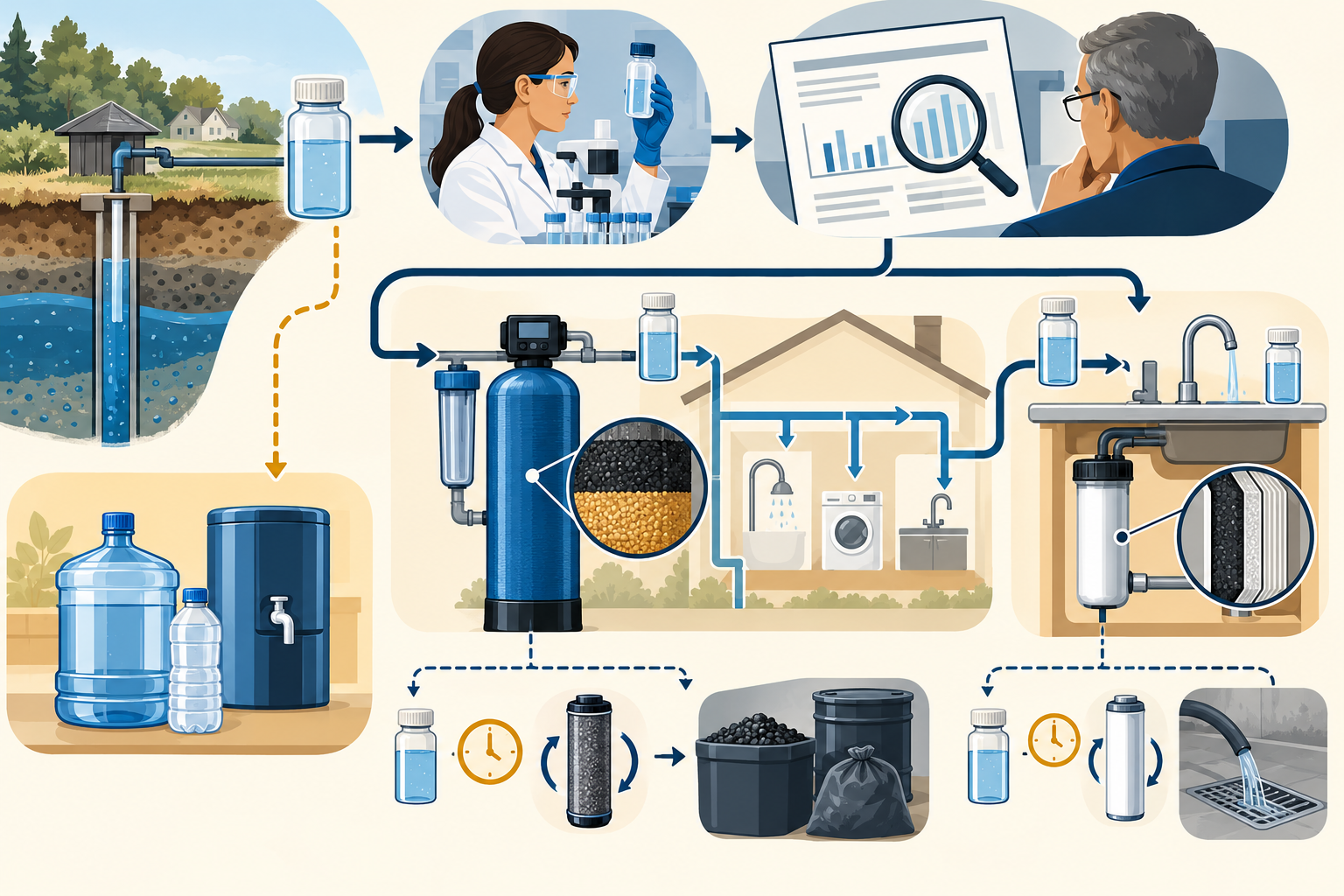
Confirm the test and the decision context
PFAS testing can be more specialized and expensive than a routine well panel. Confirm the laboratory, analytes, detection limits, sample point, and interpretation with the responsible authority. A positive screen should not be turned into a treatment purchase without understanding what was measured and what decision the result supports.
Changing U.S. rules apply to public systems
As of October 12, 2026, EPA’s October 8 rulemaking page still describes its May 2026 PFAS actions as proposals. One proposal would keep the existing PFOA and PFOS limits for covered public drinking-water systems while allowing eligible systems to seek more time; a separate proposal would rescind regulations for PFHxS, PFNA, HFPO-DA, and specified mixtures. The PFOA/PFOS comment period has closed, but the page still labels the action proposed. These public-system rules do not create a private-well compliance duty, household health threshold, or treatment design. Private-well owners should follow current state or local advice and recheck the EPA status if using this regulatory context later.
An authority may also help with source investigation, interim water decisions, or alternate supply. Do not assume that a deeper well or an existing carbon filter solves the problem; any changed source still needs testing.
Main residential treatment paths
Activated carbon or granular activated carbon can be used in some applications; anion exchange and RO can also be considered depending on the compound and water conditions. Health Canada evidence emphasizes that residential treatment may reduce a limited number of PFAS and that efficacy varies. The exact certification or verified performance claim matters more than the technology name.
Point-of-use treatment may limit the treated volume to drinking and cooking outlets. Whole-home treatment handles incoming water and can be appropriate for a broader exposure objective or authority-directed scope, but it increases flow, plumbing, pretreatment, maintenance, and verification requirements.
Installed cost structure
Budget for PFAS laboratory testing, design, the treatment unit, pretreatment, storage, plumbing, electrical work, flow controls, drain or reject handling, installation, commissioning, and treated-water testing. A current US specialist orientation for installed RO is around $1,000–$4,800, but that does not price PFAS treatment, carbon or ion-exchange systems, or Canadian installation.
Whole-home systems can require larger media vessels, valves, backwash or service space, and a plan for exhausted media. POU systems may need a dedicated faucet, storage tank, drain, and replacement cartridges. The correct cost comparison includes the same target outlets and certification boundary.
Certification and media exhaustion
NSF explains that certification is not a ranking and does not mean a product reduces every contaminant. Check the exact PFAS claim, compound coverage, capacity, flow, influent conditions, and replacement requirement. A marketing claim for “PFAS reduction” without a defined test and product scope is not enough for a health-sensitive purchase.
Media exhaustion can occur before the household notices a taste change. Budget replacement, service, monitoring, and periodic inlet/outlet testing. Ask how the provider determines exhaustion and what happens to spent media or resin.
Residuals and alternate supply
Treatment creates residuals: spent carbon or resin, reject water from RO, cleaning water, or other waste streams. Disposal and discharge requirements are local and system-specific. Do not route a reject or backwash stream into a septic or surface-water system without confirming the appropriate design and authority requirements.
An alternate drinking-water supply may be part of the comparison while treatment is designed, verified, or maintained. Include its recurring cost and convenience, but do not present it as a universal health recommendation.
Three scenarios
Defined POU treatment: A confirmed result, limited outlets, exact certified claim, and practical replacement and testing plan. Lower treated volume can lower the installed and operating cost.
Whole-home treatment: A broader water-use objective requires POE. The budget is dominated by flow, media capacity, plumbing, pretreatment, service, residuals, and verification.
Evolving or uncertain evidence: The authority or professional needs more testing, current certification information, or an interim supply before selection. Deferring equipment is safer than buying an unverified device.
Quote questions
- Which PFAS compounds and concentrations were measured?
- What current authority guidance applies to this property?
- What exact certified or verified reduction claim applies?
- Is the scope POU, POE, or mixed, and which outlets are covered?
- What pretreatment, flow, plumbing, power, drain, residual, and access assumptions apply?
- How are exhaustion, replacement, spent media, reject water, and testing handled?
- What is the five- or ten-year ownership cost?
PFAS status and certified product availability can change. Obtain current local US or Canadian guidance and pricing rather than converting a US figure. The sound decision is a verified treatment boundary with a credible maintenance and residuals plan, not the lowest first-year total.
Treat certification as a scope, not a logo
Ask for the exact PFAS compounds covered, test conditions, capacity, flow, influent assumptions, and replacement trigger. NSF explains that certification is not a ranking and does not mean a device reduces every contaminant. The words “carbon,” “RO,” or “PFAS filter” do not establish performance for the result in your report.
The provider should also identify how samples will be taken at the inlet and outlet and who interprets them. If media exhaustion is not visible from taste or appearance, monitoring and scheduled testing become part of the treatment cost. Store the result, model, lot or media information, service record, and test history for future decisions or property sale.
Compare treatment with alternate supply
An alternate drinking-water supply may be the practical bridge while testing, authority review, or equipment procurement occurs. Over a longer period, compare its recurring delivery or purchase cost and inconvenience with treatment, maintenance, residual handling, and verification. A treatment train can be economical, but only when the certified target and maintenance responsibilities remain clear as the evidence and household use evolve.
Build an evidence-and-service record
Keep the laboratory report, authority correspondence, exact equipment and media, certification claim, installation conditions, inlet and outlet results, replacement dates, and disposal records. PFAS guidance and product availability can change; the record prevents a future provider from treating an old marketing label as current proof. It also lets the owner compare recurring treatment with an alternate supply using real consumption and service data.
Decide what the first quote is allowed to decide
A first proposal should not silently lock the owner into a permanent whole-house system before the result, exposure boundary, and service path are understood. It can price temporary water, confirmatory sampling, a design visit, and an initial treatment option separately. If the household only needs protected drinking and cooking water, a point-of-use comparison may be sensible while the owner investigates a broader source or plumbing response. If all fixtures are part of the concern, the quote must show why whole-house treatment is needed and what flow it must handle.
The useful decision is not simply whether a device is available. It is whether the proposed claim, capacity, certification, maintenance, residual handling, and follow-up testing remain credible for the actual property. Put those conditions in writing before comparing equipment totals.