
A current US specialist orientation places installed well-water treatment around $1,200–$3,600, with an average near $2,300. That range is useful only as broad market context. Treatment can be a single device or a multi-stage system, and the cost is controlled by the tested contaminant, concentration, flow, demand, plumbing, electrical work, pretreatment, verification, and ongoing consumables. It is not a Canada benchmark and does not establish that any device will work for your water.
Why there is no single well-water filter
Well water can have a health-sensitive contaminant, an aesthetic problem, a sediment problem, a corrosivity problem, or a pump/source issue. A softener, sediment filter, UV unit, carbon or media filter, and reverse-osmosis system address different objectives. NSF notes that certification is not a ranking and does not mean a product reduces every contaminant; the specific certified reduction claim must match the actual problem.
Start with a laboratory result and source investigation. Health Canada recommends correcting a contamination source where possible, then matching point-of-use or point-of-entry treatment to the contaminant and exposure. The same principle applies to ordinary staining or odor: test before buying a system.
Source correction versus downstream treatment
Treatment may be the wrong first expense if the wellhead is damaged, surface water enters, the casing is compromised, a pump is failing, or a source condition can be corrected. A device can improve water at the tap while the underlying pathway continues to contaminate the system.
Source correction can require a wellhead repair, rehabilitation, disinfection, drainage work, or a new source. Downstream treatment is more appropriate when the source cannot be changed economically or the tested water needs a controlled treatment barrier. The quote should state which problem each line addresses.
Single-stage and treatment-train projects
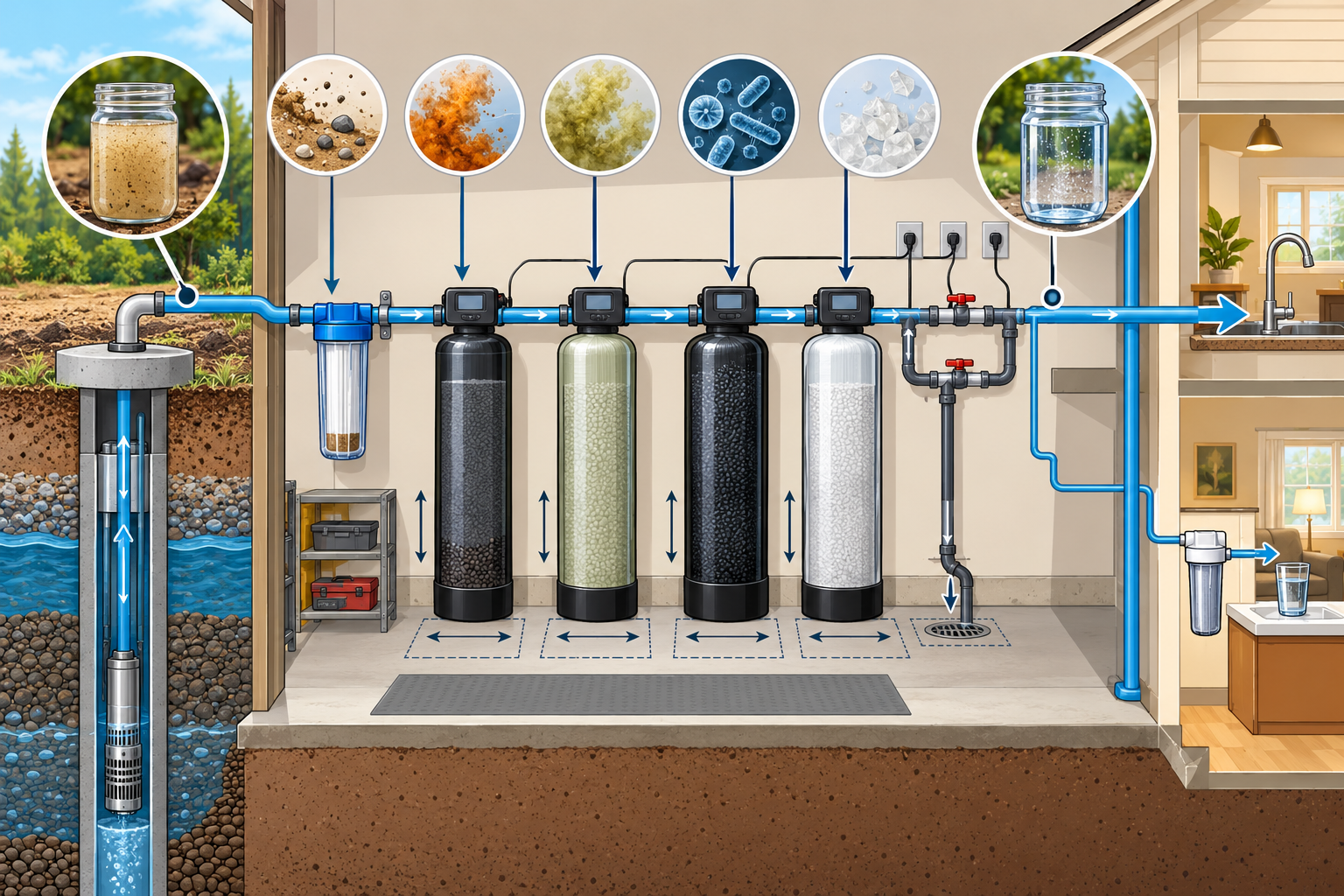
A simple system may have one tested objective and one compatible device. A treatment train may combine sediment pretreatment, oxidation or media, softening, UV, carbon, RO, or other stages. Each stage adds equipment, pressure loss, controls, space, bypasses, plumbing, maintenance, and possible failure points.
More stages are not automatically better. They may be necessary for the chemistry and flow, or they may reflect an unverified sales package. Ask what result requires each stage, what would happen without it, and which performance or certification claim supports it.
Main cost drivers
- contaminant and concentration;
- raw-water chemistry and pretreatment;
- flow rate and peak household demand;
- point-of-use versus whole-home scope;
- number of treatment stages and control valves;
- available space, drain, plumbing, and electrical supply;
- storage or booster requirements;
- testing before and after installation;
- access, labor, travel, and local market;
- filters, salt, media, lamps, membranes, electricity, and service.
Flow is especially important. A device sized for one drinking-water tap is not automatically suitable for the whole house. A treatment system can reduce pressure or need backwashing, reject water, drain connections, or continuous power.
Three project cases
Focused point-of-use: A tested drinking-water objective is treated at one or a few outlets. The budget includes the device, installation, filters, storage or drain connection, and verification.
Whole-home treatment: All water entering the home is treated because the objective affects multiple uses, plumbing, appliances, or the selected exposure boundary. The budget includes flow capacity, pretreatment, bypasses, electrical, drain, and larger consumables.
Complex train: Several chemistry or microbial issues require staged treatment and ongoing monitoring. The installation and lifecycle costs can exceed a simple system by multiples because every stage has its own equipment and maintenance.
Installation and verification
Plumbing changes, a drain or reject connection, a dedicated circuit, a treatment bypass, floor drainage, structural support, excavation, freeze protection, or a booster pump can sit outside a product-only quote. Ask where the system is installed relative to the pressure tank and service line and which fixtures receive treated water.
Test the inlet and outlet when the contaminant or treatment makes verification important. A product label or generic standard does not prove the actual installed system performs under your water chemistry and flow. Certification needs to match the specific contaminant and claim.
When a result raises a radiological question
Radiological treatment should follow an interpreted test result rather than a generic filter package. Health Canada’s drinking-water guidance uses gross alpha and gross beta as screening measures, with radionuclide-specific follow-up when indicated; a screening result does not automatically establish that an individual radionuclide guideline has been exceeded. For a Canadian well, discuss the result and follow-up with the provincial or territorial authority or a qualified laboratory before sizing equipment. The appropriate treatment location and technology depend on the radionuclide, concentration, water chemistry, flow, and the household’s exposure objective. Health Canada describes residential point-of-use and point-of-entry options, which may include reverse osmosis or ion exchange, but no one device is a universal radiological solution. Confirm that the selected product’s tested or certified claim matches the radionuclide and conditions, then plan inlet and treated-water verification. Ask the provider and local authority how spent media, reject water, or other residuals should be handled where relevant.
Radon in well water has a separate exposure boundary
Radon released from well water can contribute to indoor air, but EPA says soil entry is the larger indoor source in most cases. An indoor-air result alone does not establish that the well is the source; measuring indoor air and well water can help distinguish the paths. For a demonstrated radon-in-water concern, EPA describes point-of-entry aeration or granular activated carbon (GAC). Point-of-use treatment covers only a small share of household water and does not address inhalation exposure from radon released during other water uses. EPA describes GAC as generally less costly than aeration, while warning that radioactive material can accumulate and may require special handling or disposal. This 2016 U.S. guide provides relative tradeoffs, not a current installed price or a Canadian recommendation; consult the local radiation-control or drinking-water authority and a qualified provider.
Lifecycle cost
Use a five- or ten-year view. Include consumables, salt or media, lamp and sleeve work, membranes, service visits, electricity, water sent to drain, testing, and eventual equipment replacement. A cheaper system with frequent media or difficult service may cost more than a higher-priced system with a clearer maintenance plan.
Quote normalization
Ask every bidder for raw-water results, target contaminants, flow and demand assumptions, exact equipment, treatment stages, certified claims, installation scope, electrical and plumbing work, testing, warranty, maintenance interval, consumable price, and exclusions. Separate required treatment from optional taste or convenience upgrades.
US and Canada
US market orientation can show order of magnitude but should not be converted into CAD. Canadian equipment availability, labor, water-quality guidance, and local authority requirements vary. Obtain local pricing and verify the current provincial or territorial context before treating a proposal as complete.
The sound treatment budget is the one that explains why each stage exists, what result will verify it, and how much it will cost to own—not the one with the most filter housings.
Ask for a treatment map
Require the proposal to map raw-water result → treatment stage → treated outlet → verification method. For example, a sediment stage may protect UV or RO, while a softener may address hardness and a separate stage addresses a different result. This mapping exposes redundant equipment and makes it clear which failure leaves which use untreated.
Ask what happens if the raw water changes, flow increases, power fails, or a filter is exhausted. A complete design includes bypass and service access, but bypass is not permission to ignore a health-sensitive result; it is a condition that needs a safe operating plan. Include alarms, sampling points, and the replacement decision in the ownership budget.
Choose the smallest complete system
The smallest responsible system is not necessarily the fewest stages. It is the smallest design that matches the tested contaminants, required flow, treated outlets, certification, pretreatment, and verification. A larger system can be wasteful when it treats water that does not need it. A smaller product can be false economy when it clogs, loses pressure, lacks the right certification, or cannot be maintained locally.
For a long ownership horizon, price service availability and consumables before accepting a discounted installation. For a short horizon, avoid discretionary upgrades but retain required testing, plumbing, electrical, and safety work. The useful quote makes those choices visible instead of hiding them in one equipment allowance.
Price the handoff and failure response
The treatment project should include an operating handoff, not just installation. Ask for the raw-water result, each stage’s purpose, sample points, bypass conditions, alarm or exhaustion signal, maintenance schedule, and the provider responsible for commissioning. If the system is out of service, the household needs a clear temporary-water or authority-directed response rather than an assumption that a bypass is always safe.
The cost comparison should also include what happens when the raw water changes or a downstream stage fails. A new well, flood, casing repair, pump change, higher demand, or a treatment bypass can alter the design load. Include a reserve for testing and redesign where the consequence of an incorrect treatment claim is material. A lower number is not a complete quote if it cannot explain how performance will be checked after installation.
Read the proposal as a treatment map
The proposal should trace water from the well to each important outlet: raw-water sample, pretreatment, main treatment stages, storage or pressure equipment, bypass, treated-water sample, drain, and discharge. This exposes dependencies that an equipment list hides. A sediment filter may protect a UV unit or membrane; a pressure change may affect a softener or fixture; a bypass may leave the household without the intended protection.
Ask what happens when one stage is unavailable. The answer may be a safe temporary supply, a qualified bypass, or no use until service and testing are complete. Include that downtime and the cost of replacement media in the ownership comparison. A complete system is one the owner can operate and verify over time, not merely one that fits on installation day.