
After a serious home loss, the first quote is rarely the final project cost. A damaged home may need temporary protection, source control, water removal, drying, contents handling, selective demolition, cleaning, specialty remediation, reconstruction, and temporary housing. Some of those scopes happen together; others cannot be priced responsibly until hidden conditions are understood.
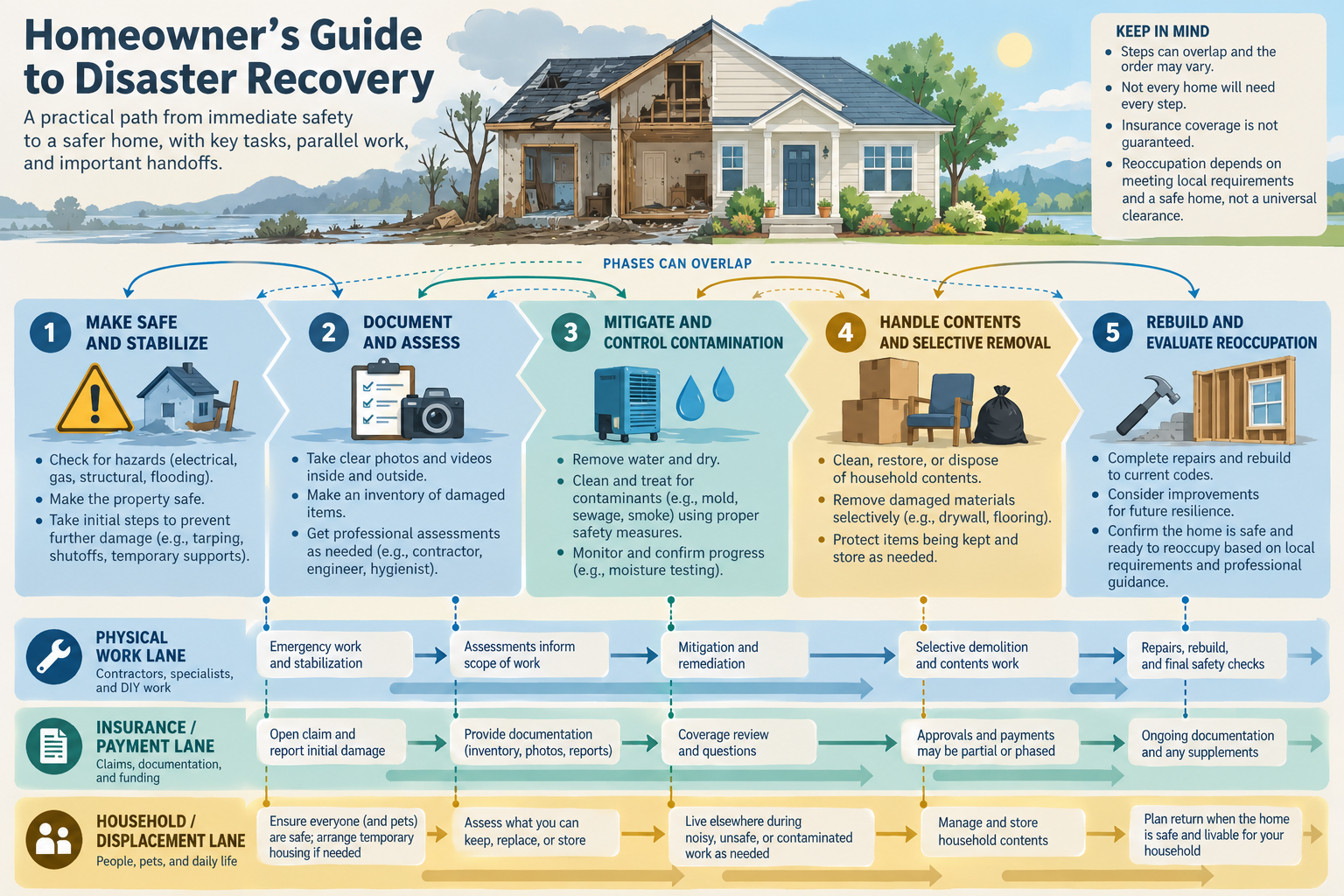
Phase 1: Make the site safe and stabilize it
Do not treat a damaged building as ready for normal entry. Fire, flood, sewage, structural movement, gas, electrical damage, smoke, and carbon-monoxide hazards can change what is safe. If an area is unsafe, leave it and use the appropriate emergency or qualified professional response. Temporary board-up, roof tarping, or opening protection may limit additional damage, but it is not permanent repair.
The first cost question is therefore not simply “what is the repair price?” It is “what must happen now to prevent a larger loss, and who is qualified to do it?”
Phase 2: Document and assess
When it is safe, photograph and video the conditions before items are moved or removed. Record the apparent source, affected rooms, visible damage, contents, temporary work, and expenses. Notify the insurer promptly when a claim may be involved, and keep receipts and copies of estimates.
An initial assessment should distinguish the event from its consequences. For example, a failed supply pipe is a plumbing repair; wet drywall, damaged flooring, saturated insulation, contents, and drying are restoration scopes. A roof opening is a stabilization problem; the permanent roof assembly may be a later roofing project.
Phase 3: Mitigate and control contamination
Mitigation limits continuing damage. Depending on the loss, it can include extraction, moisture mapping, air movement, dehumidification, cleaning, containment, controlled removal, and monitoring. Floodwater and sewage may add contamination and disposal concerns. Fire losses may add smoke, soot, firefighting water, odor, and HVAC assessment.
Rapid drying can reduce mould risk, but it does not guarantee that mould will not develop. Hidden cavities, wet insulation, contaminated materials, and affected air-distribution systems require a scope decision rather than a promise that fans alone will solve the problem.
Phase 4: Handle contents and selective removal
Some belongings can be cleaned or restored. Others may be too contaminated, porous, damaged, or costly to treat. Inventory, photographs, packing, transport, storage, specialty cleaning, disposal, and replacement decisions can become separate cost centers. Sentimental value can make a purely replacement-cost comparison inadequate.
Selective demolition may expose more damage, but removing material is not the same as rebuilding it. Ask which materials are being removed, why, how the decision was documented, and which later estimate includes replacement.
Phase 5: Rebuild and evaluate reoccupation
Reconstruction may include framing, insulation, drywall, finishes, cabinetry, fixtures, and reconnection of building systems. Permits, inspections, current-code work, specialty materials, access, and hidden conditions can change the scope. Flooded electrical equipment, private wells, appliances, HVAC systems, and structurally affected areas need the appropriate qualified inspection before use.
Reoccupation is not proved by a drying invoice or a contractor’s general assurance. Health, building, electrical, HVAC, and local-authority considerations may all matter.
How insurance may intersect
An insurer, adjuster, restoration company, reconstruction contractor, and homeowner may each describe only part of the loss. An insurer may separate structure, contents, and additional living expenses. A policy may have deductibles, limits, exclusions, endorsements, or valuation conditions that do not match the physical scope of the work.
Ask each party to identify what is included, what is excluded, what is temporary, what is permanent, and what remains subject to a later decision. Do not assume that an estimate is a coverage decision or that coverage is a guarantee of payment.
Keep the recovery decisions separate
One total cannot answer every question after a loss. Keep the physical condition and required work separate from the restoration or reconstruction scope, the contractor’s price, the insurer’s valuation and coverage decision, payment timing, homeowner-selected improvements, and household displacement or contents costs. A restoration contractor can explain the work needed to manage the observed condition. A reconstruction contractor can explain the work needed to restore the defined building scope. An adjuster or insurer addresses policy and payment questions; a building official or qualified specialist addresses the decisions within that authority.
This separation also explains why two estimates can both be useful but have different totals. One may authorize only emergency protection or mitigation; another may price rebuilding after demolition exposes the assemblies. A contents or temporary-housing budget may sit outside both building estimates. Compare the affected locations, phase, starting and ending condition, assumptions, exclusions, and contingencies before treating either total as the whole recovery cost.
What drives the total restoration cost
Total cost usually grows with the extent and duration of exposure, contamination, hidden cavities or assemblies, access, emergency timing, selective demolition and disposal, contents handling, specialist assessment, the permanent finish being restored, permits or inspections where applicable, and the time the household must function around the work. These are conditional cost drivers, not an automatic checklist for every loss. For example, a modest source repair can still lead to a larger restoration project if water or smoke reached several rooms, stored belongings, or concealed building materials.
Before authorizing the next phase
For urgent work, limit the authorization to the stabilization or mitigation actually needed now. Before a broader phase begins, keep a written scope, photographs or condition records where safe, itemized estimate, exclusions, price basis, approval path for newly discovered conditions, and the expected handoff record. Confirm who is responsible for source repair, contents, specialty assessment, reconstruction, permits or inspections where applicable, and communication with the insurer. This does not resolve coverage, but it makes a later scope, supplement, or change order easier to understand and compare.
Three budgets that are easy to confuse
A useful recovery budget usually has at least three parallel views. The first is the physical work: what must be stabilized, dried, cleaned, removed, repaired, or rebuilt. The second is the payment view: deductible, limits, valuation, endorsements, exclusions, and the timing of any insurer payment. The third is the household view: temporary lodging, meals that cost more than normal, transportation, storage, lost access to rooms, and the effort of managing the project.
These views overlap but do not answer the same question. A contractor can price work without knowing what a policy recognizes. An adjuster can discuss a claim without determining whether a wall cavity is dry or whether a structure is safe to occupy. A household can incur storage or temporary-living costs before the final reconstruction scope is known. Keeping the three views separate makes a disagreement easier to locate.
Why the scope grows after the first visit
The first visit often occurs when the building is wet, smoky, inaccessible, or partly covered by temporary protection. Later work can reveal concealed moisture, damaged insulation, corroded components, residue in air pathways, unstable framing, or contents that need specialist handling. A larger estimate is not automatically proof that the first contractor was careless, but it should explain what new condition caused the change.
Ask for a dated record of the discovery, the affected room or assembly, the evidence supporting the change, and the proposed remedy. The record should identify whether the added work is emergency mitigation, demolition, cleaning, reconstruction, code compliance, a voluntary improvement, or an unresolved allowance. This prevents every new line from being described vaguely as “additional damage.”
When different specialists become reasonable
A larger loss may involve a restoration firm, plumber, roofer, electrician, HVAC professional, structural professional, environmental specialist, contents restorer, reconstruction contractor, designer, building official, and insurer. More participants do not necessarily mean the project is being duplicated. They may own different decisions.
For example, a plumber can stop a leak, a restoration company can manage wet assemblies, an HVAC professional can assess a contaminated air system, and a reconstruction contractor can replace the removed finishes. A building official decides local compliance questions; an insurer addresses policy and settlement questions. The homeowner should ask who is coordinating the handoff and what written record moves from one scope to the next.
A phase-by-phase authorization checklist
Before approving a phase, ask:
- What condition is present now, and what condition will exist when this phase ends?
- What rooms, assemblies, contents, and systems are included?
- What is temporary, and what is permanent?
- What is measured, what is assumed, and what cannot yet be inspected?
- What work is excluded or belongs to another trade?
- What event creates a supplement or change order?
- What record will document completion and the next handoff?
The goal is not to force a single contractor to perform every task. It is to make the recovery chain understandable. A homeowner can then compare the next estimate with the condition actually left by the previous phase, rather than comparing unrelated totals and guessing which one is complete.
Two handoffs deserve their own records: when an owner and renter share a flooded property’s recovery, separate the building, belongings, logistics, and displacement budgets in the rental-home guide; when an insurer-approved payment is not available for a scheduled repair, trace who holds it and what release conditions apply in the mortgage-proceeds guide.