
Water damage restoration can mean a short extraction and drying visit or a long project involving demolition, contents, mould response, and reconstruction. A price is useful only when you know which of those scopes it represents.
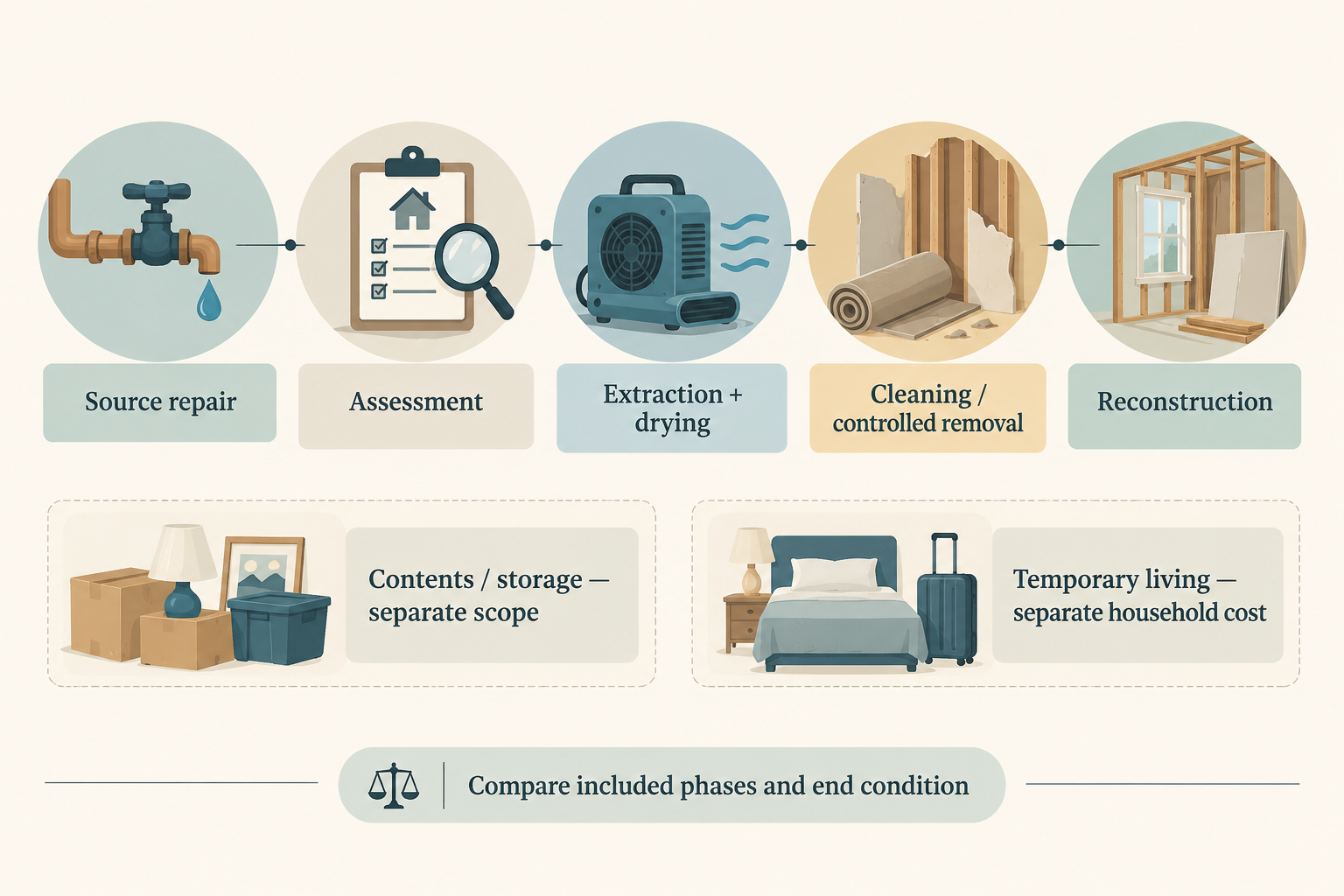
What a restoration scope may include
The early scope can include inspection, water removal, moisture mapping, air movement, dehumidification, monitoring, cleaning, controlled removal, disposal, and treatment of affected contents. The later scope may include drywall, insulation, flooring, cabinetry, trim, painting, or reconnection of systems. Repairing the source—such as a failed pipe or appliance—is a separate question.
One 2026 U.S. consumer-market guide reports a broad water-restoration observation of about $450–$16,000. That figure is a community market signal with uncertain inclusions. It is not a prediction for a particular house, a national average, a Canadian conversion, or an insurance settlement.
Why estimates vary
The largest drivers are the water source, contamination, volume and duration of the release, affected area, hidden cavities, material type, access, urgency, equipment duration, demolition, contents, and reconstruction finish. A small visible stain can conceal wet insulation or a wall cavity. A large but recent clean-water release may have a different scope from a smaller sewage or flood loss.
Rapid drying is a risk-reduction measure, not a guarantee. Health Canada says that drying wet furnishings and materials within about 48 hours makes mould less likely; it does not establish a universal drying deadline or prove that a structure is dry.
Compare the phases before comparing the totals
An estimate limited to mitigation may contain extraction, equipment, monitoring, cleaning, and selective removal. A reconstruction estimate may begin after the area is dry and the damaged materials are removed. Contents handling, storage, permits, code work, and temporary housing may be outside either document.
Ask for quantities, equipment duration, moisture records, demolition assumptions, disposal, cleaning, contents, reconstruction, taxes, permits, exclusions, and change-order conditions. A contractor may allocate a task differently from an adjuster without either document being a complete description of the whole recovery.
Compare quotes using the same five questions:
- Affected area: Which rooms, floors, cavities, materials, contents, and access areas were measured or assumed?
- Included phases: Does the number cover source control, mitigation, drying, removal, cleaning, contents, reconstruction, or only one phase?
- End condition: Is the handoff dry and ready for reconstruction, cleaned but unfinished, or a usable finished room?
- Documentation: Will the contractor provide moisture records, photographs, quantities, disposal records, and the assumptions behind any concealed work?
- Exclusions: Are finish restoration, trade coordination, permits, taxes, contents, storage, code work, source repair, or temporary living outside the total?
Two contractors can therefore give different but internally coherent numbers. One may stop after drying; another may coordinate drywall, flooring, cabinetry, paint, plumbing, electrical, or HVAC trades through a finished handoff. The comparison is meaningful only after the starting and ending conditions are aligned.
Safety and insurance boundaries
Do not treat a general water-loss article as permission to enter standing water, operate equipment in unsafe electrical conditions, clean sewage, or use a potentially contaminated HVAC system. Flooded or contaminated systems need the appropriate professional assessment.
An insurer’s scope and a restoration contractor’s scope answer different questions. Coverage depends on the policy, cause, exclusions, endorsements, limits, and jurisdiction. Keep the source repair, consequential restoration, contents, and permanent rebuild visible so you can ask the right party about each one.
A useful cost stack
Think of a water-loss budget as a conditional stack rather than one package:
- source control or emergency protection;
- inspection and moisture assessment;
- extraction and drying;
- cleaning or contamination control;
- controlled demolition and disposal;
- contents handling or storage;
- reconstruction and system reconnection; and
- temporary living or other displacement costs.
One loss may use only the first three layers. Another may require all of them, and a flood or sewage event may add specialized containment and disposal. Do not add every layer mechanically to an estimate. Use the observed condition, water source, material, and professional scope to decide which layer is real.
Clean water is not the same as a clean project
A sudden release from a supply line may begin with a comparatively lower-contamination source, but the restoration decision still depends on what the water contacted, how long it remained, and whether it reached soil, sewage, chemicals, or contaminated contents. Floodwater and sewage backup require a more conservative response. A source label alone is not a substitute for an onsite assessment.
Materials also behave differently. Hard, non-porous surfaces may be cleanable when the condition and contamination permit. Drywall, insulation, carpet pad, particleboard, and other porous assemblies may retain water or contamination and require removal. The quote should identify the material and the reason for cleaning, drying, or replacement rather than using a generic “water damage” allowance.
A broad range needs a scope beside it
A market range is useful only when the reader can tell which project it describes. A small, promptly discovered loss limited to one room may involve source repair, extraction, equipment, monitoring, and minor finish work. A larger loss can add several floors, concealed cavities, contents, controlled demolition, disposal, reconstruction, and temporary living. Those are not different prices for the same job; they are different scopes.
When an estimate gives a headline number, ask what condition it starts from and what condition it creates. “Water removed” is not the same as “structure dry.” “Drywall removed” is not the same as “room rebuilt.” “Cleaning included” may not include contents, HVAC, odor treatment, or disposal. The end condition matters as much as the total.
Compare three common project scenarios
In a localized clean-water loss, the source may be repaired quickly and the affected flooring or wall area may be dried in place. The main cost drivers are response time, access, equipment, monitoring, and whether the assembly can be restored without demolition.
In a delayed or multi-room loss, water may reach insulation, subfloors, cabinets, contents, or concealed cavities. The scope can include opening assemblies, removing materials that cannot be dried, disposing of debris, treating contents, and rebuilding finishes after mitigation. The loss may still have started as a simple supply-line failure.
In a contaminated or external-water loss, the source and exposure change the decision. Sewage, floodwater, chemicals, or unknown contamination can require a more conservative professional response, controlled access, specialized disposal, and separate insurance or public-health questions. The water-damage label alone cannot determine the correct scope.
What to compare in competing estimates
Put each estimate into the same sequence:
- source control and temporary protection;
- assessment and moisture mapping;
- extraction, equipment, and monitoring;
- cleaning, containment, demolition, and disposal;
- contents, storage, and specialty handling;
- reconstruction and system reconnection; and
- permits, inspections, taxes, supervision, and exclusions.
Then compare affected rooms, quantities, equipment duration, assumptions, and end condition. Ask whether a quantity is measured or an allowance, whether equipment is charged by day or by job, and whether monitoring visits are included. If demolition depends on what is found inside a wall, ask how the discovery will be documented and approved.
Insurance does not define the physical loss
Notify the insurer according to the actual policy, keep photographs and receipts when safe, and ask how the claim wants damaged contents and emergency work documented. A policy may treat structure, contents, additional living expenses, deductible, limits, endorsements, and valuation separately. The contractor’s scope describes physical work; it does not guarantee coverage.
The homeowner’s most useful question is often: “Which part of this number pays for the building to reach what condition, and which part is still unknown?” That question protects against both under-scoping and automatic additions. It also makes the later handoff to reconstruction, contents restoration, or a system-specific contractor easier to manage.
Small loss or complex loss?
The same source can create very different projects. A short, promptly discovered leak in an accessible room may need limited extraction and drying. The same leak discovered after a weekend may involve cabinets, insulation, subfloor, contents, odor, and temporary living. A loss in a finished basement, upper floor, crawl space, or occupied multi-unit setting adds access and coordination questions.
Ask which fact places the estimate in its current scenario. Is it the duration, the water path, the material, the contamination category, the amount of demolition, or the need for other trades? If that fact is uncertain, the quote should say how it will be checked and what change would follow. A conditional scope is more useful than a false precision that cannot survive the first opening.