
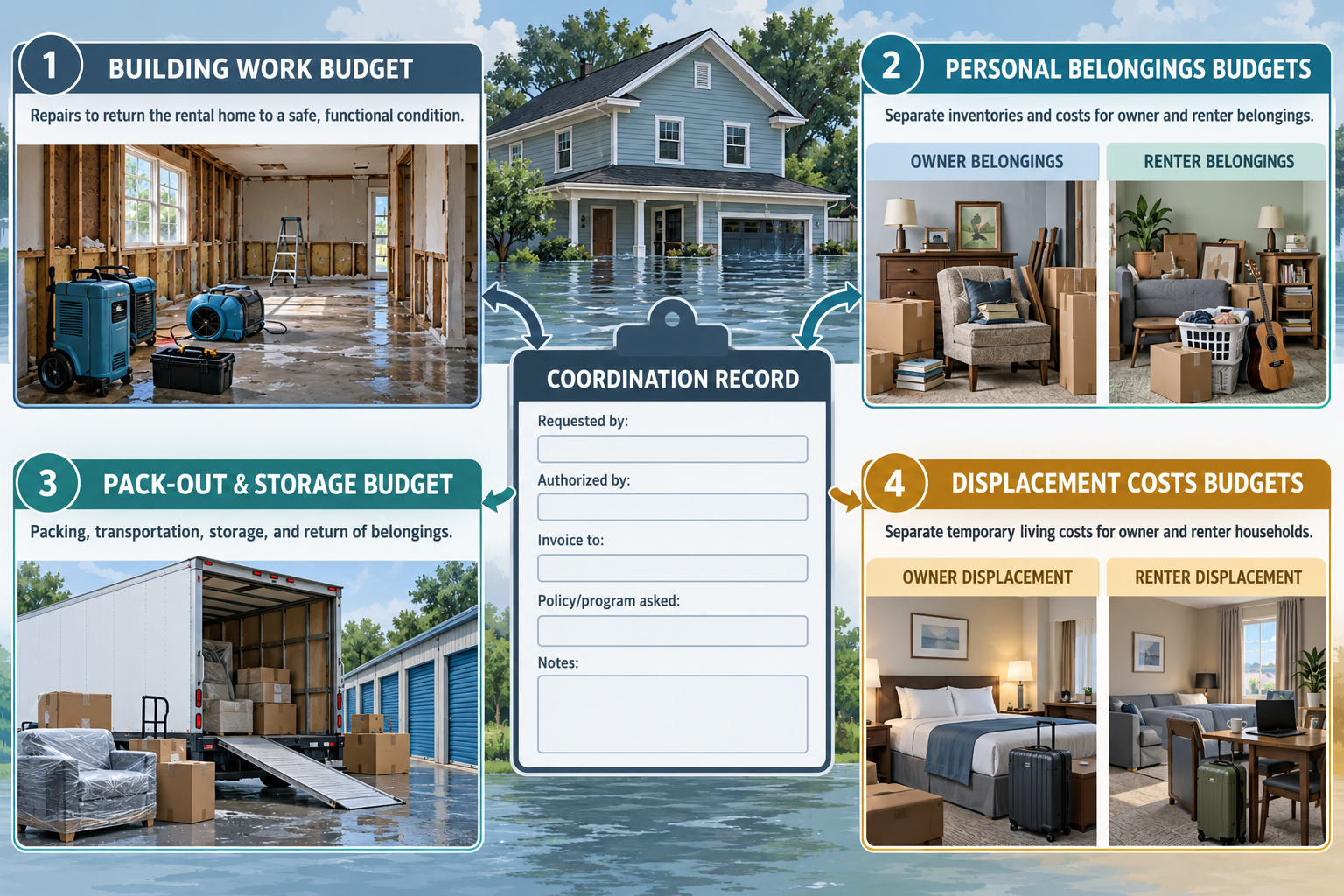
A flooded rental property can trigger four separate scopes: repairs to the building, damaged owner or renter belongings, pack-out and storage, and displacement. They may involve different people, contractors, policies, and invoices.
Coordinate who requests and authorizes each service, who receives the invoice, and which policy or program is being asked. Do not assume one policy, lease, contractor, or public program pays all costs. Local law, the lease, actual policy wording, and the flood facts determine many answers.
Start with safe access and a shared event record
Do not enter a structurally suspect or officially restricted building to photograph belongings or meet a contractor. Flood damage can involve unstable floors, electricity, gas, sewage, contaminated water, or damaged systems. Follow emergency instructions and wait for the relevant officials or qualified professionals to address entry conditions. A restoration estimate, landlord’s permission, insurance payment, or completed drying job is not an occupancy clearance.
Once access is considered safe, make a dated record of the event and the visible condition: affected rooms, water level if known, source information, damaged building areas, owner-supplied items, renter belongings, temporary work, and expenses. The owner and renter can coordinate a shared timeline and room map while keeping separate property inventories, policies, receipts, and claims. Share only the records needed to coordinate work or substantiate a particular claim.
If an item must be removed for health or safety, do not leave a dangerous condition in place solely to wait for an inspection. Record it first when safe, note who authorized disposal, and retain any inventory or contractor record. EPA’s flooded-home guidance for renters advises photographing belongings before disposal and discussing the rental agreement with the landlord; it does not determine claim acceptance or lease duties.
Separate four recovery budgets
| Budget | Typical scope to identify | Questions to settle before counting the amount |
|---|---|---|
| Building and installed property | Assessment, stabilization, extraction, cleaning, drying, demolition, systems, permits, and reconstruction | Who is commissioning the work? What areas and phases are included? Which building policy or code question remains open? |
| Belongings | Owner-supplied furniture or appliances and renter-owned clothing, furniture, electronics, documents, or other contents | Who owns each item? Is it damaged, salvageable, stored, discarded, or still being assessed? Which separate contents policy may apply? |
| Recovery logistics | Inventory, pack-out, transport, treatment, storage, retrieval, disposal, and pack-back | Which items require removal for access or treatment? What time period and return work are included? Could another estimate charge for the same handling? |
| Displacement | Temporary lodging and the household’s added food, laundry, travel, storage, pet, or accessibility needs | Which household incurred the expense? What normal costs continue? Is any insurance benefit or assistance route available, and when is it actually payable? |
These are accounting categories, not a legal allocation of responsibility. Record who owns, authorizes, and invoices each scope, then verify any disputed duty under the actual lease and local rules.
Coordinate each scope without assuming who pays
Use one coordination sheet for the building and separate records for each household’s belongings, housing expenses, and insurance inquiry. For every proposed task, record the affected room or item, the condition it addresses, the person or company requesting the work, the person who can authorize it, the invoice recipient, the expected end condition, and the payment source being investigated.
| Decision | Record | Confirm with the relevant parties |
|---|---|---|
| Building stabilization and repair | Photos, assessment, work area, contractor scope, price basis, and change-order assumptions | Owner or authorized manager, insurer, restoration and reconstruction contractors, and local officials as applicable |
| Owner-supplied property | Item list, ownership, condition, proposed treatment or replacement, and location | Owner, building insurer, contents provider, and any contractor handling the item |
| Renter belongings | Dated inventory, photographs, receipts or estimates, condition, and disposal or salvage decision | Renter, renter’s insurer, contents specialist, and landlord for access and coordination |
| Pack-out and storage | Item-level custody record, destination, duration, treatment, access charges, and pack-back | The person authorizing the service, the provider, and the insurer or program asked about the charge |
| Temporary housing | Dates, household members, ordinary expenses that continue, added costs, and receipts | Each affected household, its insurer, and any current assistance administrator |
The person who can authorize building work may not own every item or hold every relevant policy. Confirm access and authority before promising work or disposal. Resolve lease, rent, reimbursement, or return-date disputes with an appropriate local tenant or housing authority; this guide does not decide those rights.
The owner should define the building scope
The owner or authorized property manager should keep the building assessment and construction estimate separate from contents and household displacement. Ask the restoration company to identify the immediate stabilization, water removal, cleaning, drying, material removal, monitoring, disposal, and any later reconstruction. Ask what is still unknown behind walls or below floors and how new findings will be priced and approved.
The owner should contact the property insurer under the actual policy and ask how this event, building damage, owner-supplied contents, deductibles, limits, and any flood or sewer-backup wording are treated. A contractor can describe work and price a scope; the contractor cannot decide coverage. If the building is mortgaged and insurance proceeds are named to a lender or servicer, the separate guide to lender-controlled repair proceeds explains the cash-flow questions to ask.
Ask local building or floodplain officials about permit and compliance requirements before treating an allowance as mandatory. A waterline, estimate, or community risk rating does not decide whether a property meets a substantial-damage threshold. Permanent plumbing, structural, electrical, below-grade, and shared-property repairs may need other specialists.
The renter should document belongings and coverage separately
List each affected item or group, its owner, room, condition, exposure, and whether it was photographed, moved, treated, stored, discarded, or replaced. Preserve available ownership and value records. Keep owner-supplied furniture, appliances, fixtures, and renter property distinct so the same object is not counted twice.
Public Safety Canada’s flood-ready renter guidance says renters generally bear the loss of their belongings and that landlord insurance commonly protects the building and landlord property, not tenant contents. It recommends checking renter insurance for belongings and additional living expenses. These are broad consumer statements; confirm the actual lease, local rules, policy, and claim.
Ask the renter’s insurer whether the policy covers the event and cause of water, which belongings and limits apply, what documentation it needs, and whether temporary displacement benefits are available. Overland flood, sewer backup, and other water damage may be treated differently. Do not assume that a standard contents policy includes every flood peril, or that a building policy covers the renter’s personal property.
Treat pack-out and storage as their own line items
Pack-out can be needed to create safe work access, protect belongings from further damage, or send items for specialist treatment. Before removal, ask for a room-level inventory, photographs when safe, labeling and custody procedures, storage location and billing unit, minimum period, treatment charges, access or retrieval charges, disposal authorization, and the exact meaning of pack-back. Keep building demolition and contents handling distinct even when one contractor coordinates both.
Compare packing, transport, storage, treatment, disposal, and return separately. Storage is not the same expense as temporary housing; moving an item for demolition is not automatically a contents loss; and replacement does not automatically include storage. Ask each estimate to identify overlaps before adding totals.
Build a separate temporary-housing record for each household
Each displaced household should record when the home became unavailable, where members stayed, which ordinary costs continued, and what extra expenses were incurred. Lodging, meals, laundry, travel, storage, pets, accessibility, and work or school access help organize the budget, but an insurer or program decides what it recognizes.
An owner’s property policy and a renter’s policy are separate inquiries. In the United States, EPA says renters may apply for FEMA Rental Assistance; the current FEMA event and address rules determine whether a household can apply or qualify. EPA’s referral does not establish a declaration, eligibility, or award. In Canada, Public Safety Canada’s renter page directs people to their policy and provincial, territorial, or local sources; available assistance and eligibility depend on the jurisdiction and any activated program. Do not treat federal government-to-government disaster funding as a renter’s personal payment.
Keep ordinary housing costs separate from extra displacement costs. Track amounts requested, approved, issued, and received separately; do not count a reimbursement as deposit money until its timing and conditions are confirmed. For policy-based living costs, see additional living expenses during restoration.
Price the scopes without inventing a rental-home total
There is no single meaningful “flooded rental home” price to apply to every property. A shallow, promptly addressed event may produce a limited cleanup and drying scope; deeper or contaminated flooding can involve broader removal, contents losses, system assessment, reconstruction, storage, and months of displacement. Those amounts belong to different estimates, households, currencies, and possible payers.
Ask contractors to state the affected area, assumptions, included phase, quantities, labor and equipment basis, removal, contents handling, exclusions, and change-order triggers. Compare mitigation with mitigation, reconstruction with reconstruction, contents treatment with replacement, and each household’s added living costs with its own records. Do not convert U.S. observations to Canadian prices or combine separate invoices into a fictional average.
If insurance and confirmed assistance leave an actual repair gap, use the separate post-disaster funding guide to distinguish grants, loans, tax questions, and amounts still unfunded. A delayed or unissued payment, an owner/renter allocation dispute, and a permanent shortfall are different problems and should not be collapsed into one number.
Plan access, schedule, and the return-home handoff
Coordinate access, room closures, retrieval of belongings, utility restrictions, schedule changes, and unresolved decisions in writing. A landlord’s permission does not override safety instructions, and a contractor’s completion date is not occupancy clearance. Before regular use resumes, identify who addresses the applicable structural, electrical, HVAC, contamination, water, permit, and health questions. Close out with what was cleaned, removed, repaired, stored, and returned, who confirmed it, and which policy or lease questions remain open.
Questions to take to the owner, renter, insurer, and contractor
- Which rooms and systems are affected, and what safety or authority decision is pending?
- Who owns each damaged fixture, appliance, furnishing, and personal item?
- Who is commissioning each service, authorizing access or disposal, and receiving the invoice?
- Does each proposed estimate include building work, contents, transport, treatment, storage, or return?
- Which policy or program is being asked about, for which household and water cause, and when is any payment actually available?
- Which lease, local-rights, permit, shared-property, or reoccupation question needs a local authority or professional?
- What must be documented before the next contractor phase begins?
Keep physical scope, ownership, approval, invoice, and possible payment source separate throughout recovery; one party’s contract does not settle another household’s costs.