
Fire restoration begins after the flames are out, but the project is not defined by the burned area alone. Smoke, soot, odor, firefighting water, contents, HVAC, hidden heat or water damage, demolition, and rebuilding can all affect the cost.
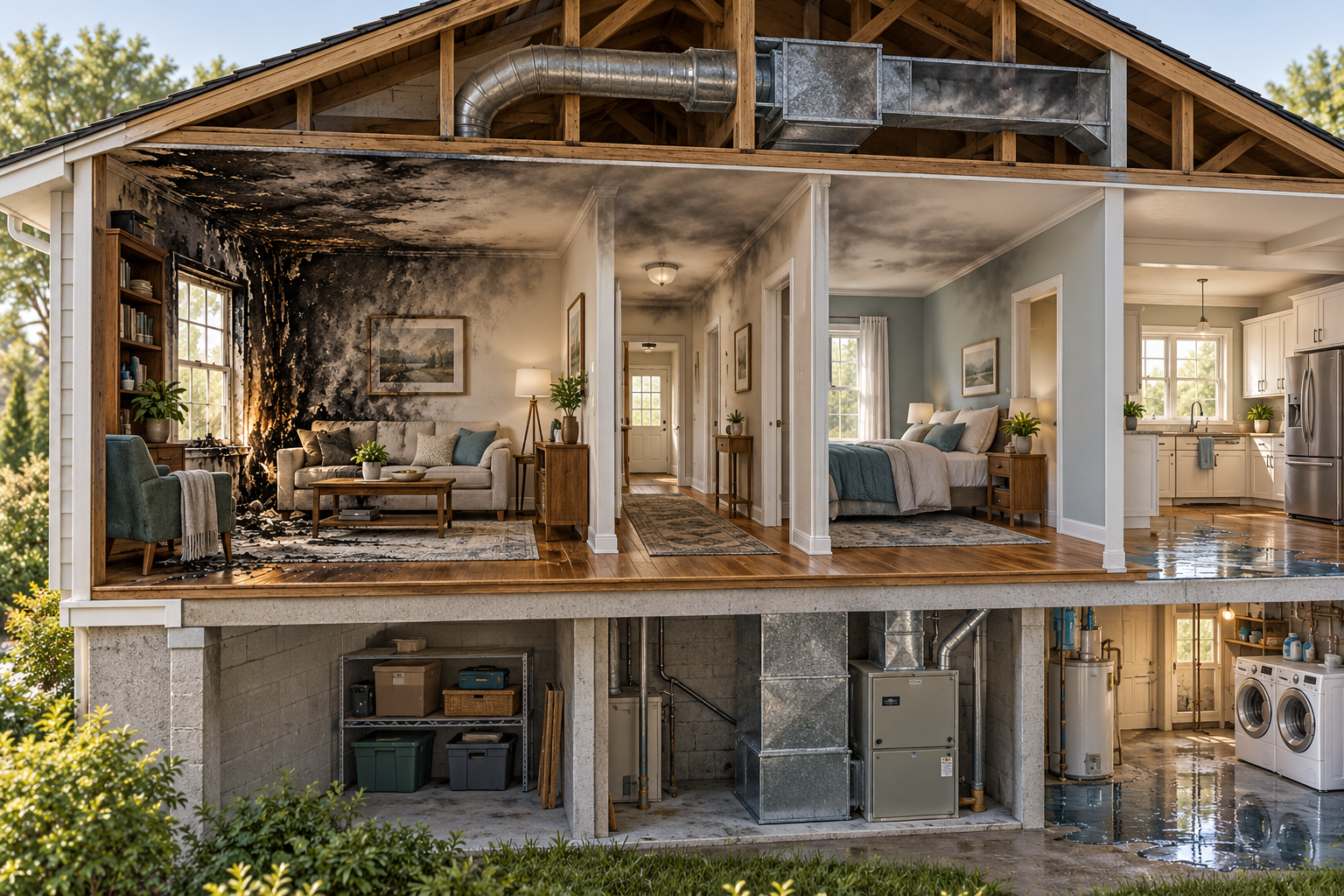
Use the burned area as a starting point, not a total
The affected boundary can include rooms with smoke residue, suppression water, damaged utilities, contents, or HVAC exposure even when flames did not reach them. Ask how the boundary was established and what remains unknown. The right scope may be localized or extensive; the visible burn pattern alone cannot decide.
For budgeting, separate emergency protection, assessment, cleaning, contents, demolition, reconstruction, and temporary housing. This makes it possible to accept urgent stabilization without committing to a permanent rebuild before the structure and policy scope are understood.
What to ask before work expands
Ask which discoveries would create a supplement, who documents them, and who approves the added work. Keep structural, electrical, HVAC, hazardous-material, and reoccupation questions with the qualified professional responsible for them. A restoration price should not be used as a substitute for those decisions.
The early scope may involve temporary stabilization, assessment, residue removal, odor work, contents handling, controlled demolition, cleaning, and documentation. A later reconstruction scope may include framing, insulation, drywall, finishes, system work, permits, inspections, and current-code requirements.
The HVAC system deserves a conditional assessment after a fire, water, or mould event. It is not automatically a replacement, and a standing structure is not automatically ready for occupancy. Structural, electrical, gas, air-quality, and local-authority decisions need the appropriate professionals.
Why fire-loss prices vary so widely
Severity ranges from a contained room to major structural destruction. The relevant drivers include affected assemblies, smoke movement, residue type, suppression water, contents, salvageability, demolition, disposal, access, temporary protection, finish level, system replacement, permits, labor, and temporary housing.
One 2026 U.S. consumer-market observation places professional fire cleaning and repair around $3,083–$52,031. This is a broad community range with limited predictive value. It is not a national or Canadian estimate and does not show what a particular claim, contractor, or structure requires.
Separate cleaning from rebuilding
Ask whether the estimate covers assessment, smoke and soot cleaning, odor treatment, contents, demolition, disposal, reconstruction, system work, permits, and temporary living costs. Cleaning a surface does not prove that a concealed cavity or air-distribution system is unaffected. Removing damaged material does not include replacing it unless the scope says so.
Insurance and next decisions
Document conditions when safe, notify the insurer according to the policy, and keep receipts and estimates. The adjuster’s scope, the contractor’s estimate, and the policy’s coverage are different documents. Deductibles, limits, exclusions, valuation, and code coverage can affect the homeowner’s out-of-pocket budget.
The practical question is not “what is the average fire restoration cost?” It is “which parts of this loss need stabilization, cleaning, contents work, removal, reconstruction, and temporary living support, and what evidence supports each phase?”
Questions that prevent scope surprises
Ask which rooms and systems were assessed, whether the structure has been cleared for the proposed work, what smoke and suppression-water effects are included, and where the estimate stops. Ask who is responsible for contents, HVAC, debris, structural review, electrical work, permits, reconstruction, and temporary housing. If a task is contingent on opening a wall or ceiling, ask how that discovery will be priced and approved.
Keep a copy of the pre-cleaning inventory and photographs when safe. A later decision about cleaning, discarding, rebuilding, or reoccupying should be tied to the observed condition and appropriate professional judgment. The documentation can help compare scopes, but it is not a guarantee of an insurer’s valuation or payment.
Some fire projects end with a clean and usable portion of the home while other areas are rebuilt. Others require broad reconstruction because heat, smoke, water, or structure affects interconnected systems. The useful budget does not force those outcomes into one average; it shows which path the property is actually taking.
A fire-loss cost stack
Separate the budget into emergency stabilization, assessment, smoke and soot cleaning, odor treatment, contents, demolition and disposal, reconstruction, system work, permits or inspections, and temporary living. A contained fire may need only some of those layers. A larger loss may need all of them, and the order can change as the structure and contents are examined.
Firefighting water can create a water-restoration scope even when the flames were limited. Smoke can reach rooms that look intact. Heat can affect materials or systems without leaving the same visible pattern as burning. Contents may need inventory, off-site treatment, storage, or replacement. The first visible room is therefore a starting point, not a reliable measurement of total cost.
Three project paths
In a contained room fire, stabilization, residue assessment, localized removal, smoke cleaning, and finish repair may be the main work. The household may still need temporary access or living arrangements while the room is isolated.
In a wider smoke and suppression-water loss, the building may remain structurally standing but need contents handling, HVAC assessment, odor treatment, drying, selective demolition, and reconstruction of several finishes. A lower burn area does not necessarily mean a small restoration project.
In a major structural loss, engineering, demolition, debris management, design, permitting, utility work, reconstruction, and long-term temporary housing can dominate. A policy may also raise separate questions about valuation, limits, code work, and payment timing. “Total loss” should not be used casually because structural, economic, regulatory, and insurance meanings can differ.
Assessing smoke, HVAC, and reoccupation
The appropriate professional should identify affected and unaffected areas, including air-distribution systems where relevant. HVAC is not automatically a replacement, and a cleaned surface is not an occupancy clearance. Structural, electrical, gas, environmental, health, and local-authority questions belong to the professionals or authorities responsible for them.
Ask what the assessment covers, what evidence supports cleaning or removal, what remains inaccessible, and what the report does not decide. This keeps a restoration estimate from becoming an unsupported safety promise.
How to compare estimates
Line up the rooms, assemblies, contents, equipment, demolition, disposal, cleaning, odor work, reconstruction, finish level, system connections, permits, inspections, taxes, supervision, exclusions, and change-order rules. Ask what condition the estimate starts from and what condition it creates. If a wall or ceiling must be opened, ask how the discovery will be recorded and priced.
Document the loss when safe and keep receipts. The insurer, adjuster, contractor, and homeowner may use different scopes. Deductibles, limits, endorsements, exclusions, valuation, and code treatment are policy questions. A broad 2026 U.S. community observation of about $3,083–$52,031 illustrates the spread of fire-restoration market reports, but it is not a Canadian estimate, a claim prediction, or a substitute for a defined scope.
The useful answer is not an average. It is a transparent path from stabilization to a documented, professionally assessed, and appropriately scoped rebuild or restoration.
What a homeowner should receive at each phase
After stabilization, expect a record of the protected areas and remaining exposure. After assessment, expect affected rooms, systems, contents, and unknowns to be identified. After cleaning or demolition, expect photographs, removed-material information, and a clear reconstruction boundary. Before reoccupation, the relevant structural, electrical, HVAC, environmental, health, and local-authority questions should have an identified owner.
This phase record is valuable even when one company performs the entire project. It shows whether the quoted amount is paying for emergency work, smoke and residue treatment, contents, rebuilding, or a household consequence. It also gives the homeowner a basis for questioning a line without assuming that every disagreement is an insurance dispute.
Separate emergency safety from restoration
Fire losses often combine decisions that should not be made by the same shortcut. Securing an unsafe opening, isolating utilities, and protecting the property may be urgent. Deciding whether framing, wiring, ductwork, contents, or finishes can be cleaned, repaired, or replaced requires the appropriate assessment. Rebuilding to a preferred layout or finish is a separate household choice.
Ask the project team to label each recommendation by reason: immediate safety, observed fire or smoke damage, suppression-water or chemical damage, code or permit requirement, ordinary wear revealed by opening, or elective improvement. That labeling does not decide insurance coverage, but it gives the homeowner and insurer a common physical description.
The same separation helps when a property appears partially usable. A room may be structurally separated while HVAC, electrical, odor, contents, or access questions remain. A professional should define the restriction and the condition for release instead of allowing a visual cleanup or temporary barrier to stand in for a reoccupation decision.