
Insurance affects the budget for a loss, but it does not determine the physical damage. The contractor’s estimate, the adjuster’s scope, the policy, and the homeowner’s desired upgrades may describe different amounts.
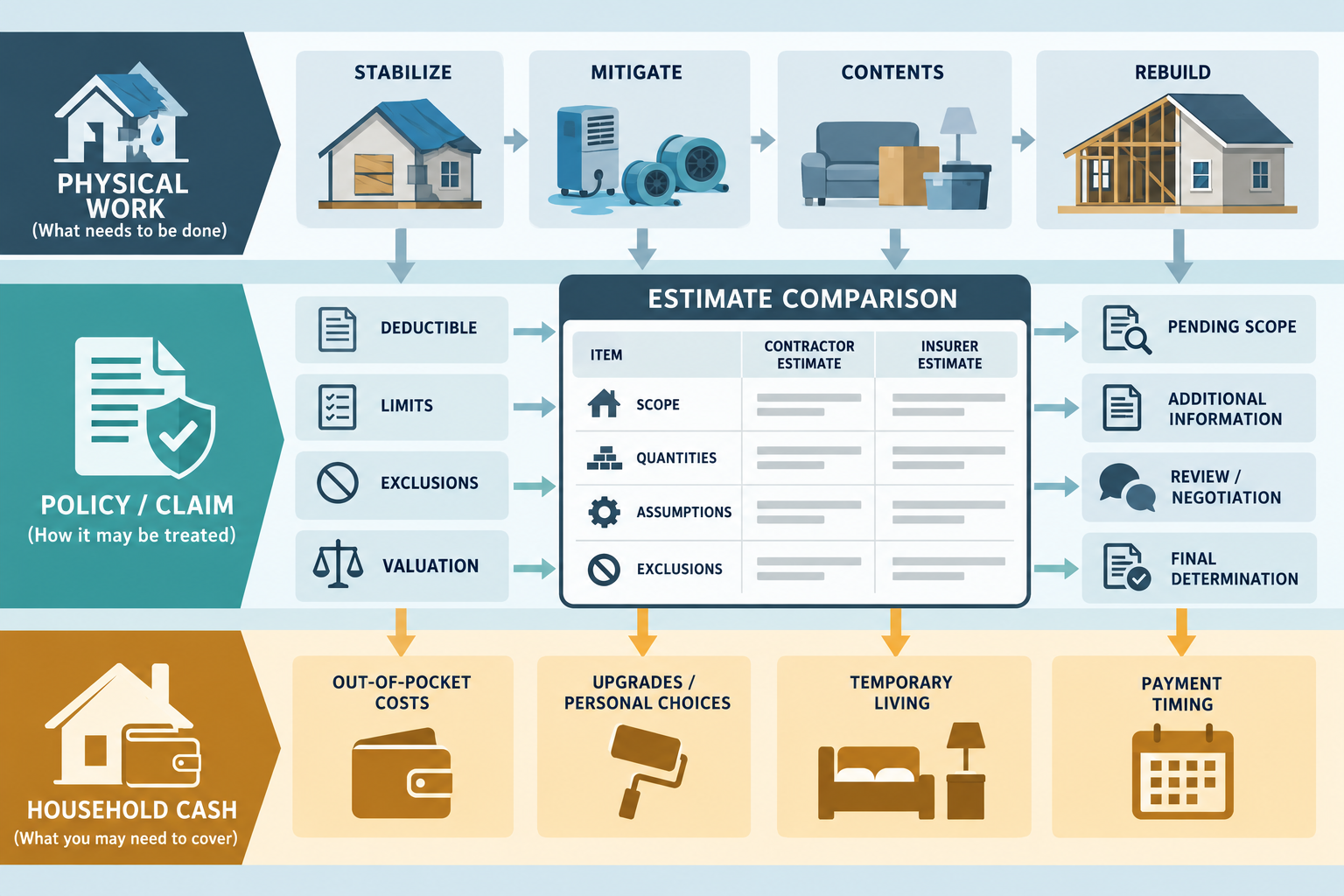
Start with the physical scope
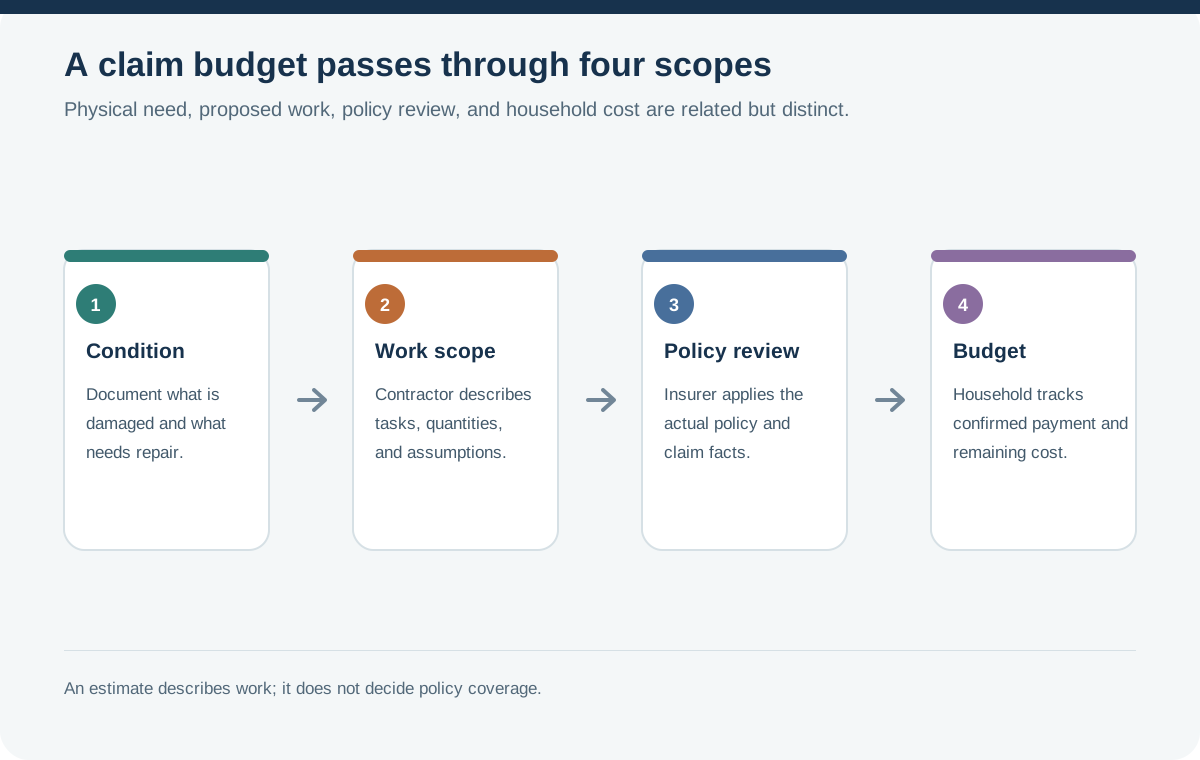
Before debating coverage, describe the condition in plain terms: what failed, what was exposed, what was removed, what remains wet or unsafe, and what needs rebuilding. Then map each item to the contractor scope and policy question. This prevents an insurer’s preliminary number from being treated as a technical determination or a contractor’s estimate from being treated as a coverage promise.
If the cause is disputed, keep cause and consequence separate. A policy may treat the source repair differently from resulting damage, and the actual wording controls.
Ask these questions independently:
- What condition does the building and its contents have?
- What work is needed to stabilize, clean, dry, remove, or rebuild it?
- What does the policy cover for this cause of loss?
- What deductible, limit, valuation rule, exclusion, endorsement, upgrade, or delay affects the amount paid?
The deductible is only one part of the out-of-pocket budget. Uncovered source repairs, betterments, code work outside a policy extension, excluded causes, limits, temporary living costs beyond a policy limit, and work the homeowner chooses to add can also matter.
Document and notify carefully
When safe, photograph and video the damage, list affected contents, keep receipts, retain estimates, and notify the insurer according to the actual policy. Do not delay urgent work that prevents additional damage solely to wait for an adjuster, but document what had to be done and why.
An insurer may divide payments among structure, personal property, and additional living expenses. A supplement may be needed when demolition or drying reveals a condition that was not visible initially. That is not a promise that every supplement will be approved.
If a property is designated Severe Repetitive Loss under the NFIP, FEMA’s narrow administrative review of the designation is distinct from a complaint about an insurer’s current scope or payment. A policyholder may ask for review of specified claim-history or market-value records, or after mitigation; that request does not itself decide the current claim. See the code-upgrade guide for the distinction.
U.S. and Canadian coverage are not one rule
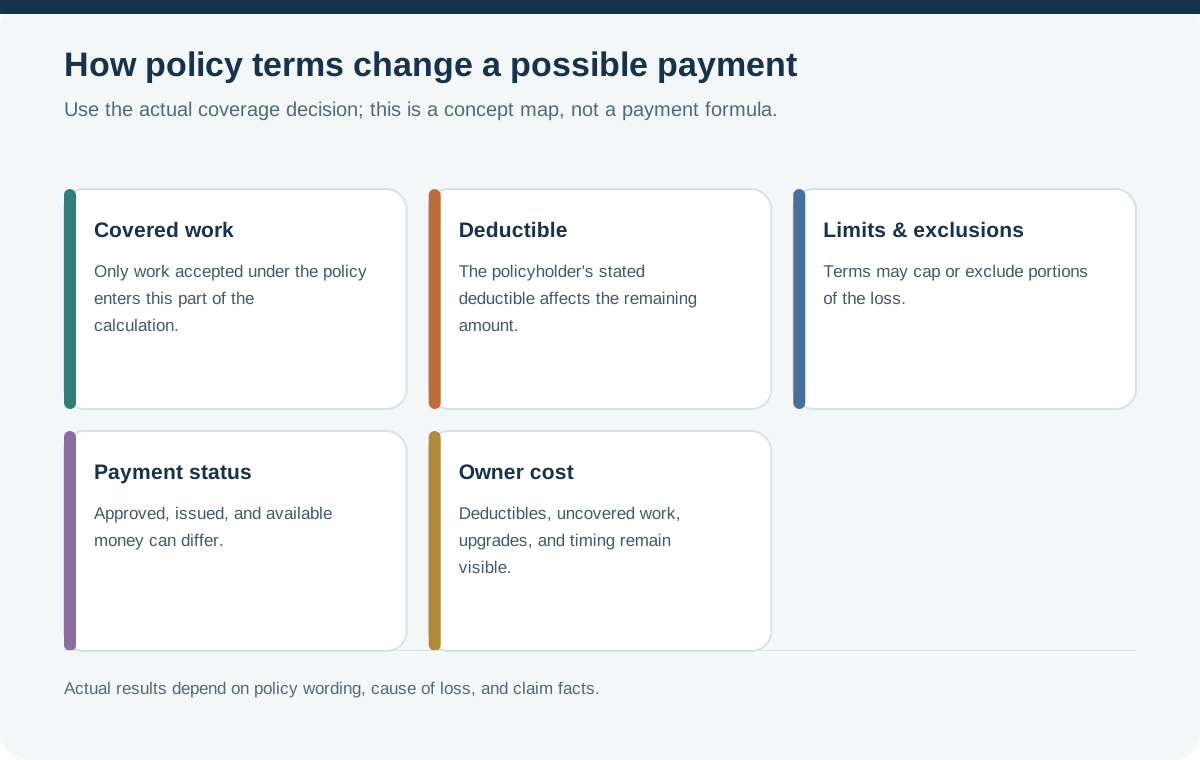
U.S. consumer guidance and Canadian guidance use different regulatory contexts. Canadian flood and sewer-backup coverage may be optional or endorsement-dependent. U.S. policy concepts such as ACV, RCV, and additional living expenses also remain contract- and policy-dependent. Ask the insurer about the actual wording, limits, deadlines, valuation, and documentation requirements.
In Canada, a community flood-risk rating may help frame general awareness but does not decide damage, coverage, or claim amount at an address. Public Safety Canada’s Community Risk Index overview describes its geographic and decision-use limits.
Some claims also have narrow jurisdiction-specific rules. California’s 2026 AB 1795 addresses certain insured residential wildfire-smoke claims within a defined impact zone; both it and AB 1642 contain an operative condition tied to taking effect by January 1, 2027. Check the current AB 1795 and AB 1642 text, claim date, policy, and location. This is not a general U.S. or Canadian coverage rule. In Ontario, the Disaster Recovery Assistance for Ontarians program is activated only for specified areas and may cover eligible essential-property or basic emergency costs after other payments are considered. Check the current Ontario program page for active areas and rules. For broader options when a claim leaves a funding gap, see assistance, loans, and tax questions after a disaster.
An approved claim amount and cash available for the contractor’s next invoice are separate questions. If an insurer has already issued a check but a mortgage lender or servicer must process its release, use the mortgage-proceeds guide. If the home is rented, keep the owner’s building claim and renter’s belongings and temporary-living inquiries distinct in the rental-home recovery guide.
Compare the budget, not just the estimate
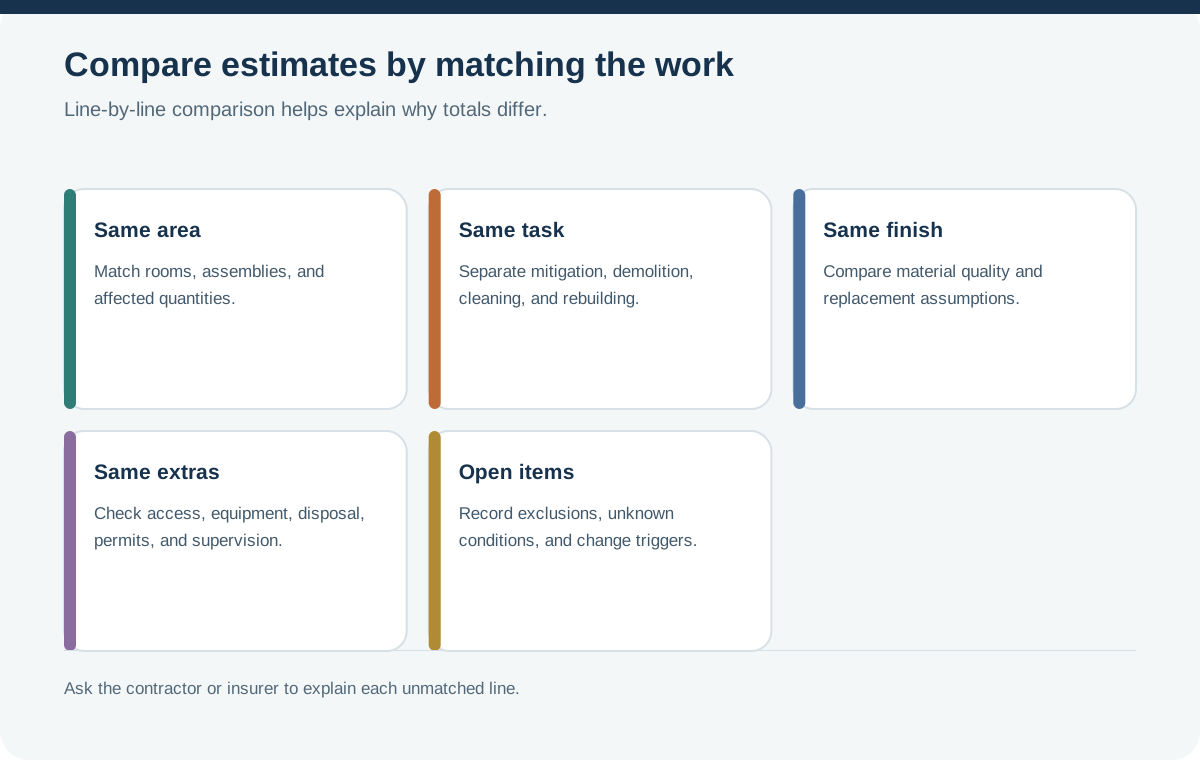
Make a table with the physical scope, contractor amount, insurer amount, deductible, homeowner-selected upgrades, excluded work, and unresolved items. Keep temporary protection, mitigation, contents, reconstruction, code work, and temporary living costs separate. This shows where the budget gap comes from without treating a contractor or insurer as the sole authority over every question.
Find out what a gap actually represents
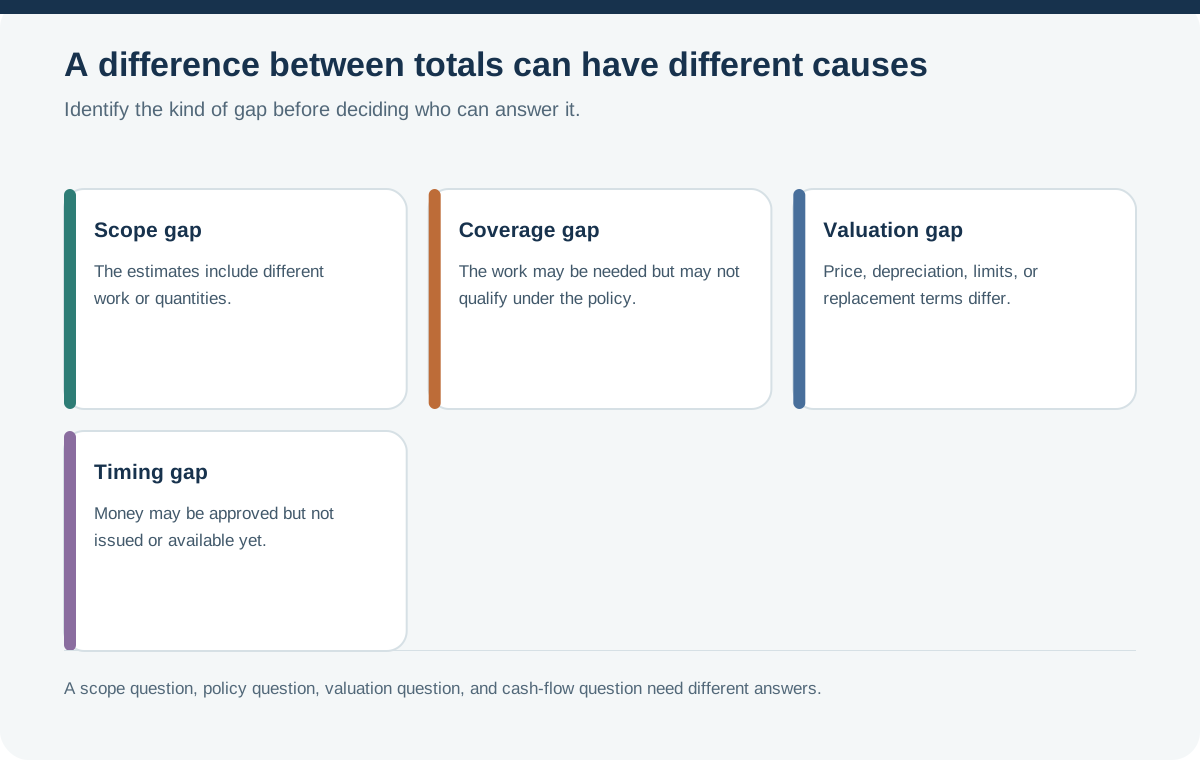
When two totals differ, ask both parties to compare the same locations, quantities, assumptions, and finished condition. A gap may come from:
- Omitted physical work: a room, assembly, access step, disposal item, trade, or contents task appears in one scope but not the other.
- Different quantities: the documents measure different areas, lengths, material layers, equipment periods, or numbers of items.
- Policy scope: the work may be physically real but subject to an exclusion, limit, endorsement, deductible, or valuation condition.
- Like-kind assumptions: one estimate restores the observed pre-loss function while another includes matching, a different material, or a different finish.
- Pending supplements: demolition, drying, or inspection may reveal conditions that were not visible when the first estimate was written.
- Optional upgrades: the homeowner may have requested a better material, layout, efficiency feature, or finish.
- Unresolved conditions: the need for structural, contamination, code, or system work may not yet be established.
The label “supplement,” “upgrade,” or “not covered” does not by itself explain which of these is responsible. Request the line, location, quantity, assumption, and reason for the difference in writing.
Why the estimates differ
An adjuster may start with visible damage and policy categories. A contractor may include access, equipment, demolition, waste, trade coordination, and contingencies needed to perform the work. Both documents may be incomplete at different moments. Hidden moisture, contaminated materials, structural conditions, specialty finishes, and current requirements can create a documented supplement or change order.
Compare affected locations, quantities, assumptions, and end condition. If a contractor includes an item the insurer has not, ask whether the difference is technical necessity, a policy limitation, a voluntary upgrade, or an unresolved condition. If the insurer’s scope omits work the contractor considers necessary, ask for the evidence and the process for review rather than relying on a verbal promise.
When a second technical or professional view may help
A second restoration, reconstruction, engineering, contents, or other qualified professional view may be useful when the physical condition is disputed, hidden work cannot be described clearly, the estimates use materially different quantities or end conditions, or a contamination, structural, electrical, HVAC, or code question is outside the first contractor’s competence. The purpose is to clarify the observed condition, necessary physical work, assumptions, and alternatives.
That view does not decide whether the policy covers the work or require an insurer to accept a particular estimate. Keep the technical report, contractor scope, adjuster scope, and policy question separate. For a straightforward difference in deductible, limit, valuation, or endorsement, the insurer or claim representative is the relevant source; for an uncertain physical condition, the relevant technical professional is the better source.
Before requesting another view, ask what question remains unanswered, what area or record the professional will inspect, what deliverable will be provided, and whether the opinion covers mitigation, reconstruction, contents, code, or only one of those phases. Avoid paying for a second opinion that simply repeats an already comparable scope.
Build the out-of-pocket picture in layers
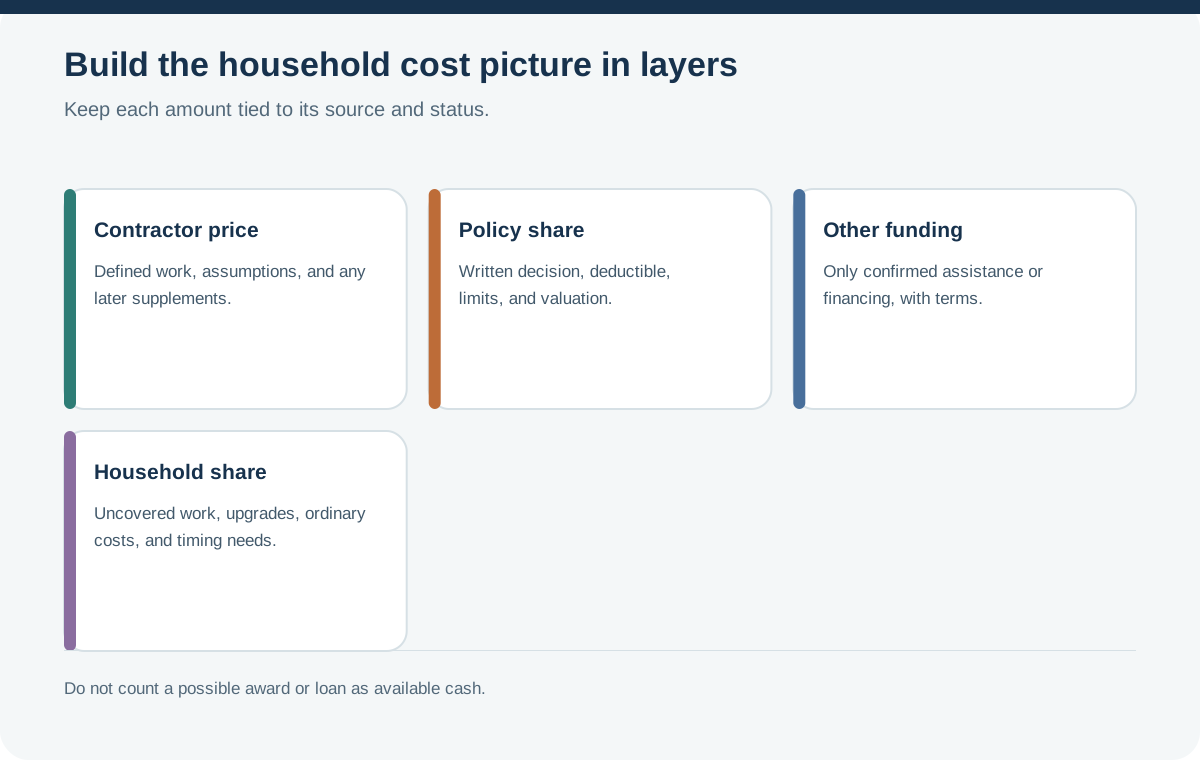
Start with the physical scope: stabilization, mitigation, contents, demolition, reconstruction, code work, and temporary living. Then identify the policy questions attached to each layer: deductible, limit, endorsement, exclusion, valuation, authorization, and payment timing. Finally list homeowner choices such as upgraded finishes, layout changes, resilience work, better materials, or work beyond the damaged area.
This layered view explains why a contractor’s estimate, an adjuster’s estimate, and a household budget can all be different without one document being automatically wrong. A contractor may price work that is physically necessary but not covered under the policy. An insurer may recognize an amount that does not cover a voluntary upgrade. The homeowner may need cash before a later payment or before additional living expenses are resolved.
Questions when scopes do not match
When two estimates differ, identify the exact disagreement:
- Do they describe the same rooms and assemblies?
- Do they begin and end at the same project phase?
- Are quantities measured or estimated?
- Does one include contents, disposal, permits, code work, or temporary living?
- Does one assume drying or demolition that the other does not?
- Is the difference physical necessity, price, policy treatment, or homeowner choice?
Ask the contractor to explain physical scope and the insurer or adjuster to explain policy treatment. If a structural, electrical, HVAC, contamination, or code question is unresolved, obtain the appropriate specialist view rather than asking an insurance document to answer it.
Why supplements occur
Restoration estimates are often made before every assembly is visible. A supplement can follow concealed damage, a measured quantity, a change in the rebuild condition, a local authority requirement, a necessary source repair, or a documented contents decision. A supplement should describe what was discovered and why the original scope did not include it.
Do not treat every supplement as evidence of poor estimating, but do not approve unexplained additions. Ask for photographs, measurements, reports, the affected room, the proposed remedy, and the approval route. Keep emergency mitigation moving when delay would cause more damage, while reserving permanent or optional work for a defined authorization.
U.S. and Canadian policy context
U.S. and Canadian insurance structures and terminology differ. Coverage for flood, sewer backup, escape of water, code work, contents, additional living expenses, actual cash value, replacement cost, and deductibles depends on the actual contract, cause of loss, endorsement, limits, and jurisdiction. Do not convert one country’s consumer guidance into a rule for the other.
Documentation is still broadly useful: photographs, inventories, receipts, estimates, condition records, temporary-work invoices, and correspondence. It supports a claim conversation but does not guarantee payment or replace the policy’s requirements.
A decision record for the claim budget
Keep a running table with the physical phase, contractor, estimate, included work, excluded work, policy question, homeowner decision, and next handoff. Record whether the amount is known, estimated, or contingent. Include storage, temporary lodging, transportation, meals, and other displacement costs separately when relevant.
The goal is not to predict a claim outcome. It is to make the economic decision legible: what must be done to protect and restore the property, what the policy may recognize subject to its terms, what the household must fund temporarily, and what work is a voluntary choice.