
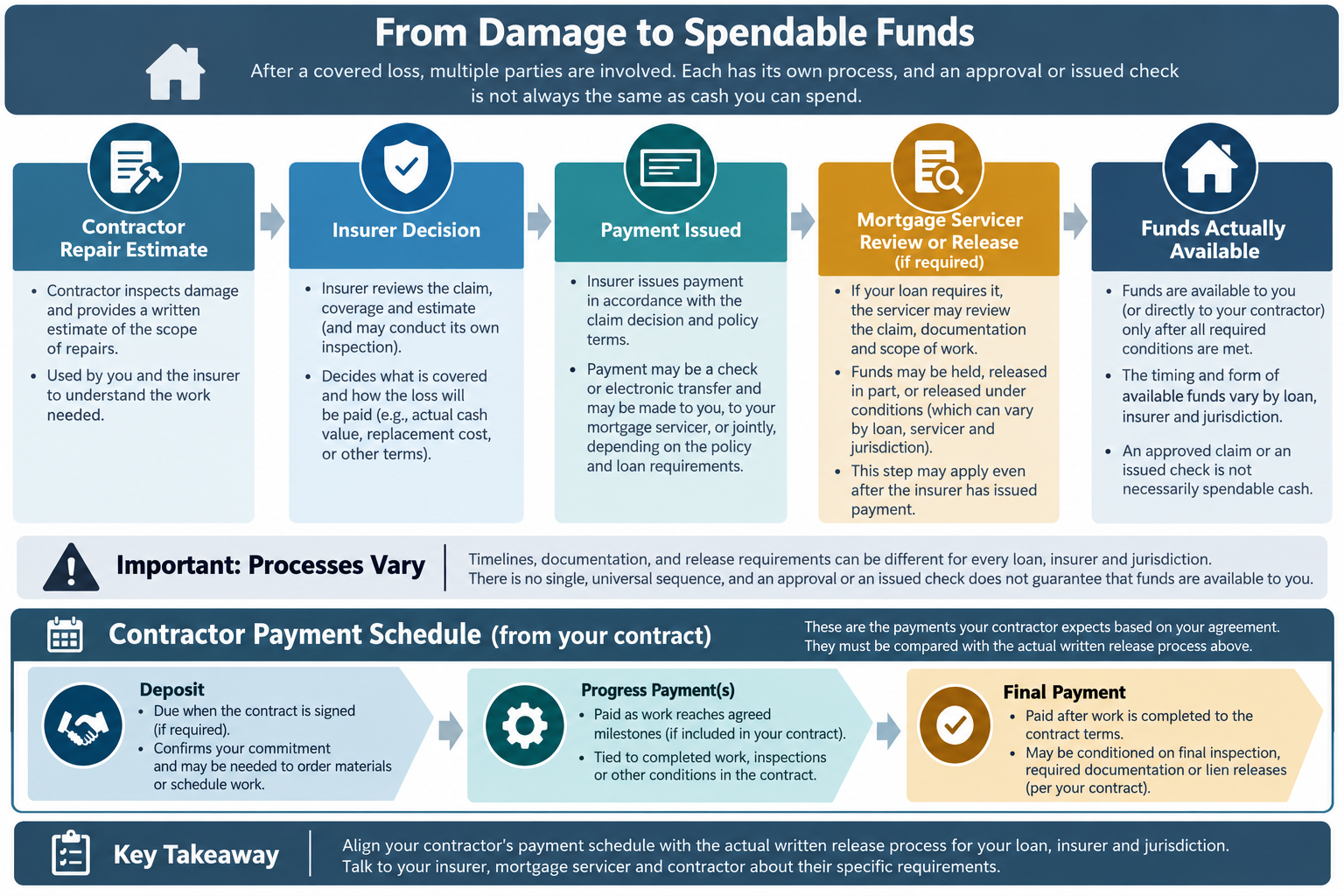
An insurer may approve a repair amount or issue a claim payment before a contractor’s next invoice is due. If a mortgage lender or servicer is named on the check or holds the proceeds for release, that amount may not yet be available to meet a deposit or progress payment. The useful question is not only “how much was approved?” but also “who has the money now, what must happen before it is released, and when will it be usable?”
Separate that timing problem from the cost of the physical work, the insurer’s coverage or valuation decision, and any repair amount the policy does not fund. Do not promise a contractor payment date from an approval letter or treat every pending dollar as a permanent shortfall.
Track five different amounts
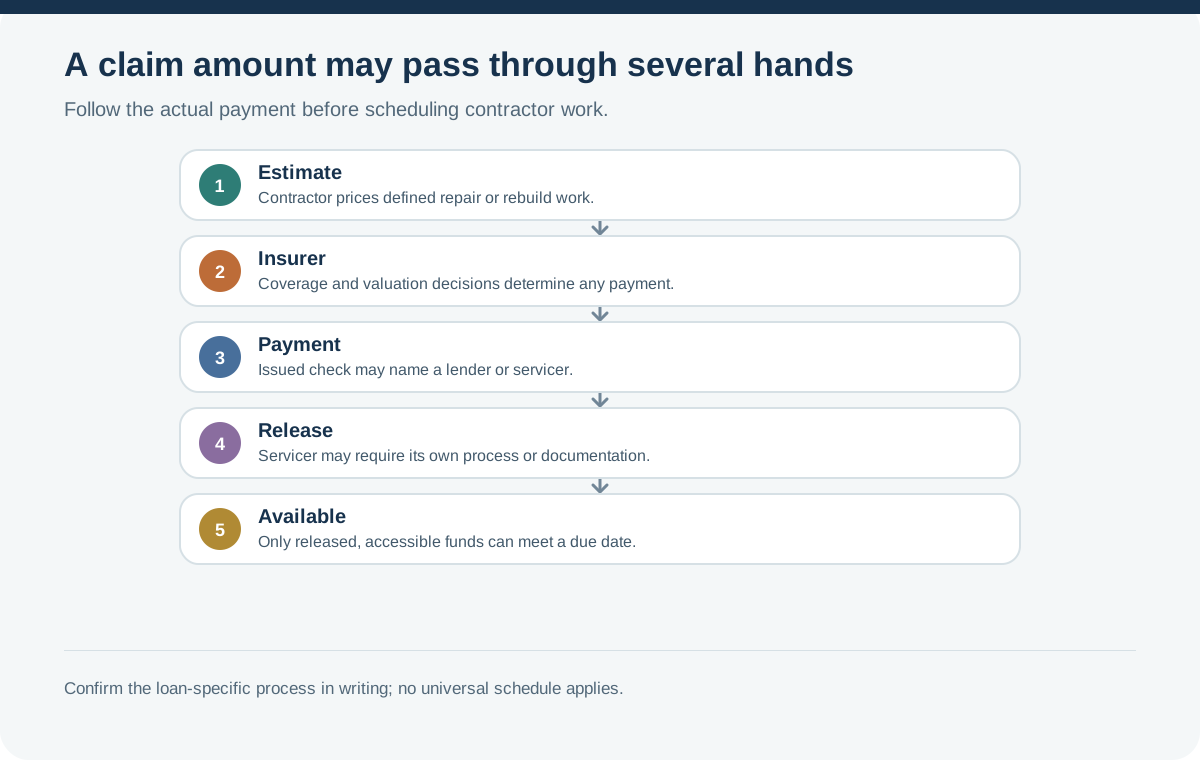
Keep a simple recovery cash-flow ledger. Give each amount a status instead of adding everything into one “insurance total.”
| Ledger line | What it means | Evidence to record |
|---|---|---|
| Repair estimate | Contractor’s current price for defined work | Dated scope, quantities, assumptions, exclusions, and schedule |
| Insurer decision | Amount or scope the insurer has approved or is still reviewing | Written estimate, coverage decision, deductible, limits, and open items |
| Payment issued | Check or electronic payment that the insurer says it has sent | Date, payees, amount, category, and any endorsement requirement |
| Funds currently available | Money deposited and accessible for the repair budget | Deposit confirmation and any servicer instructions or restriction |
| Remaining project gap | Work, deductible, upgrade, or timing need not met by confirmed available funds | Scope comparison, contractor due dates, pending supplements, and unresolved funding source |
Keep building repairs, contents, temporary living, savings, and assistance or loans in separate columns: contents or living-expense money is not automatically construction cash. Track the insurer-approved amount, payment issued, and released cash as different values.
Find out who controls the payment
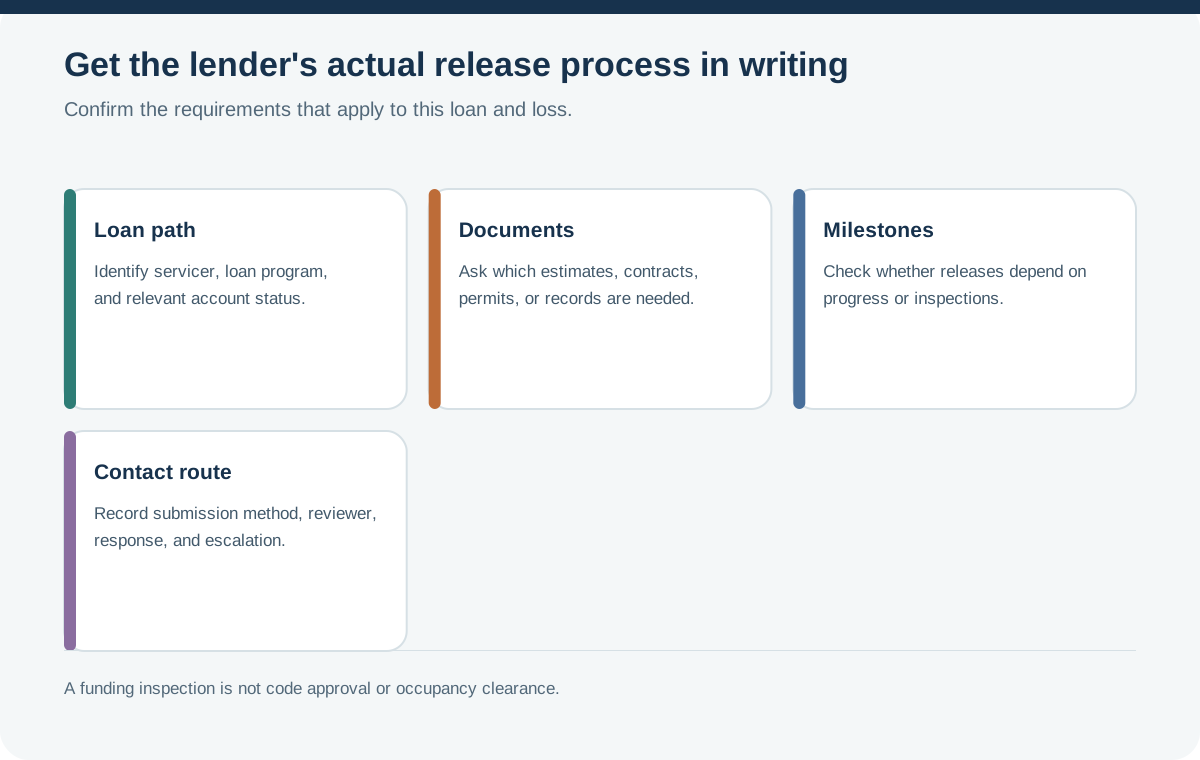
Read the check and insurer message for payees. If a mortgage company is named, confirm whether it must endorse or process payment, then contact the loss-draft or insurance-proceeds department in the lender’s instructions. A branch, insurer, or contractor may not know this loan’s release rules.
Ask the servicer for the written procedure that applies to this property and claim. Confirm:
- which loan and servicing program the procedure covers;
- whether the check must be endorsed or deposited through a particular process;
- what repair estimate, contractor contract, permit, proof of insurance, or other document it needs;
- whether funds can be released in stages and what event triggers each stage;
- whether progress photographs, receipts, an inspection, or a completion record are required;
- how to request a release, who reviews it, how the response is delivered, and where to ask about a delay; and
- whether any amount is being held by the insurer for a policy reason rather than by the lender after payment.
These are questions, not a universal document checklist. The actual loan agreement, servicing process, policy, repair plan, property status, and applicable law control. Keep copies of the instructions and each submission, along with the date and response to every release request.
Match the contractor schedule to confirmed releases
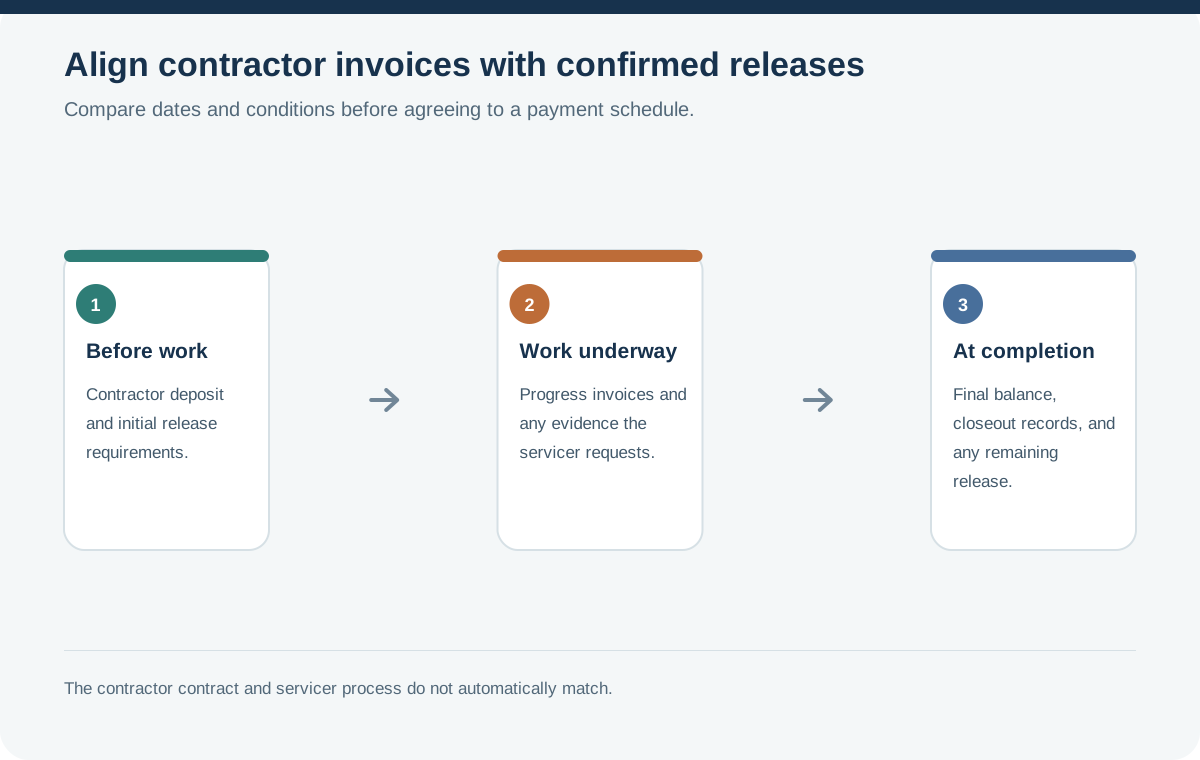
Before accepting a deposit or progress schedule, put the contractor’s due dates beside the release conditions the servicer has confirmed in writing. A schedule may require an initial deposit, payments at milestones, and a final amount. A lender may use different documentation or review stages. The two schedules do not automatically line up.
| Project milestone | Contractor question | Servicer question |
|---|---|---|
| Before work | What deposit is due, when, and for which defined work? | What must be submitted before an initial release can be requested? |
| Work underway | What progress is complete and what invoice is due next? | What evidence or inspection is required for a progress release? |
| Work complete | What remains on the contract, including approved changes? | What documentation or final review is needed for any remaining funds? |
Ask the contractor to show which amount is deposit, stored materials, completed work, a change order, or completion balance. Ask how a delayed release would affect the schedule and whether written payment terms can account for it. A contractor’s demand does not make the servicer release money, and a servicer’s review does not change the contractor’s contract automatically. Do not rely on a verbal assurance that an insurer or lender will cover a particular invoice.
If the project needs a mechanic’s lien waiver or similar payment record, confirm which forms apply in the property’s jurisdiction and retain them with the invoice and proof of payment. CFPB recovery guidance recommends asking how insurance proceeds will be distributed before hiring and keeping phase-by-phase contractor payment records. State or provincial law and the actual contract determine the legal effect of a particular waiver.
Understand the usual U.S. example without treating it as a rule
The Consumer Financial Protection Bureau (CFPB) says a home claim check is generally payable to both the homeowner and mortgage servicer or lender when the property has a mortgage. It describes a common pattern in which the servicer releases part before work begins, more as work progresses, and the rest after completion and an inspection. CFPB labels this as typical practice; it is not a guaranteed schedule, amount, or procedure for every servicer or mortgage.
Use the CFPB explanation of claim payments as a prompt to contact the actual servicer, not as permission to commit funds against an assumed release. Confirm the named payees and process for the particular loan.
Fannie Mae’s current B-5-01 servicing guide illustrates a program-specific variation. For a covered loan current or less than 31 days delinquent when the loss occurs, proceeds may be released in stages as repairs progress, and a final inspection is not required for that status path. Loans 31 or more days delinquent follow different release and inspection rules. Confirm that the loan is covered by Fannie Mae’s guide and get the servicer’s written process before relying on this example. It does not apply to every mortgage or establish code approval or safe occupancy.
Verify Canadian arrangements with the actual lender
The U.S. examples do not establish a Canadian standard or one national release sequence. Review the claim payment and mortgage documents, then ask the actual lender in writing who must endorse or hold the payment, what evidence it needs, and whether releases are staged. If the process is unclear, request the loss-proceeds department and written response or complaint route. Keep lender arrangements separate from insurer coverage and provincial or territorial disaster assistance.
Separate lender-held money from insurer conditions
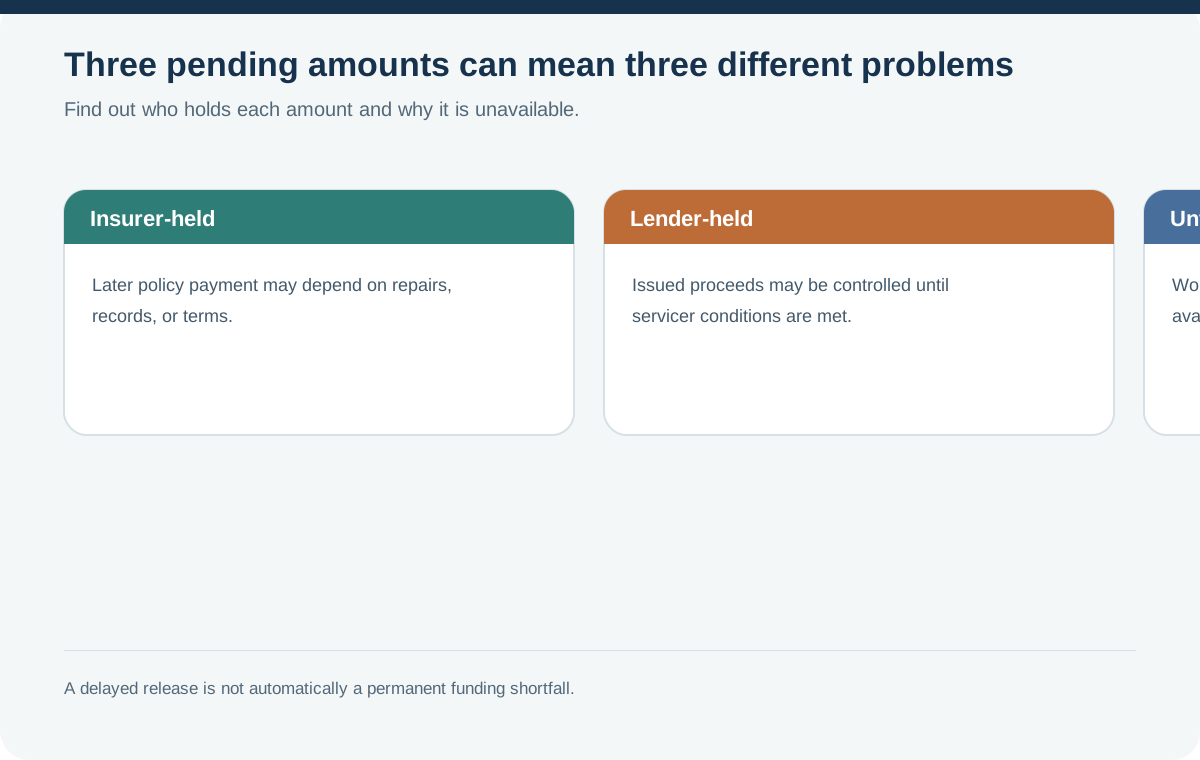
Two different delays can look alike in a household budget. An insurer may issue an initial amount and condition a later payment on repair, replacement, documentation, or policy terms. Separately, an insurer may have issued a check that is payable to a lender or servicer, whose procedure governs access to the proceeds. Ask which institution currently holds each amount and what written condition remains.
Recoverable depreciation, when a policy uses that kind of replacement-cost process, is not automatically lender-held proceeds. A lender’s release of money is not automatically the insurer’s final valuation of the loss. Compare the issued check, insurer’s estimate, policy condition, and servicer’s release record. For the valuation question, see actual cash value versus replacement cost; for differences between the physical estimate and insurer scope, see insurance and restoration costs.
If a lender asks for an inspection or progress evidence, ask what the review is intended to confirm and what record follows. A loan-servicing inspection does not by itself establish that work has the required permit, satisfies code, resolves an environmental or structural concern, or makes the home safe to occupy. Those decisions belong to the relevant local authority and qualified professionals.
Keep the regular mortgage obligation separate
CFPB consumer guidance says borrowers remain responsible for mortgage payments while an insurance claim is being paid. Do not assume that an open claim or a delayed repair-proceeds release pauses a regular payment. If the disaster creates a payment hardship, contact the servicer promptly about available options and get any agreement, duration, and repayment terms in writing. CFPB describes forbearance as a temporary pause or reduction arranged with the servicer; the deferred amount still has to be repaid under the agreed terms. It is a separate mortgage arrangement, not repair funding or debt forgiveness. See the CFPB’s forbearance explanation.
Decide whether the problem is timing or a real shortfall
Update the ledger when an amount is issued, released, spent, denied, or revised. A cash-flow timing mismatch exists when a known funding source may cover an agreed scope but is not available by a contractor due date. An actual scope or funding gap exists when the defined work exceeds all confirmed insurance and other funding, when coverage is denied, or when the owner chooses work outside that scope. Both can occur at once, but a pending release alone does not prove underinsurance.
If the insurer has not accepted part of the physical scope, compare estimates and ask what information is needed for a claim review. If the insurer’s valuation is the question, use the policy-specific payment and depreciation guidance. If the scope is agreed but funds are inaccessible, continue with the servicer’s release process. If insurance and available resources still do not cover needed work, use assistance, loans, and tax questions after a disaster to evaluate a possible funding gap. If the building work itself may change from repair to rebuild, compare the options in repair versus rebuild after major damage.
Questions for each party
Ask the insurer:
- What amount has been approved, what has actually been issued, and what remains under review?
- Which policy condition or documentation requirement applies to any later payment?
- Which part is building repair, contents, or temporary living, and who is named as payee?
- What payment record should be sent to the servicer?
Ask the lender or servicer:
- Who currently holds or processes the payment, and what written procedure applies to this loan?
- What specific evidence triggers an initial, progress, or final release, if stages apply?
- How should the request be submitted, how will the review be documented, and whom should the borrower contact about a delay?
- What, if anything, changes if the repair scope or contractor schedule changes?
Ask the contractor:
- Which work and milestone does each deposit or invoice cover?
- What amount is due before work, during progress, and at completion?
- Which changes require a new authorization, and how will schedule changes be handled if a release is delayed?
- Which invoices, progress records, receipts, or lien documents will be provided?
Track the answer, responsible party, document, and expected date for each open item. Count money toward a contractor commitment only when the applicable payer has confirmed the process and the funds are available on a schedule the household can meet. That record makes a temporary payment delay easier to distinguish from a claim dispute, a mortgage hardship, or a lasting restoration shortfall.