
Board-up and tarping are temporary stabilization services. They protect an opening or damaged roof from weather, trespass, and additional exposure while the permanent scope is assessed. They do not replace a roof, window, door, wall, or structural assembly.
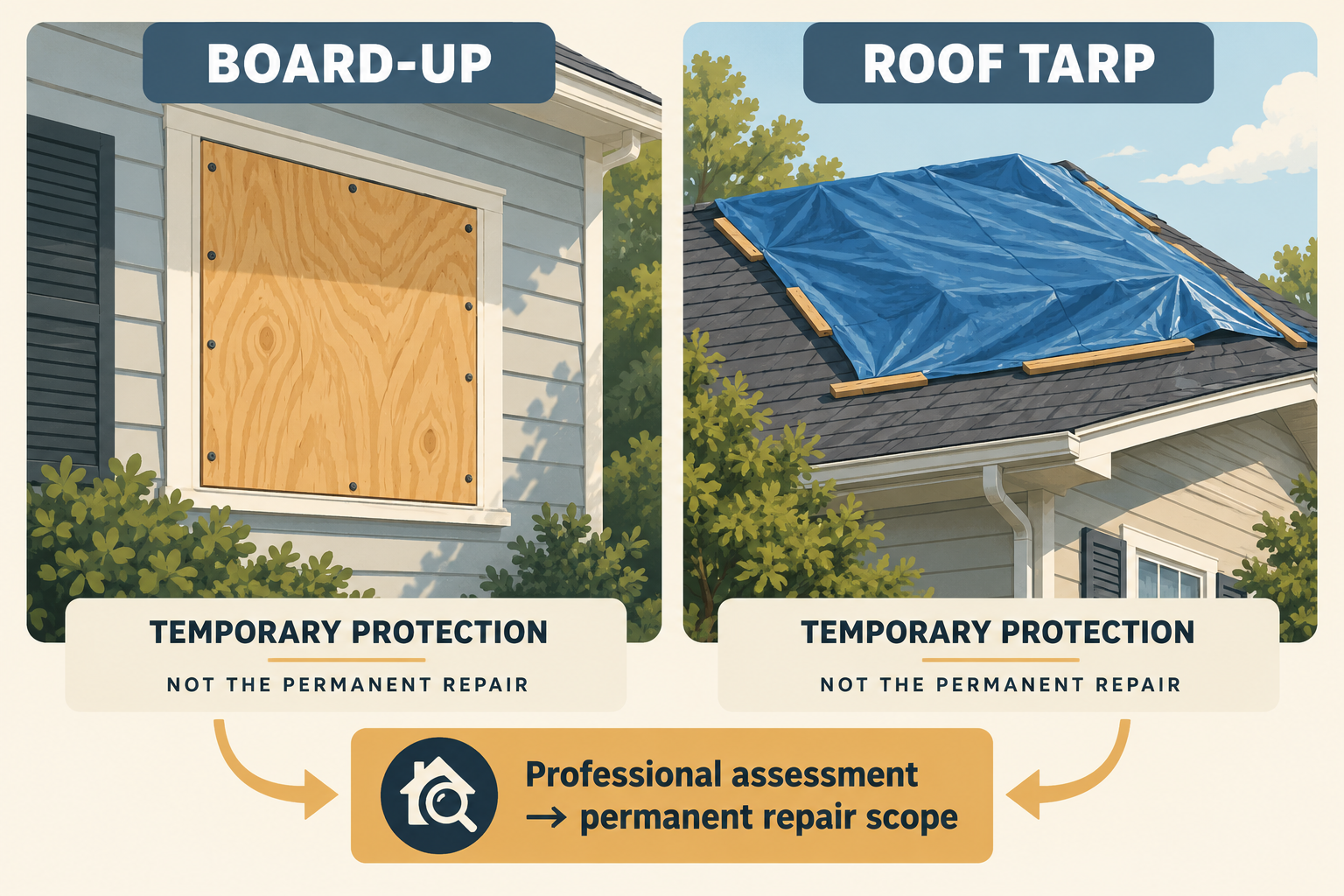
Board-up versus tarping
A board-up usually closes a broken window, door, wall opening, or other accessible opening with temporary material. A roof tarp covers a damaged roof area or opening. The right method depends on the damage, weather, access, attachment surface, and whether the temporary protection itself could create a hazard.
Do not climb onto a damaged roof or enter an unsafe structure to measure it. Describe what can be observed safely and let the responding professional determine the access and protection method.
What may be included in the price
An emergency estimate may combine a response or service call, labor, temporary materials, equipment, access, travel, after-hours response, removal of failed temporary protection, and a later inspection or repeat mobilization. A 2026 U.S. consumer-market observation places professional roof-tarping examples around $150–$3,300, but the range is a broad market signal rather than a standard rate. It does not establish a Canadian price or what an insurer will pay.
The price can rise when the roof is steep or high, the opening is large or irregular, the surface is unstable, weather is worsening, the property is difficult to access, or the work requires special attachment and fall-protection measures. Catastrophe demand can also affect availability and response time.
What a stabilization estimate should say
Ask the contractor to identify:
- the opening or roof area being protected;
- the temporary method and materials;
- access, equipment, and after-hours charges;
- how long the protection is expected to last;
- whether inspection or re-tarping is included;
- what removal, disposal, or permanent repair is excluded.
Photograph conditions before work when it is safe, and keep the invoice and receipts. Tell the insurer about the loss according to the policy. Documentation supports claim administration, but it does not turn temporary work into covered work.
The handoff to permanent repair
Temporary protection should lead to a defined next step: roof, opening, cladding, structural, or restoration assessment. Ask whether the same company is offering only stabilization or also a later repair contract. A tarp invoice should not be treated as a roof-replacement estimate, and a board-up should not be treated as a window or wall reconstruction scope.
How the price is usually assembled
The visible material may be inexpensive compared with the response needed to install it. A contractor may charge a minimum service call, travel, labor, temporary materials, ladders or lifts, fall-protection equipment, and disposal. A board-up can require measuring and cutting panels, protecting the opening from wind, and returning to remove the temporary covering. Tarping can require access across a steep or fragile roof, a method that will not create more damage, and a later inspection after weather changes.
Ask whether the quote is a lump-sum or time-and-materials price. If it is a lump sum, ask what assumptions it makes about area, height, access, materials, and number of workers. If it is time-and-materials, ask for the labor rate, minimum charge, material markup, travel, equipment, and authorization limit. This lets you compare two emergency quotes without assuming their different formats represent different work.
Board-up decisions beyond the first visit
A broken window or door may need more than a panel. The opening can expose interior finishes, contents, wiring, security systems, or weather-sensitive equipment. A board-up should not conceal a structural concern or prevent a qualified professional from assessing the surrounding assembly. If water is entering, the temporary protection and the interior drying scope should be documented separately.
For a roof tarp, ask how the installer will protect the damaged surface and whether the method is intended for a short interval or a longer temporary period. Wind, snow, rain, ponding, and later access can affect performance. A tarp is not evidence that the roof beneath it is sound, and its presence does not establish that a permanent repair can wait indefinitely.
How the price changes by situation
A small, accessible board-up can be a short service call. A high opening, a damaged frame, or an opening above a stairwell may require a lift, additional workers, interior protection, and a method that resists wind without damaging the surrounding assembly. The same nominal opening can therefore produce different invoices.
Roof tarping has similar variation. A low-slope roof with safe access is a different job from a steep, wet, fragile, or partially collapsed roof. If a tree, power line, fire-damaged framing, or unstable chimney is involved, the first step may be hazard control or structural assessment rather than tarp installation. A professional may need to return after weather changes, and that visit should be identified as either included maintenance or a separate charge.
An emergency response can also create related costs. Water may have entered insulation, ceilings, wall cavities, flooring, or contents before the opening was protected. Those areas may need moisture assessment, extraction, drying, controlled removal, or temporary relocation of belongings. They are consequential restoration scopes, not automatically part of the board-up or tarp price.
Temporary protection is not a repair strategy
The goal of a board-up or tarp is to reduce additional exposure while a permanent decision is made. It should not hide a structural concern, make a damaged roof appear serviceable, or prevent later inspection of the surrounding assembly. Ask how the installer will leave access for a qualified inspection and whether the method is intended for a short interval or a longer temporary period.
Weather can change the result. Wind, snow, rain, ponding, falling debris, and later access may affect a temporary covering. If the protection moves, leaks, or becomes unsafe, keep people away from the area and call the responsible professional. Do not climb onto a roof to inspect or repair a tarp yourself.
Compare the handoff, not only the emergency total
Before accepting a stabilization estimate, ask what record you will receive: photographs, protected-area description, material list, observed interior damage, recommended next inspection, and exclusions. If the company will also price permanent work, ask for separate documents or clearly separated phases. A later roof, window, cladding, structural, or restoration estimate should identify the condition it starts from.
This separation helps in three common situations. First, a homeowner may need to authorize urgent protection before knowing whether the underlying assembly can be repaired. Second, an insurer may need documentation while the contractor is concerned with preventing further damage. Third, the stabilization firm may not be the right company for permanent reconstruction. A clear handoff preserves those choices.
The practical comparison is therefore:
- What is exposed or unsafe now?
- What temporary measure will limit additional damage?
- What does that measure cost, including access and repeat visits?
- What assessment must follow?
- Which permanent repair or restoration scopes remain outside the invoice?
If those questions are answered, an emergency price can be useful even when it is not the final project cost.
The decision after the temporary visit
Once the opening is protected, ask what inspection or repair now becomes possible. A roofer may need to assess the permanent roof assembly; an electrician or structural professional may need to evaluate an affected opening; a restoration contractor may need to check interior moisture; and an insurer may need the photographs and invoice. The next step should follow the observed condition rather than the existence of the tarp itself.
If weather or security conditions change before permanent work begins, document the change and contact the responsible professional. Do not treat the temporary measure as a reason to delay a necessary assessment or as evidence that a larger repair can be skipped.
Repeat visits and changing exposure
An emergency measure is partly a schedule decision. Ask how long the board-up, tarp, temporary glazing, or other protection is expected to last, who inspects it after severe weather, and whether the price includes removal or replacement. If permanent work is delayed, the provider should explain the new risk and the cost of extending protection rather than silently allowing a temporary measure to become the project plan.
Keep the temporary invoice separate from interior restoration. A tarp can reduce new water entry without proving that existing wet materials are dry; a board-up can improve security without proving that the opening is structurally sound. Photographs, access notes, and the recommended next inspection create a useful bridge between the urgent visit and the permanent scope.