
Restoration estimates are difficult to compare because they often describe different phases of one loss. Start with scope and condition, then compare prices. A lower total may simply omit drying, contents, demolition, reconstruction, permits, or an assumption about hidden damage.
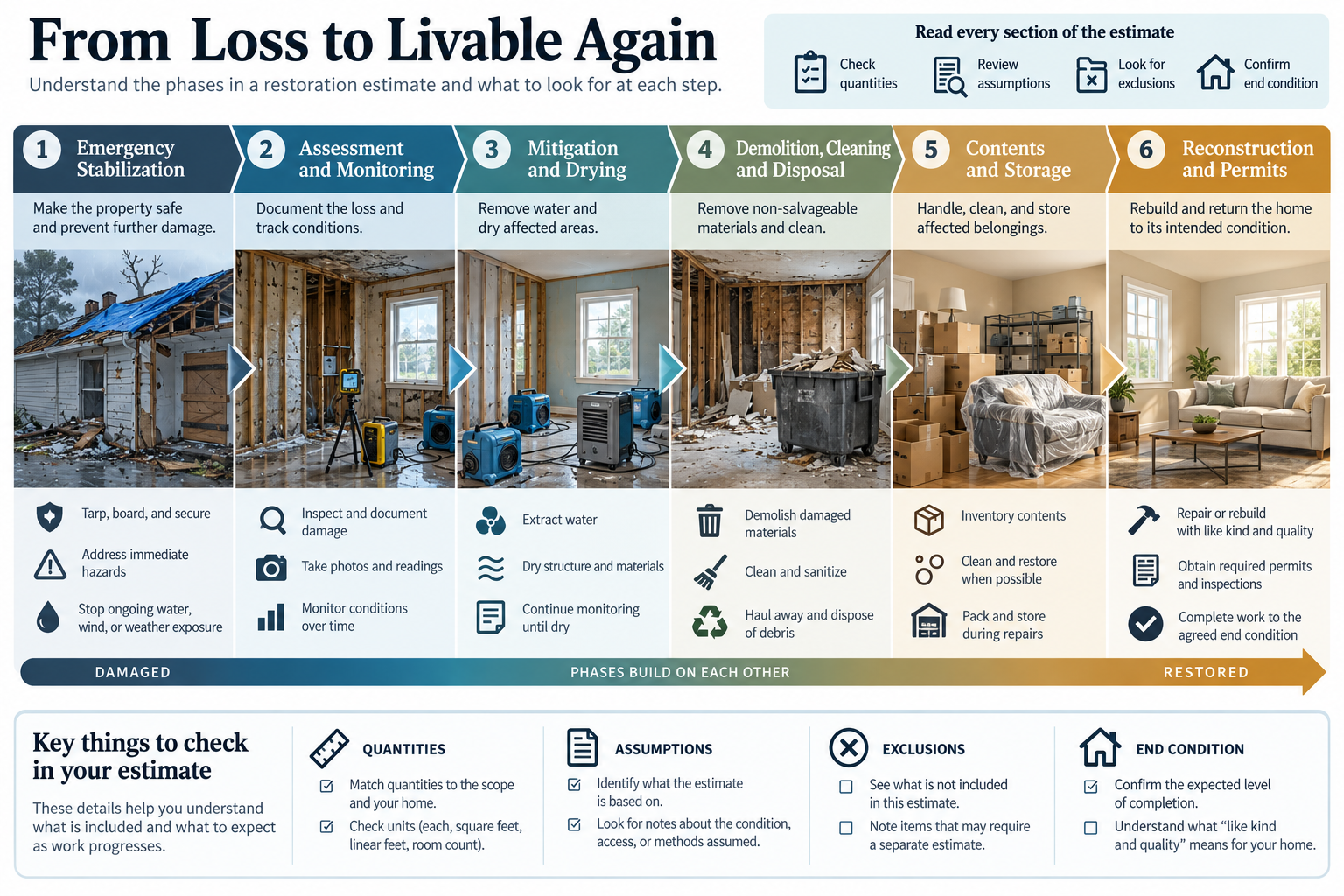
Sort the estimate by phase
Look for separate sections for:
- emergency stabilization and source-control coordination;
- inspection, moisture mapping, and monitoring;
- extraction, equipment, and drying duration;
- containment, demolition, disposal, and cleaning;
- contents, pack-out, treatment, and storage;
- reconstruction, systems, finishes, permits, and inspections;
- supervision, overhead, taxes, exclusions, and change orders.
The names and allocation of line items vary between companies. Controlled demolition may appear in mitigation because it is needed to expose or dry an assembly, while replacement appears in reconstruction.
Ask what each number assumes
For every major line, ask for the area or quantity, unit, duration, labor, equipment, material, access assumption, and condition that would change the charge. Equipment pricing should say whether the charge is per day, per visit, or part of a job total. Drying time is condition-dependent, not a fixed number promised by a generic guide.
Ask whether contents, disposal, tax, permits, code work, system reconnection, temporary protection, and temporary housing are excluded. If a wall or floor must be opened before the full condition is known, ask how that discovery will be documented.
Compare contractor and adjuster scopes carefully
An adjuster reviews damage and policy terms; a contractor describes physical work. An insurer may pay in stages or divide structure, contents, and additional living expenses. Neither document automatically resolves a technical disagreement about drying, removal, or reconstruction.
Use the estimate to make missing work visible. Do not add every possible phase to the bill automatically, and do not assume that a line item is covered because it appears in a contractor’s scope.
Questions before accepting
Ask: What condition did you observe? What is included and excluded? Which scope is temporary? Who handles the source repair? Which items are subject to a supplement? What records will I receive? What ends the mitigation phase? Which permits and inspections are included?
Those answers are more useful than comparing two unexplained bottom-line totals.
Start with the condition, not the total
The first page may show a grand total, but the decision begins with what happened, what is damaged, and what condition the contractor intends to create. Ask for the rooms, assemblies, quantities, and assumptions behind that total. If the scope is still changing, identify which lines are known and which are contingent.
This is particularly important when a clean-looking water loss reaches hidden cavities, when smoke or ash crosses a room boundary, or when a flood affects utilities and contents. The estimate needs a condition story before the numbers can be compared.
Read the estimate in phases. Emergency stabilization may include a board-up, tarp, temporary protection, travel, or after-hours response. Assessment may include inspection, moisture mapping, testing where appropriate, photographs, and reporting. Mitigation may include extraction, air movement, dehumidification, monitoring, cleaning, containment, selective demolition, and disposal. Contents may include inventory, pack-out, treatment, storage, and pack-back. Reconstruction may include materials, labor, trade coordination, permits, inspections, taxes, and finish work.
Not every loss needs every phase. A line-item map is useful because it makes omissions visible; it should not turn possible work into automatic work. Ask which observed condition supports each phase and what the property will be like when that phase ends.
Units and assumptions matter
A price is easier to compare when the estimate shows the unit of work: room, square foot, linear foot, item, equipment day, labor hour, trip, load, or lump-sum task. Confirm whether quantities are measured, estimated, or allowances. Ask whether labor, materials, equipment, setup, monitoring, travel, disposal, taxes, and markup are included.
Words such as “as needed,” “allowance,” “TBD,” and “supplement” shift uncertainty into the future. That may be reasonable when an assembly cannot be opened safely yet, but the estimate should say what triggers added work and how approval occurs. A detailed list is not necessarily a better scope if its quantities are unsupported; it is simply easier to question.
Read the estimate as a condition story
The estimate should explain what happened, what was observed, what remains unknown, and what condition the contractor expects to create. Start by marking each line as observed work, an allowance, a contingency, a recommendation, or an optional improvement. Then identify the room, assembly, quantity, unit, and phase for each item.
This is especially important when the loss involves hidden moisture, smoke or ash, sewage, floodwater, contents, or structural movement. A broad “clean and restore” line may conceal several decisions. A long estimate may still omit reconstruction or contents if those phases are outside the contractor’s scope.
What common line groups mean
Emergency lines can include travel, after-hours response, board-up, tarp, temporary protection, source-control coordination, and documentation. Assessment lines can include inspection, moisture mapping, photographs, testing where appropriate, and reports. Mitigation lines can include extraction, air movement, dehumidification, monitoring, containment, cleaning, controlled demolition, and disposal.
Contents lines may include inventory, packing, transport, storage, treatment, disposal, and return. Reconstruction lines may include materials, labor, trade coordination, system reconnection, permits, inspections, protection, taxes, supervision, and final cleanup. The same task can be allocated differently by different companies, so compare the work and end condition rather than the label alone.
Find omissions without adding work automatically
Ask whether the estimate includes the source repair, affected HVAC, electrical or structural assessment, contents, temporary living, storage, disposal, permits, code work, finish matching, and cleaning. If a category is not listed, ask whether it is excluded, assigned to another contractor, not yet known, or unnecessary for the observed condition.
Do not turn a checklist into an automatic package. A clean-water loss does not necessarily need containment, a partial room move may not need full-house storage, and a small finish repair may not need a whole-home rebuild. Each phase should connect to the condition and a stated decision.
When a supplement is reasonable
Hidden conditions can make a supplement legitimate. The estimate should record the discovery, affected area, quantity, evidence, proposed remedy, and approval path. Examples include a wet cavity found after a finish is removed, a subfloor damaged below flooring, or a code requirement identified by the authority. A supplement is harder to evaluate when it simply adds a large allowance without showing what changed.
Keep contractor, adjuster, and policy documents separate. The insurer may organize structure, contents, and additional living expenses differently from the contractor’s phases. A line item in a contractor estimate is not automatically covered, and a missing line is not proof that the work is unnecessary.
A final comparison checklist
Before accepting an estimate, confirm the starting condition, ending condition, rooms, quantities, charging units, equipment duration, labor and material assumptions, access, disposal, taxes, markup, permits, inspections, exclusions, change-order rules, and responsible handoff. Ask which records you receive at completion.
The goal is not the longest estimate or the lowest total. It is a scope that lets the homeowner see what is being purchased, what remains uncertain, and what later decision could change the price.
A worksheet for estimate revisions
When a scope changes, compare the original and revised versions by room and phase. Mark each line as unchanged, added, removed, quantity-changed, price-changed, or moved to another trade. Then write the reason: a newly opened assembly, a revised measurement, a professional assessment, an authority requirement, a missed item, or a homeowner selection. The reason matters as much as the amount.
Also compare what is no longer included. A lower total may reflect a deleted drying day, a reduced contents allowance, a different finish, an excluded permit, or work transferred to another contractor. Ask whether the revised end condition is still the same. If it is not, the estimates are not alternatives for the same decision.
This method is useful during insurance review because it keeps three conversations distinct: what damage exists, what work is reasonably needed to restore it, and what the policy pays. A contractor can explain the first two; the insurer determines coverage under the contract. The estimate should make those boundaries easier to discuss rather than implying that a line-item format decides coverage.