
Professional well disinfection or shock chlorination is a service used in some contamination, flood, repair, or construction situations. A current US specialist source treats professional well shocking as a distinct service, but does not establish a durable national price. The final cost depends on well geometry, access, flushing, source correction, laboratory testing, and whether the treatment must be repeated. This is a cost and scope guide, not a DIY chlorine procedure.
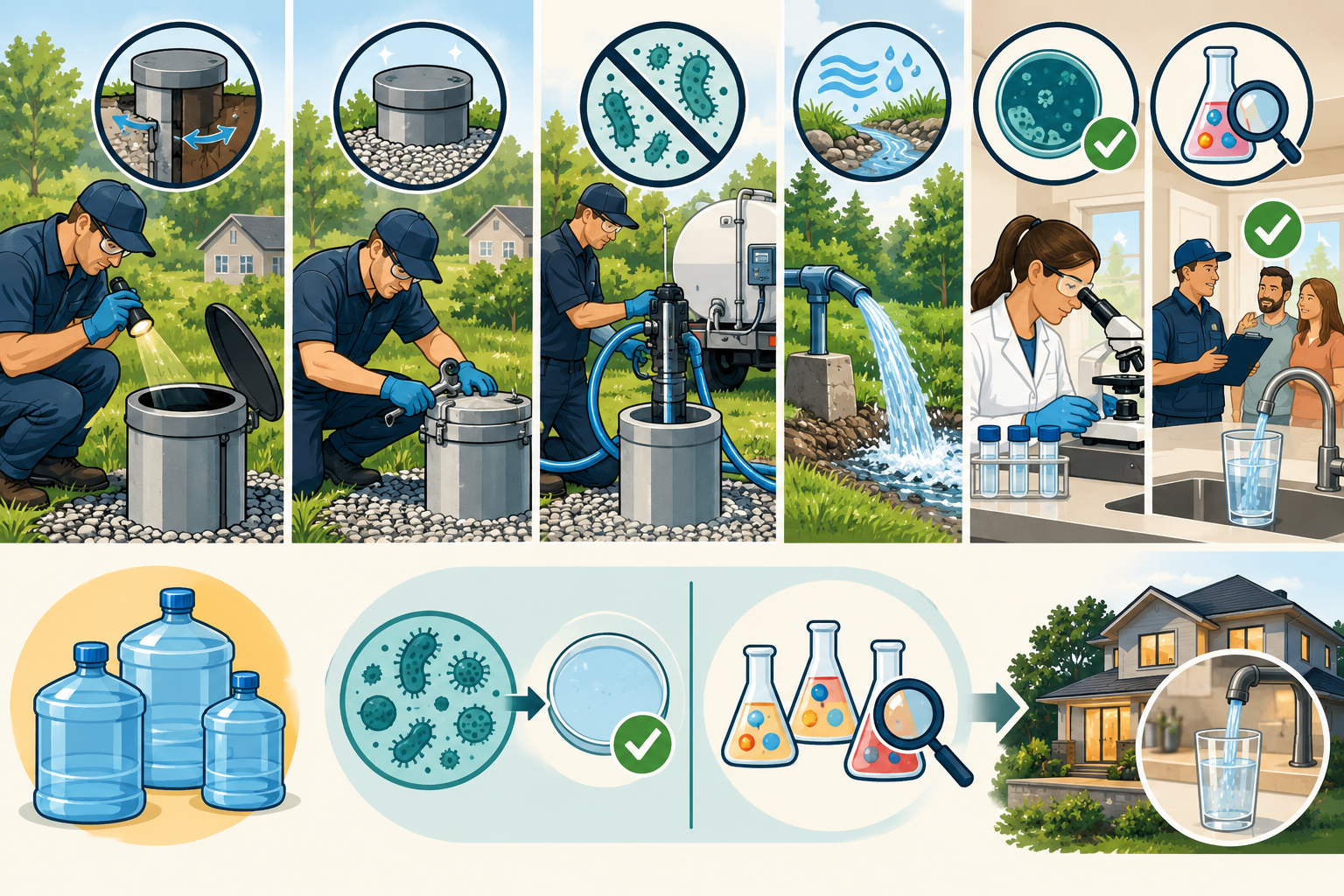
When disinfection may be recommended
EPA organizes post-flood response around inspecting the well and pump, disinfecting when appropriate, and sampling before normal use. Health Canada describes shock treatment as a response to microbial contamination and says a contamination source should be removed or repaired where possible. Current local public-health guidance controls the decision for the actual property.
Disinfection does not permanently correct a cracked casing, poor seal, surface-water entry, septic problem, recurring source, or other pathway. If the cause remains, the result can return and the household pays for repeated service without solving the system problem.
What the professional service includes
The scope may include reviewing the laboratory result or event, inspecting the wellhead and pump, selecting a system-specific treatment, bypassing or protecting equipment as appropriate, circulating and flushing the system, coordinating safe discharge, and collecting follow-up samples. The provider should also explain temporary water-use restrictions and the conditions for return to normal use according to local authority instructions.
Well depth, casing diameter, pump arrangement, treatment devices, access, septic and surface-water proximity, and discharge location change the labor and risk. A deeper or more complex system can require more product, handling, time, and testing, but do not infer a chemical amount from a generic table.
Testing is part of the decision
A treatment event should not end when the chlorine smell disappears. Public-health guidance determines when and how to sample, what laboratory to use, and whether repeat tests are needed. Health Canada guidance describes follow-up sampling and continued safe-water precautions until acceptable results are established; applicability depends on the jurisdiction and event.
A disinfection invoice is not the full event budget
After a flood, the complete recovery budget may also include qualified well and pump assessment, temporary water, event-selected sampling, a repair, collection and laboratory fees, and follow-up. After wildfire, disinfection alone does not investigate possible chemical contamination or damaged components. Use the separate guides to flooded-well recovery and wildfire-affected well recovery for those wider cost branches. Neither guide provides a universal return-to-use rule.
Include initial testing, disinfection, post-treatment testing, and possible repeat confirmation in the budget. If a well is flooded, damaged, or repaired, the physical inspection and source correction may cost more than the disinfection itself.
Three cost cases
Focused service: A documented microbial result, accessible well, no visible source defect, professional disinfection, and a defined follow-up sample.
Event response: Flooding or repair creates additional inspection, equipment protection, flushing, temporary water, sampling, and possible restoration.
Recurring contamination: The first disinfection is followed by another positive result. Budget source investigation, wellhead or casing repair, septic or drainage evaluation where supported, repeat testing, and possibly continuous treatment rather than repeated shock service alone.
Disinfection versus continuous treatment
Shock disinfection is an event intervention. UV or another certified treatment system is a separate ongoing control strategy that may be considered when contamination cannot be corrected or recurs. It requires appropriate pretreatment, power, maintenance, monitoring, and testing. Do not install UV because a smell or one test suggests it without confirming the treatment objective and equipment claim.
Safety and professional boundary
Well disinfection involves chemicals, contaminated water, electrical equipment, pressure, discharge, and treatment devices that may be damaged by the process. Health Canada guidance includes system-specific precautions and notes that first-time operators may hire a licensed contractor. Follow the current authority and manufacturer instructions; do not use this article to calculate bleach, open a well, or decide when water is safe.
Questions for the quote
- What event or test result supports disinfection?
- Will the source pathway and wellhead be inspected first?
- Are equipment bypass, flushing, discharge handling, and temporary water included?
- Which laboratory and follow-up samples are included?
- What result permits return to normal use?
- What is the plan if contamination returns?
- Are local contractor, authority, notification, or record requirements involved?
US price orientation should not be converted into CAD. The correct local total includes the full corrective sequence and the authority’s return-to-use requirements. A one-time treatment is economical only when it is matched to the cause and verified afterward.
Separate treatment from source correction
Ask the provider to state whether the wellhead, casing, drainage, pump, treatment equipment, and nearby contamination pathways were inspected. If a source defect remains, repeated shock treatment can become an expensive holding pattern. If the water is contaminated after flooding or repair, the inspection and follow-up sample may be as important as the disinfection service.
The quote should identify who supplies temporary water, who collects samples, which laboratory is used, what discharge restrictions apply, and what happens if the first follow-up result is not acceptable. Those lines control the total more than the chemical product itself. A provider who promises a same-day return to use without an authority-appropriate test is not offering a complete corrective scope.
Decide when recurrence changes the economics
One event may justify one professional disinfection. A repeated result changes the decision toward source investigation, casing or wellhead work, drainage or site correction, and possibly continuous treatment. Compare the cost of repeated service and testing over the ownership horizon with a certified UV or other treatment system, while preserving the responsibility to correct a physical contamination pathway.
Make the service scope comparable
Ask whether the provider is pricing a planned repair-related disinfection, a microbial-result response, or an emergency flood response. The same word can conceal different work. Compare the sample interpretation, inspection, equipment protection, flushing, discharge, temporary water, laboratory follow-up, and repeat-visit terms.
The cost decision changes if the result returns. Repeated service should trigger a review of casing, cap, drainage, well construction, sampling, season, and nearby conditions. Continuous UV or another treatment barrier may be a reasonable comparison only after the authority and professional determine that source correction cannot remove the risk. Budget the barrier’s pretreatment, power, monitoring, lamps, service, and testing.
Keep the treatment record with the water tests and well repairs. The dates, provider, sample point, result, and follow-up decision help determine whether a later positive sample represents recurrence, a new event, or an incomplete response. That information has direct economic value because it prevents repeating a service without learning from the first one.
Price the safe-water interval as part of the project. A household may need temporary drinking water while the well is inspected, disinfected, flushed, and tested. The provider should state which steps are complete before normal use and which authority or laboratory controls the answer. That sequence is more important than a low service-only price.
Price the return-to-service decision
The household’s real question is not only what a provider charges to introduce a disinfectant. It is when the water can be used normally again and what evidence supports that decision. Include the laboratory sample, authority interpretation, temporary water, equipment reconnection, and any repeat visit in the scope. A service-only total can be misleading if the owner still cannot use the water or needs another sample before the response is closed.
Keep the event record with the result that triggered the work: the sample point, date, well condition, treatment performed, flushing or discharge limits, follow-up result, and any repair. If contamination returns, that record helps distinguish recurrence from a new event and directs spending toward source correction or an appropriate ongoing barrier. It also prevents a future contractor from repeating a generic disinfection without understanding what happened the first time.
Decide when the first response is complete
The service is not economically complete when the chemical or service visit ends. The owner needs the agreed follow-up sample, result interpretation, and a plan for what happens if the result is still positive. For a one-time event, that may close the project after source conditions are corrected. For recurrence, the next expenditure should be directed toward finding the pathway or evaluating an appropriate continuing barrier, not automatically toward another identical visit.
Ask for separate prices for inspection, disinfection, laboratory work, temporary water, repairs, and repeat service. This prevents a low disinfection allowance from hiding the actual response and makes competing providers comparable. Keep the property record with the sample points and dates so future decisions are based on a pattern rather than memory.