
“Casing repair” can describe a modest above-grade correction, a liner or sleeve, or extensive work that changes the well’s construction. “Wellhead repair” can mean a cap, seal, exposed casing, drainage, or connection issue. Those scopes have very different costs. Current US specialist market observations identify material, diameter, depth, access, and labor as major drivers but do not establish a universal price or Canadian benchmark.
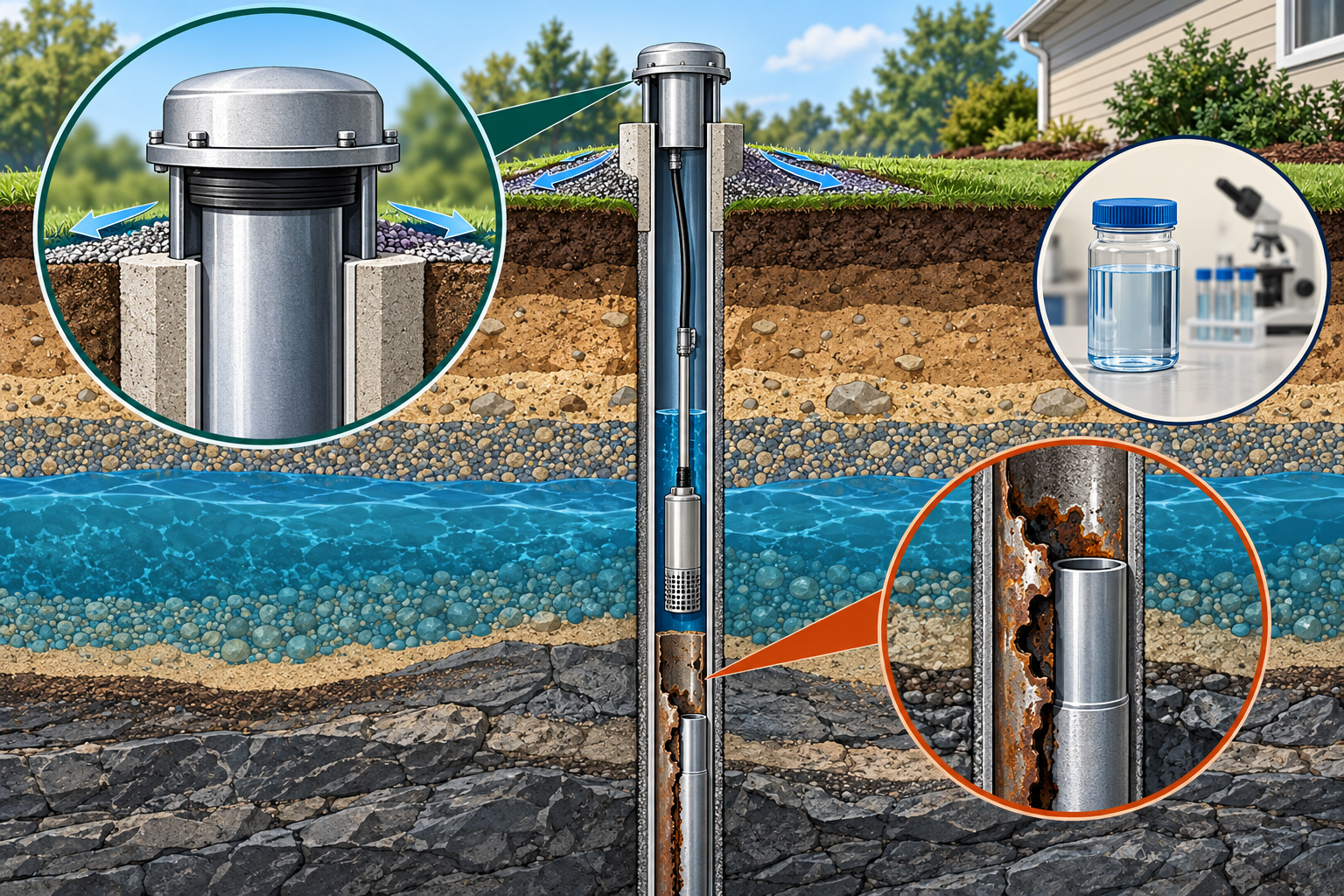
Why the wellhead matters
EPA describes casing as maintaining the well opening and helping keep undesirable water out, and a cap as limiting entry by debris, insects, and animals while controlling venting. The wellhead also needs protection from surface water and damaging site drainage. A missing or damaged cap is therefore not merely an appearance issue.
The first inspection should identify what is visible, what is below grade, how the well was constructed, whether the casing is sound, and whether the problem may have allowed contamination. Do not cover a damaged wellhead with a generic seal without addressing the water-quality and construction question.
Minor wellhead work
A focused job may replace a cap, seal, vent, exposed fitting, short connection, or damaged above-grade component. Access, seized hardware, corrosion, electrical proximity, and the need for disinfection or water testing can expand the scope. Ask for photographs and a defined explanation of what is being protected.
Surface grading can also be part of the correction when runoff reaches the well. If excavation, drainage, or landscaping restoration is substantial, make those lines visible and coordinate with the appropriate site-drainage scope.
Casing damage and major repair
Cracks, corrosion, settlement, deformation, or a damaged casing can require a sleeve, liner, partial replacement, or more extensive reconstruction. The method depends on material, diameter, depth, borehole condition, screen, water-bearing formation, and local construction requirements. A deep casing intervention may involve pump removal, specialized equipment, testing, disinfection, and a difficult access premium.
Do not generalize a casing requirement from one jurisdiction. EPA’s component overview emphasizes local geology and governing requirements; Ontario and British Columbia provide current examples of licensed professional involvement, but neither establishes a universal Canadian construction method.
Cost structure
Budget separately for inspection and diagnosis, wellhead materials, excavation or access, pump removal, casing or liner materials, specialized labor, water handling, disinfection, laboratory testing, electrical or plumbing interfaces, site restoration, and records or permits where required. A low cap-replacement number is not comparable with a quote that includes deep casing access and post-repair testing.
Testing after compromised integrity
If a cap, seal, casing, flood condition, or repair has created a possible contamination pathway, follow current local testing and public-health guidance. A physical repair does not prove water quality. Treatment should follow a result and an investigation, not the appearance of the repaired wellhead.
Repair, rehabilitation, or new well
Repair may fit a localized wellhead defect with sound casing and source conditions. Rehabilitation addresses declining performance from a diagnosed well-condition problem. A new well becomes a competing option when casing damage is extensive, the borehole cannot be serviced, the source is inadequate, or repair cost approaches new construction plus closure of the old well.
Three scenarios
Above-grade correction: Replace a cap or seal, correct local drainage, inspect the system, and test when the authority or condition warrants.
Accessible casing work: A sleeve or liner is feasible, pump access is manageable, and the provider can measure post-work performance and water quality.
Major reconstruction: Deep, corroded, deformed, undocumented, or inaccessible casing requires specialized work. Compare the complete risk and cost with rehabilitation or a replacement well before authorizing an open-ended repair.
Quote checklist
- What exact component is damaged and how was it diagnosed?
- Is the scope above grade, below grade, or full-depth?
- What material, diameter, depth, and construction assumptions apply?
- Are pump removal, excavation, electrical, plumbing, testing, disinfection, and restoration included?
- What contamination or water-quality follow-up is required?
- Which local licenses, permits, records, or inspections apply?
- What is the stop point if the casing condition is worse than expected?
The best bid makes a visible distinction between protecting the opening, restoring the casing, and replacing the source. Request local pricing independently in the US or Canada; the available market data does not support currency conversion or a universal casing-repair range.
What evidence should accompany the quote
Ask for photographs, the accessible casing and wellhead dimensions, construction records, the suspected entry or structural failure, and any water-quality result. If the contractor cannot see the underground condition, the quote should identify the inspection or access step that will reduce the uncertainty. “Casing replacement” without depth, diameter, material, and method can conceal a major difference in scope.
The treatment consequence matters. A cap repair may need a follow-up sample. A casing intervention may require pump removal, disinfection, or a new treatment design. A grading correction may reduce surface-water exposure but cannot prove the casing is sound. Price these links explicitly, and do not let a physical repair stand in for laboratory verification.
For an owner deciding between repair and a new well, compare the likely repeat-work exposure. A localized, accessible repair with a measurable result can be good value. Extensive reconstruction in a deep or undocumented well may approach new construction while preserving the same geology and access. The decision is not based on the visible cap alone.
Price the interfaces
The repair may interrupt pumping, treatment, and household use. Ask who disconnects and reconnects the pump, pressure system, UV or RO equipment, electrical supply, and plumbing, and whether disinfection or sampling follows. A cap replacement that is cheap at the wellhead can still require a broader response if the seal was open to surface water or the repair disturbs the source.
For a buried or remote well, include locating, excavation, access, temporary protection, restoration, and future service access. For a deep casing intervention, ask for a staged authorization and an explicit stop point. The owner should know the price at which a replacement well becomes the better comparison rather than discovering that only reconstruction has been priced.
Keep the water-quality boundary visible
A casing or wellhead repair can protect the source, but it does not prove that the water is acceptable afterward. Price any authority-directed sampling, disinfection, treatment review, and temporary water separately. This keeps the physical repair from being mistaken for laboratory verification and helps the owner compare a localized correction with a more extensive source decision.
Ask what evidence supports the repair choice
The quote should connect the observed symptom to the proposed work: a damaged cap, poor drainage, exposed casing, seal failure, corrosion, collapse, or another condition. Photos, inspection findings, and the expected stopping point are more useful than a generic “well repair” allowance. If excavation or opening the well may reveal a larger defect, agree on the diagnostic and authorization limits before the crew starts.
Compare the repair with the cost of leaving the source vulnerable, including repeat sampling, treatment, downtime, and restoration. A minor wellhead correction can be good value when it addresses a clear pathway. A deep casing intervention may be difficult to justify without evidence that the construction can be repaired and that the post-work result will change the owner’s decision.
Plan the post-repair record
Ask the contractor to return the well record, photographs, materials or components changed, access conditions, and any test or disinfection result required by the local authority. The record should distinguish a cap or drainage correction from a casing intervention and should state what remains unverified. That distinction matters if water quality changes later or if a future provider must decide whether the source can be rehabilitated.
For a major repair, compare the post-work result with the pre-work condition: water-quality sample, visible integrity, yield or pressure behavior, or another defined measure. A repair that protects the opening but does not address a failing formation may be correct yet incomplete for the owner’s larger goal. Separating those outcomes makes the next budget—treatment, rehabilitation, or a new well—more defensible.