
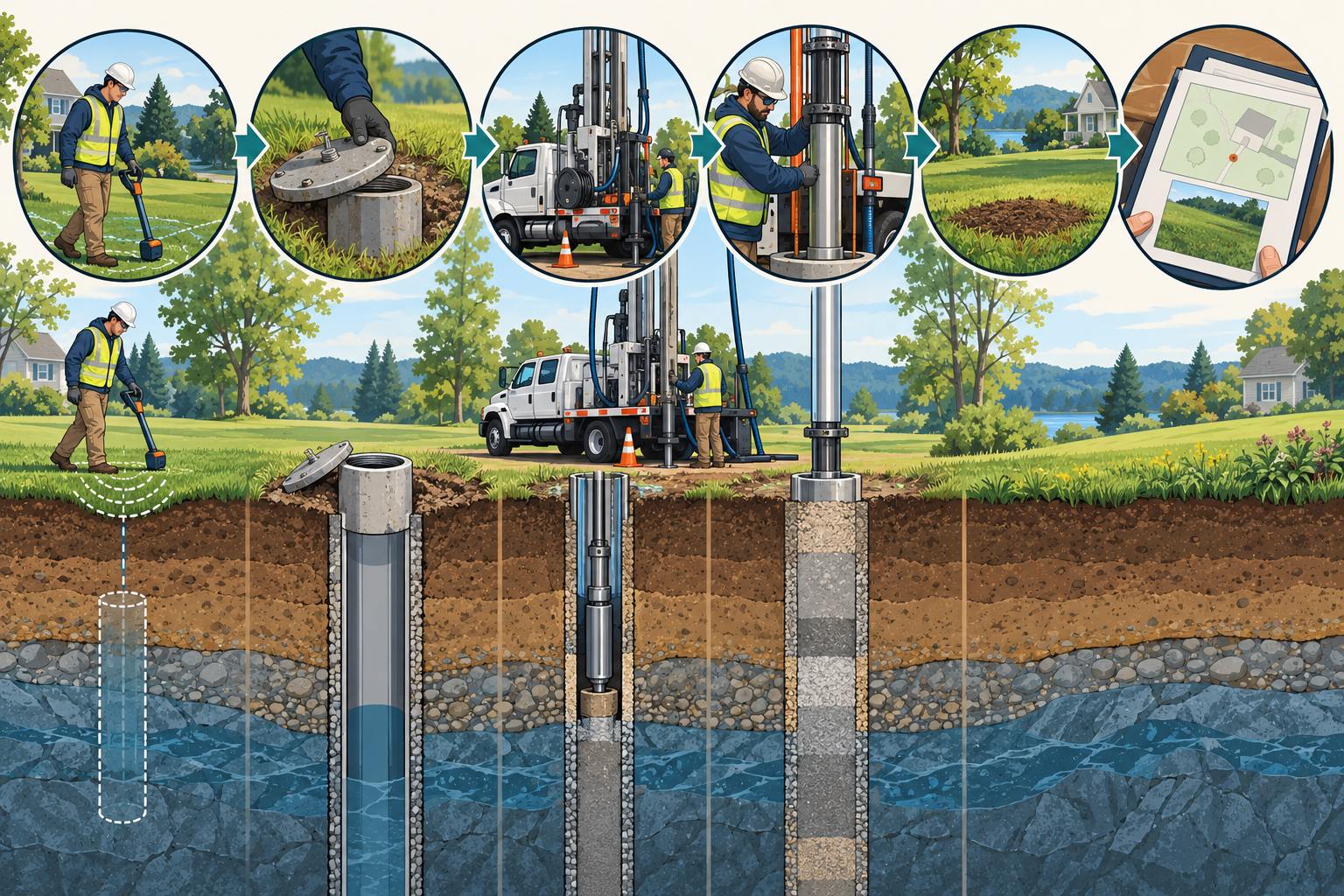
Leaving an unused private well open can create a groundwater, contamination, safety, and property-record problem. Proper closure may involve a licensed or qualified contractor, equipment removal, approved sealing or plugging materials, records, reporting, and site restoration. The exact legal and technical requirements vary materially by state, province, territory, and sometimes local authority, so no single national decommissioning price or procedure is reliable.
Unused is not the same as safely closed
An old well may still connect the surface to groundwater even when the pump is gone. Ontario states that private owners are responsible for maintaining and, when necessary, abandoning their wells, and directs owners to licensed contractors and technicians because well work can involve falling, gas, electrocution, and contamination hazards. Illinois and Iowa provide state examples of formal abandoned-well and plugging frameworks.
Those examples explain why “just leave it” is not a cost-free option. They do not establish the rule for another jurisdiction. Contact the responsible authority before covering, filling, or altering the well.
What the cost can include
A professional quote may include records research, site inspection, locating an undocumented well, removing pump or obstruction, mobilization, access, water handling, approved sealing or plugging materials, labor, reporting, inspection, and surface restoration. Depth, diameter, casing, water level, artesian or flowing conditions, unknown construction, and restricted access can materially increase the job.
If the well is being replaced, compare a combined drilling-and-closure proposal with separate bids. Some access and mobilization can overlap, but the closure still needs its own method, records, and responsibility.
Records and contractor requirements
Rules may specify who may perform the work, what material or sequence is acceptable, what permit or notification is needed, and what record must be submitted. Ontario’s current guidance, for example, addresses licensed work and well-record submission. It is not legal advice and does not apply automatically to the US or another Canadian province.
Ask the authority and contractor to state the applicable current rule and the documentation delivered at completion. A low price that omits required reporting is not a complete comparison.
Unknown and complicated wells
An undocumented well may need locating, probing, inspection, or a different access plan before closure. Large diameter, deep, damaged, flowing, contaminated, or obstructed wells may carry specialized equipment and safety costs. Do not accept a generic per-foot estimate until the contractor has explained the assumptions.
Three scenarios
Documented accessible well: The location, depth, casing, and pump are known, access is straightforward, and the authority’s requirements are clear. The quote can separate inspection, removal, closure, records, and restoration.
Unknown legacy well: The contractor must locate or characterize the well and may discover additional casing or obstruction. Carry a diagnostic allowance and an authorization threshold.
Replacement project: A new well is drilled while the old source is closed. Coordinate permits, records, site layout, equipment removal, testing, and restoration so the owner does not pay twice for access or overlook the old well’s closure.
Grants and cost sharing
Some jurisdictions or local programs may offer grants or cost sharing for abandoned wells, groundwater protection, or replacement work. Availability, eligibility, funding, and deadlines change. Treat a program as a potential offset only after confirming it with the current administering authority; do not reduce the base budget on an unapproved grant.
Quote questions
- Is this well legally or practically considered abandoned in the jurisdiction?
- Which authority, permit, notification, record, and contractor qualification apply?
- What depth, diameter, casing, obstruction, and water conditions are assumed?
- Are pump removal, access, materials, labor, inspection, reporting, and restoration included?
- What happens if the well is deeper, flowing, damaged, or undocumented?
- Can the closure be coordinated with a new-well project?
- What completion documents will be provided to the owner and authority?
The economics are resolved only when the price includes compliant closure and the risk of future responsibility is addressed. Obtain local pricing in the relevant currency and verify the current state, provincial, territorial, or local rule. This guide explains the decision; it is not a plugging procedure.
Treat the closure as a recordable project
Before work starts, collect any well record, construction detail, pump information, location photograph, and authority correspondence. Give the contractor a clear site plan and disclose unknown wells or obstructions. After completion, retain the closure report, permit or notification, inspection result, materials and method recorded by the contractor, and any updated property record required locally.
This documentation has economic value during a sale, future excavation, a new-well project, or a groundwater question. It also prevents a later contractor from having to rediscover the location and construction. A cheap undocumented fill can transfer the largest cost into a future transaction or corrective project.
Compare closure timing
Closing an old well during replacement drilling may reduce duplicate mobilization, but it should not be treated as automatically included. Ask whether the same rig, access, and contractor can perform both scopes and how the schedule handles a failed new well. If the owner is postponing a new source, a formal closure decision may still be required even when the old well is not visibly dangerous. Local authority guidance controls.
Do not compare an incomplete “fill” price
A low quote may cover only material placed near the surface. Compare the contractor’s inspection, access, removal, approved closure method, reporting, inspection, and restoration scope. Ask whether the price changes for greater depth, a larger casing, a flowing or obstructed well, contaminated water, or a location that cannot be reached by ordinary equipment.
The timing also matters for a sale. An unresolved old well can create questions about records, groundwater protection, excavation, future construction, and responsibility. Formal completion documents can be more valuable than a small initial saving. If a grant or cost-sharing program is possible, confirm eligibility and approval before treating it as part of the budget.
Decide whether the well is part of a larger project
An abandoned well can affect excavation, a replacement source, septic or drainage work, and a property’s disclosure history. Include those interfaces in the schedule and ask who is responsible for protecting the location until closure is complete. A professional closure is a bounded project when the site, depth, method, reporting, and completion record are known; it is an uncertainty problem when the well is undocumented or obstructed.
Plan the completion record before work starts
The closure is not complete when material has been placed. The owner should know what report, permit, inspection, map, photograph, or authority filing establishes that the work was accepted under the applicable rule. That record may matter during a sale, future excavation, a replacement-well project, or a question about groundwater protection. It is a project deliverable, not administrative decoration.
For an undocumented well, ask for a discovery stage with a clear authorization limit. The provider may need to locate the opening, establish approximate depth and diameter, identify an obstruction, assess access, or confirm whether a local closure pathway applies. Do not treat that uncertainty as a reason to accept an unlimited allowance. A staged quote lets the owner decide whether the next information is worth buying before committing to the full closure.
Use a staged quote for an unknown well
The owner should receive a completion record that identifies the property, well location, work date, provider, method, and any authority filing or inspection required locally. That record is part of the project’s value: it reduces uncertainty for future repairs, sale, construction, and groundwater-protection questions. Do not claim that one closure method or fee applies everywhere.
For a documented, accessible well, a provider may be able to price inspection, closure, reporting, and surface restoration as one defined scope. For an undocumented or obstructed well, ask for a discovery stage with a clear authorization limit. That stage may establish location, depth, casing, water condition, access, and the local closure pathway. Do not treat an allowance for unknown material or depth as a guaranteed total.
The decision can also depend on what happens next. If a replacement well, addition, driveway, or excavation is planned, coordinate closure before the larger project fixes the location or blocks equipment access. The cheapest timing is not always the lowest total if a later crew must reopen finished work or mobilize special equipment.