
Private-well ownership has recurring costs even when nothing appears broken. A realistic annual budget includes water testing, inspection or service, electricity for pumping, minor repairs, and a reserve for the pump, pressure tank, wellhead, and controls. Sophisticated treatment equipment is an additional budget layer. There is no useful universal percentage of home value or national annual fee; depth, demand, energy price, treatment, climate, and remoteness control the result.
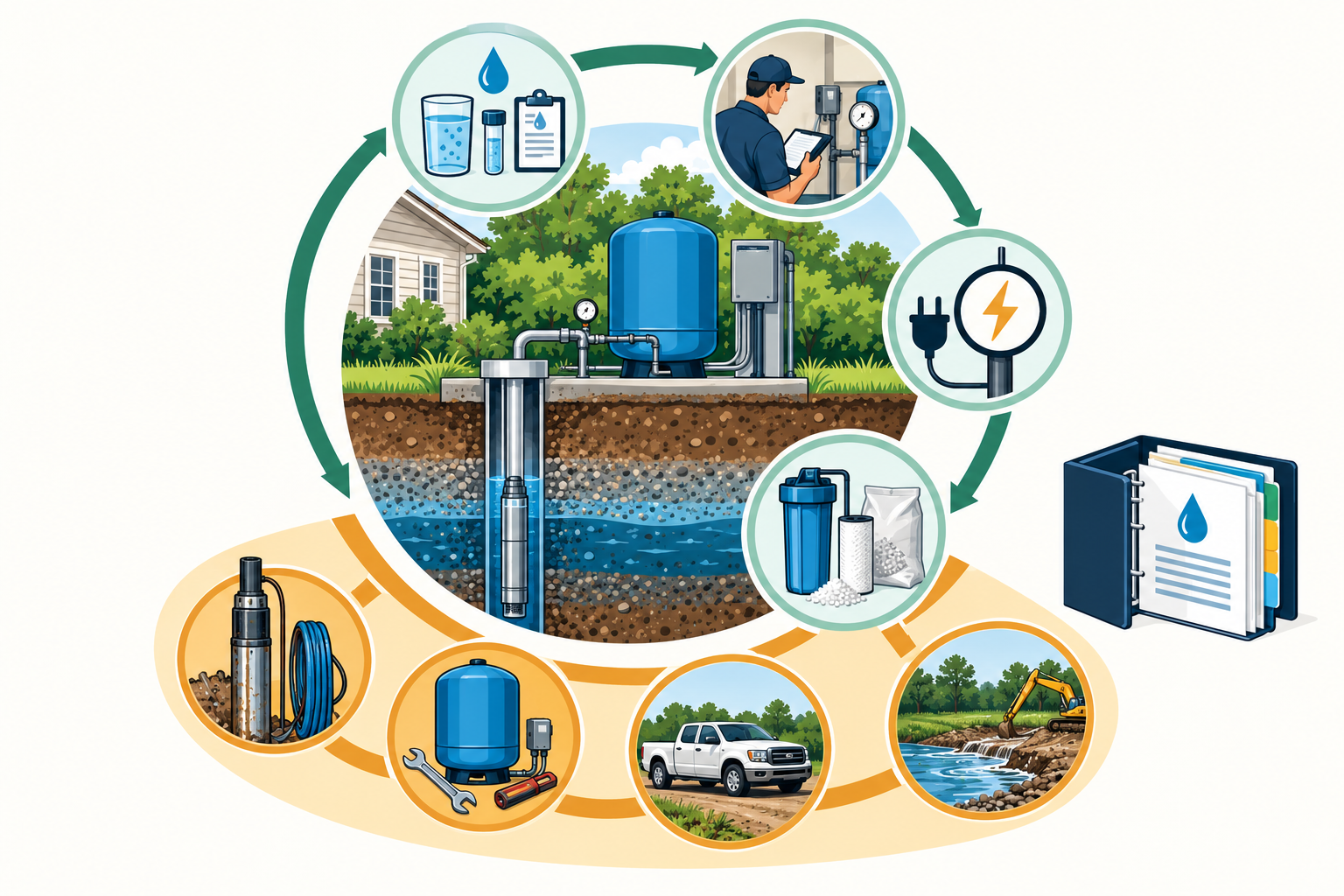
The recurring layers
Water quality: EPA and CDC guidance supports routine testing of a baseline group and additional testing after floods, repairs, construction, or changes in taste, odor, or color. Canadian owners follow provincial or territorial guidance. Testing is a recurring cost and a decision safeguard, not an optional luxury.
Physical condition: A professional check can document the wellhead, cap or seal, drainage, pressure equipment, records, and visible changes. More extensive yield or camera work is event-driven rather than an automatic annual package.
Energy: The pump’s operating cost depends on water demand, lift, pump efficiency, pressure, electricity rate, and treatment or booster equipment. A remote or storage-based system can add another pump and controls.
Service: Keep a reserve for minor controls, gauges, valves, leaks, access, travel, and emergency calls. A low annual average does not mean the expense arrives smoothly; a pump or tank replacement is a lumpy event.
Capital reserve: Set aside money for eventual pump, pressure-tank, controller, wiring, wellhead, or treatment replacement without pretending that one life-span number applies to every system. Use the actual equipment records and local replacement quotes.
Testing and inspection budget
The cheapest routine plan is not always the correct one. A new owner, recent repair, flood, land-use change, altered water quality, or vulnerable household member may justify additional authority-directed testing. Alberta gives one provincial example of at least annual bacterial testing and routine chemical analysis every three to five years, but that is not a Canada-wide schedule.
Record the laboratory, panel, date, results, well condition, pump work, and treatment changes. A record lowers future diagnosis cost and helps a buyer or service provider understand whether a change is new. Inspection cost should be based on the service’s scope; a visual visit and a yield test are not interchangeable.
Electricity and peak demand
Energy modeling is more useful than a generic monthly allowance. Track how often the pump runs, how much water the household uses, whether irrigation or livestock shares the source, and whether a treatment or booster runs continuously. A low-yield well may have a modest daily energy demand but still require storage and another pump to meet peak use.
If the property depends on a well during outages, a backup-power decision belongs with the power system. The well budget should still identify which pump, controls, treatment, and booster need power and whether their electrical requirements are compatible with the proposed backup.
Seasonal and rural variation
Freezing conditions, drought, flooding, difficult access, long travel, seasonal occupancy, and weak-grid conditions can raise both planned and emergency costs. Protecting the wellhead from surface water and keeping records can reduce avoidable problems, but no maintenance plan guarantees a stable aquifer or pump.
Remote owners may rationally carry a larger parts or emergency reserve because a failed control can require travel and a second visit. Seasonal owners should price startup, shutdown, testing, and winterization responsibilities according to the actual equipment and local advice.
A practical annual model
Build the budget in layers rather than one average:
- routine laboratory testing and any authority-directed follow-up;
- planned inspection or service;
- modeled pumping and treatment electricity;
- expected filters, salt, lamps, media, or membranes;
- a reserve for minor repairs and emergency access;
- a capital reserve for pump, tank, controls, and treatment replacement;
- a separate allowance for unusual flood, drought, contamination, or source work.
Then compare the model with recent invoices and a local replacement quote. If the actual system includes treatment, use the separate maintenance article to calculate consumables and verification. If it has low yield, include storage or source-repair exposure rather than hiding it in ordinary maintenance.
Three ownership profiles
Simple documented well: Routine testing, occasional inspection, ordinary electricity, and a modest repair reserve. The owner knows the depth, pump, pressure system, and laboratory history.
Treatment-dependent well: Testing, cartridges or media, salt, lamp or membrane replacement, service, electricity, and verification may exceed the well-only budget. The device’s maintenance schedule controls the real cost.
Remote or variable well: Travel, seasonal work, flood or drought response, storage, backup power, and replacement access create a larger reserve and greater uncertainty. The annual average understates the cash requirement in a failure year.
Questions to ask when planning
- What testing does the current local authority or laboratory recommend?
- When was the well, pump, tank, and treatment system last documented?
- What is the measured demand and pumping energy?
- Which failures would require a pump pull, excavation, or remote mobilization?
- Which consumables and post-treatment tests recur?
- What reserve is appropriate for a pump, tank, or source intervention?
- Does the emergency plan cover power loss and safe water use?
US market prices and Canadian costs must be developed independently. The right annual number is an honest range built from this system’s recurring tasks and lumpy risks, not a false national average.
Turn records into a reserve
Start with the last several years of invoices if they exist. Separate routine testing and service from one-time failures, then identify the equipment that would be expensive to access: a deep pump, buried wellhead, remote storage, treatment train, or difficult trench. A reserve based on the actual system is more useful than applying a percentage to the home’s market value.
Use low, expected, and difficult cases. The low case may contain routine testing, ordinary pumping energy, and consumables. The expected case adds a service call, a minor control, or a treatment adjustment. The difficult case includes a pump pull, contamination response, drought-related source work, emergency travel, or storage and booster repair. The purpose is not to predict the exact year of failure; it is to avoid treating a lumpy expense as a surprise.
Review the model after a well repair, new household demand, irrigation change, flood, drought, or treatment installation. The system has changed when its source, pump, pressure, or treatment changes. Update the records and reserve rather than carrying forward a budget that no longer describes the property.
Distinguish a maintenance reserve from a failure budget
Routine testing and filter changes are planned expenses. A pump pull, wellhead excavation, treatment redesign, or contamination response is a disruption reserve with a different likelihood and consequence. Keep those categories visible so a low routine total does not create false confidence about the cost of losing water service. For a remote home, travel, temporary water, and a second visit may matter as much as the replacement part.
The reserve should also reflect access. Equipment that is indoors and serviceable by a local provider has a different exposure from a deep pump, buried tank, remote wellhead, or discontinued treatment media. Review the reserve when records show repeated callouts: repeated small repairs may be evidence that a larger replacement or source investigation deserves a comparison, not simply another line in the routine budget.
Separate the reserve into planned, probable, and disruptive layers. Planned costs include testing, consumables, electricity, and scheduled service. Probable costs include minor controls, valves, access, and a second visit. Disruptive costs include a pump pull, contamination response, storage or booster repair, temporary water, and source work. The layers should not be presented as a prediction of failure; they show which cash exposure the household must be able to absorb.
Review that model after a repair, new irrigation demand, household change, flood, drought, treatment installation, or change in local service availability. A reserve that matched the old system can become misleading after the source or equipment changes. The goal is not a precise annual number but a budget that makes the largest plausible interruption visible before it becomes an emergency.