
An ultraviolet system exposes flowing water to UV light as a microbial treatment barrier. It is not a universal chemical, sediment, or hardness filter, and its performance depends on the exact equipment, flow, water clarity, lamp condition, power, and pretreatment. A current US orientation for installed treatment systems is roughly $1,200–$3,600 across many configurations, but UV projects can fall outside that range and the evidence does not establish a Canada benchmark.
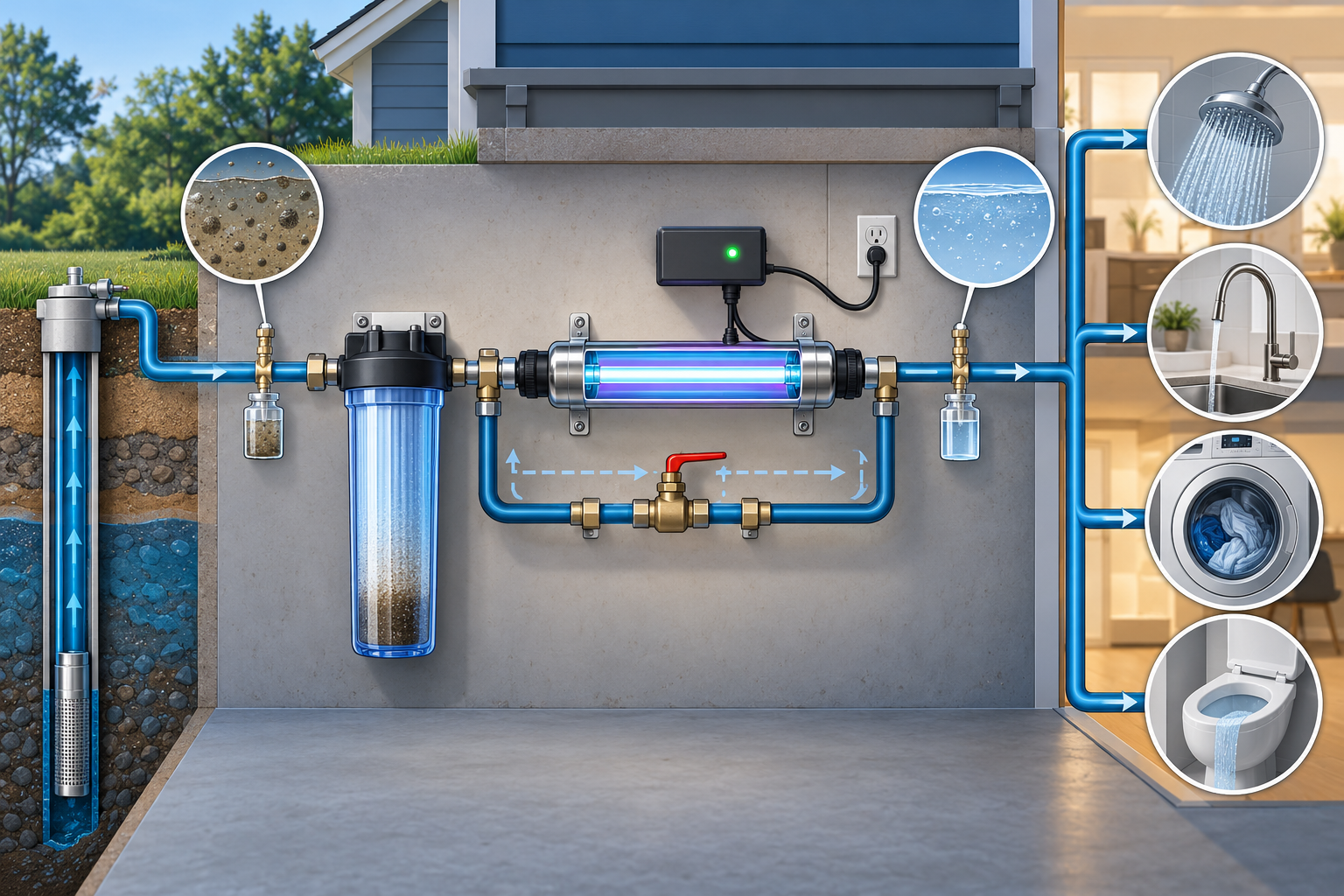
What UV does and does not do
Health Canada identifies UV Class A or NSF/ANSI 55 certification as a treatment context for bacteria, viruses, and protozoa, while requiring the actual certified claim and system conditions to be checked. NSF emphasizes that certification is not a ranking and does not mean a product reduces every contaminant.
UV therefore belongs after testing and source investigation. It may be used for a documented microbial objective, but it does not remove nitrate, arsenic, PFAS, hardness, iron, manganese, or sediment simply because those are present in well water. A separate treatment stage or source correction may be needed.
Pretreatment and water clarity
Particles and turbidity can interfere with the treatment path. A sediment filter, iron or manganese treatment, or another pretreatment stage may be required. Pretreatment adds tanks, cartridges, media, backwashing, pressure loss, drain capacity, maintenance, and cost.
Do not compare a UV lamp-only quote with a complete UV treatment train. Ask what raw-water result supports each stage and how the installer will confirm the system works at the home’s peak flow.
Installed-cost drivers
- certified performance claim and equipment size;
- peak flow rate and pressure;
- turbidity, sediment, iron, manganese, and other pretreatment;
- chamber, lamp, sleeve, sensor, alarm, and controller;
- plumbing bypass and installation location;
- dedicated electrical supply and outage strategy;
- access, space, drain, labor, and travel;
- initial and follow-up water testing;
- lamp, sleeve, cartridge, media, electricity, and service.
Whole-house systems need to treat the incoming flow, not only the drinking tap. A system sized for one outlet can be a poor fit for showers or simultaneous use. Conversely, whole-house UV can be unnecessary when the verified objective is limited and a certified point-of-use solution is suitable.
UV versus one-time disinfection
Shock disinfection responds to an event or microbial finding and may be paired with source correction and follow-up testing. UV is an ongoing barrier that requires continuous power, monitoring, lamp replacement, and appropriate maintenance. One does not automatically replace the other.
If contamination returns, investigate the source rather than using UV to hide a damaged wellhead, flood pathway, or other defect. If a public-health authority gives temporary water-use or return-to-service guidance, follow that guidance.
Maintenance and power
Lamp replacement, quartz-sleeve cleaning or replacement, sensor or alarm service, pretreatment cartridges, electricity, and verification testing create recurring cost. The interval is equipment- and water-specific. An outage can disable the system; include the pump, UV, controls, and any booster in a backup-power assessment where continuous treatment matters.
One model-specific maintenance example
Pentair’s PUV7/PUV14 manual rates its lamp for about 9,000 hours, roughly annual replacement under continuous use, and allows a two-year interval for seasonal-home use. It also calls for cleaning mineral coating from the quartz sleeve or replacing a sleeve that cannot be cleaned, and specifies sanitation and flushing after lamp or sleeve service. Those are instructions for these named models only; the manual gives no current part or labor prices. Confirm the installed model and current manual rather than applying its schedule or procedure to another UV system.
Three scenarios
Clear water, defined microbial objective: A correctly sized certified UV system with nearby power and minor pretreatment may be a focused installation.
Turbid or mineral-laden water: Pretreatment and higher maintenance dominate the budget. The quote should make pressure and backwash requirements visible.
Recurring contamination: Inspection, source correction, disinfection, testing, and then continuous treatment may be the complete sequence. UV alone is not a source repair.
Quote checklist
- Which test result and exposure objective support UV?
- What exact certification and contaminant claim applies?
- What maximum flow and water-quality conditions are assumed?
- What pretreatment is required and why?
- Are electrical, bypass, plumbing, testing, and outage provisions included?
- What are the lamp, sleeve, cartridge, electricity, and service costs?
- What monitoring shows that the system remains operational?
Do not use a generic “UV kills everything” claim. Obtain local USD or CAD pricing, match the equipment claim to the test result, and budget the maintenance needed to keep the treatment barrier operating.
Verify the complete treatment path
Ask the provider to show the incoming water test, maximum flow, UV dose or performance basis used by the specified model, pretreatment requirement, alarm behavior, and sample points. The homeowner does not need to perform the design, but should be able to see how the equipment relates to the actual water. A lamp that is on is not the same as a verified treatment result.
A whole-house system also needs a plan for taps used during maintenance, power loss, or bypass. That plan should come from the treatment professional and local guidance. If the raw water is cloudy or carries iron, manganese, or sediment, the pretreatment may require more attention than the UV chamber itself.
Compare one-time and recurring cost
For a single contamination event with a correctable source, professional disinfection and follow-up testing may be less expensive than installing and maintaining UV. For repeated contamination that cannot be corrected, UV may be worth comparing over five or ten years. Include lamps, sleeves, alarms, filters, electricity, service, laboratory tests, and backup-power implications in both cases.
Ask what failure looks like
The quote should state the maximum treated flow, the water-quality assumptions, the certification or verified performance claim, pretreatment, alarm or sensor behavior, and the action required when the lamp, sleeve, power, or filter fails. A whole-house device can leave every outlet affected by one maintenance event, while a POU device can leave other taps untreated. That operational boundary belongs in the household plan.
Compare the cost of keeping the system reliable with the cost of correcting the source. A cracked cap, surface-water pathway, or recurring microbial condition may require well work before UV. If the source cannot be corrected, include testing and service in the permanent treatment budget. The right answer is a verified treatment barrier, not an illuminated chamber purchased without a water result.
The owner should also price the consequence of a failed alarm, sleeve, lamp, pretreatment filter, or power supply. A whole-house system can interrupt every outlet; a point-of-use system can leave other outlets untreated. The correct maintenance and temporary-water plan should be clear before the equipment is accepted.
Decide whether UV is a source solution or a barrier
The acceptance record should identify the model, certified claim, maximum flow, pretreatment condition, sample points, alarm behavior, and maintenance contact. A lamp that is illuminated is not by itself proof that the treated water meets the intended objective. The value of the system is a maintained and verifiable barrier, not just a chamber installed in the water line.
For a seasonal property, include startup and shutdown, stagnant periods, power restoration, and who confirms safe operation before occupancy. For a full-time home, include a service response plan and temporary water if an alarm interrupts every outlet. These details can outweigh a modest equipment-price difference because they determine whether the barrier remains dependable when it is needed.
UV can be part of an ongoing treatment strategy, but it does not repair a compromised well or remove every water-quality concern. If the result follows flooding, construction, a casing issue, or another identifiable event, price source inspection and correction separately. If a continuing microbial risk remains after professional and authority review, compare UV with other approved or suitable approaches using the same treated outlets and verification plan.
The installed total should include pretreatment, flow control, electrical work, alarms, sample access, commissioning, and the first replacement cycle. Ask what performance is assumed when water is cloudy or the lamp is near its service limit. That is where a low equipment price can become a high ownership cost: the barrier depends on conditions outside the chamber.