
A current US specialist estimate places the average well-pump replacement around $1,898, but the average is less useful than the scope behind it. Depth, pump type, pipework, wiring, labor, access, controls, and pressure equipment can move a replacement well outside that figure. It is an orientation point, not a national price guarantee and not a Canada benchmark.
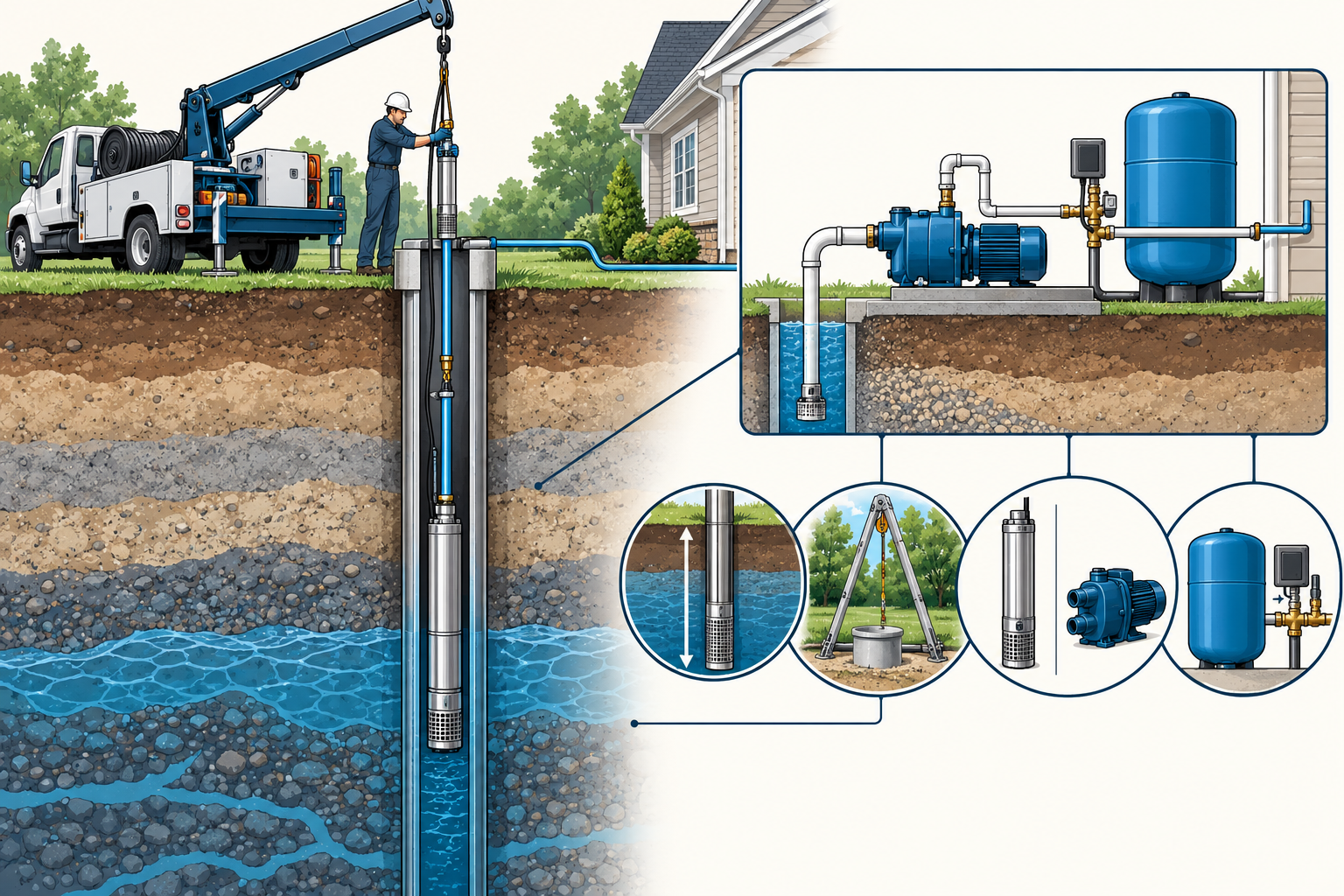
What a complete replacement quote includes
The base equipment is only one line. A complete quote may include diagnosis, disconnecting and pulling the old pump, the new pump, drop pipe, cable, safety rope or fittings where applicable, pitless or wellhead connections, controls, pressure switch and gauge, pressure tank, labor, testing, disposal, access, travel, and restoration. Not every replacement needs every line, so the quote should say what is retained.
Ask for the well depth and water level assumptions, proposed pump capacity, pump type, pipe and cable specifications, pressure settings, and compatibility with the existing well and pressure system. A pump selected only from the house size can be mismatched to the source.
Submersible and jet systems
The US Environmental Protection Agency describes jet pumps as commonly used for shallow wells and submersible pumps as commonly used for deeper wells, while emphasizing that configuration depends on construction, depth, geology, frost conditions, and local requirements. These are useful distinctions, not universal sizing rules.
A submersible pump sits inside the casing, so replacement can involve pulling the pump and the full drop assembly. A jet arrangement places the pumping equipment above ground and uses a well connection suited to its configuration. The access, pipework, controls, and labor are therefore different even when the homeowner’s symptom is the same.
The depth and access premium
Depth affects more than pump size. It affects the length and weight of drop pipe and cable, the time to pull and reinstall equipment, the available pump choices, and the consequences of losing a component down the well. A buried wellhead, tight access, landscaping, frozen ground, or remote travel can add staging and restoration.
The least expensive-looking proposal may assume easy access and reuse every existing component. Another may replace cable, controls, fittings, and a tank because their condition is visible once the system is open. Normalize those assumptions before calling one bid expensive.
Pressure equipment and electrical work
Pump replacement and pressure-tank replacement are related but not identical. A pump can be new while an old tank, switch, gauge, or manifold remains. Conversely, a tank problem can produce pressure symptoms without a failed pump. The quote should identify whether the pressure-side equipment is being tested, reused, or replaced.
Electrical work may include cable, disconnects, controls, grounding, or a circuit issue. Where a line-voltage fault is found, the appropriately qualified electrical trade may need to be involved. Keep that work visible instead of treating it as an undefined pump allowance.
Conventional replacement versus constant pressure
A conventional replacement restores a pump and pressure arrangement. A constant-pressure or variable-speed system is an upgrade involving different controls and compatibility questions. It may make sense for a household bothered by pressure cycling or with a suitable system design, but the equipment complexity and future service model are different. Compare it as an alternate system, not as a free pump upgrade.
Repair versus replacement
Replacement is easier to justify when the pump has a confirmed internal failure, the pump must already be pulled, repair parts are uncertain, failure has repeated, or a new system improves compatibility with the source and controls. Repair may be more economical when the fault is in an accessible switch, valve, controller, or wiring interface and the pump has a good history.
Ask what would happen if the pump is pulled and the original fault is not found. An honest proposal may carry a diagnostic or pull allowance and state the price for repair versus replacement. Avoid a decision based on the new-pump price alone.
Three replacement cases
Simple case: A known pump failure, straightforward access, a documented well depth, reusable drop pipe and pressure tank, and no electrical or water-quality issue. The price is mostly equipment, labor, testing, and disposal.
Typical case: The pump is pulled, the cable or fittings need renewal, controls are updated, and the pressure tank is evaluated. A realistic quote includes allowances for condition discovered during removal.
Difficult case: Deep or inaccessible equipment, a buried or damaged wellhead, restricted mobilization, poor records, or a low-yield source. The replacement may expose a separate casing, rehabilitation, storage, or new-well decision.
Quote checklist
- Identify pump type, manufacturer, model, capacity, and operating assumptions.
- State well depth, static water level, pumping level, and access assumptions where known.
- Separate pump, pull/install labor, drop pipe, cable, controls, tank, fittings, electrical work, travel, disposal, and testing.
- State whether the old tank, switch, gauge, wire, and pipe are reused.
- Explain change-order authorization if the pump cannot be removed as expected.
- Identify the warranty for the equipment and the installation separately.
- Record the final equipment details and measured performance for future service.
US and Canadian pricing
The available price evidence is US-oriented. Canadian labor, travel, equipment availability, and seasonal access can materially change a CAD quote. Do not apply an exchange rate to the US average. Obtain local bids that describe the same complete replacement, and ask whether testing, disinfection, treatment, or house plumbing is outside the pump scope.
The right comparison is not “Which pump is cheapest?” It is “Which proposal restores a compatible water system, with the pump pull, pressure equipment, electrical boundary, and difficult conditions priced honestly?”
Capacity is a system decision
Ask the installer to show the assumptions connecting well production, water level, pump capacity, pressure target, vertical lift, pipe friction, and peak household demand. The purpose is not to make the homeowner size a pump, but to make the design reviewable. A pump that can create more pressure than the source or piping can support is not automatically an upgrade.
If the replacement changes pressure settings or the pump’s operating behavior, ask whether the pressure tank, switch, wire, controller, treatment devices, and backup-power plan remain compatible. A pump quote that excludes these interfaces may be cheaper only because it transfers the risk to the next service call.
Control the unknowns before work starts
Agree on how the installer documents the old pump, the condition of the drop assembly, and the final equipment. Set a change-order process for a broken fitting, damaged cable, inaccessible wellhead, or unexpected water level. If the household cannot be without water, price temporary supply or a scheduled outage window. These details do not make the pump more powerful, but they make the replacement total more predictable.
For a long ownership horizon, value serviceability and records alongside initial price. A common, documented pump and accessible pressure system can lower future diagnosis cost. For a short horizon, avoid paying for an upgrade whose benefit is not material to the household, but do not omit required compatibility or water-quality work simply to meet a sale budget.
Decide what success means before replacing the pump
The replacement should have a measurable service objective. That may be restoring a known pressure range, delivering a specified flow at a stated water level, reducing nuisance cycling, or supplying a documented household demand. It is not necessarily “more pump.” A pump that exceeds the source’s sustainable production can leave the home with the same shortage or create a mismatch that the installer must manage.
Ask for a written boundary around conditions discovered during the pull. Examples include damaged drop pipe, a failed splice, a casing obstruction, a water level different from the design assumption, or a source that cannot recover at the requested rate. The proposal should state who authorizes extra work and what the owner receives if the proposed pump cannot be installed as planned.
The final handoff is part of replacement value. Keep the pump and controller models, cable and pipe details, measured water levels, final pressure settings, test results, warranty terms, and the date of installation. Those records reduce the cost of the next failure and help distinguish pump performance from changes in well yield, household demand, or treatment equipment.
Make the replacement result measurable
The proposal should state the expected pressure range, flow or delivery objective, operating conditions, and the test that confirms the new pump is working as intended. If the source is low-yield, the result may be a reliable pump that still cannot provide unlimited peak demand; if the problem is electrical or in the pressure system, a new pump may not solve the symptom. This distinction protects the owner from paying for capacity that the source or controls cannot support.
Ask for the old equipment’s disposition, records of depth and cable, final settings, and the warranty or service boundary. A complete handoff reduces the cost of the next diagnosis. For a remote property, also include mobilization, access, temporary water, and the chance of a second trip when comparing quotes.