
When one laundry machine fails, replacing the working partner can feel efficient but can also waste useful service life. The decision depends on the surviving machine’s condition, repair and replacement cost, compatibility, stacking, delivery and installation savings, efficiency, warranty timing, and the household’s tolerance for a second disruption. Matching brands or finishes is a secondary consideration.
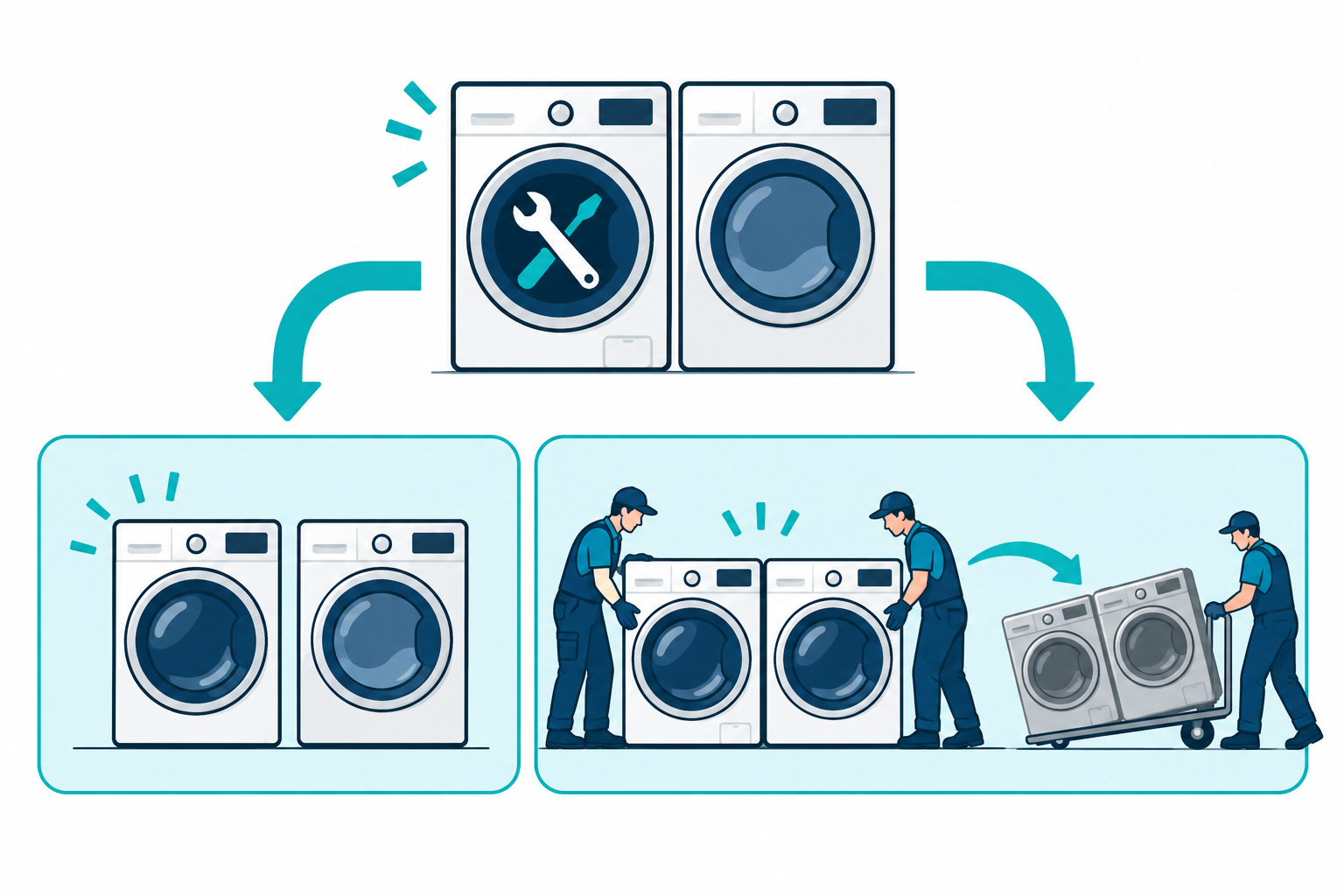
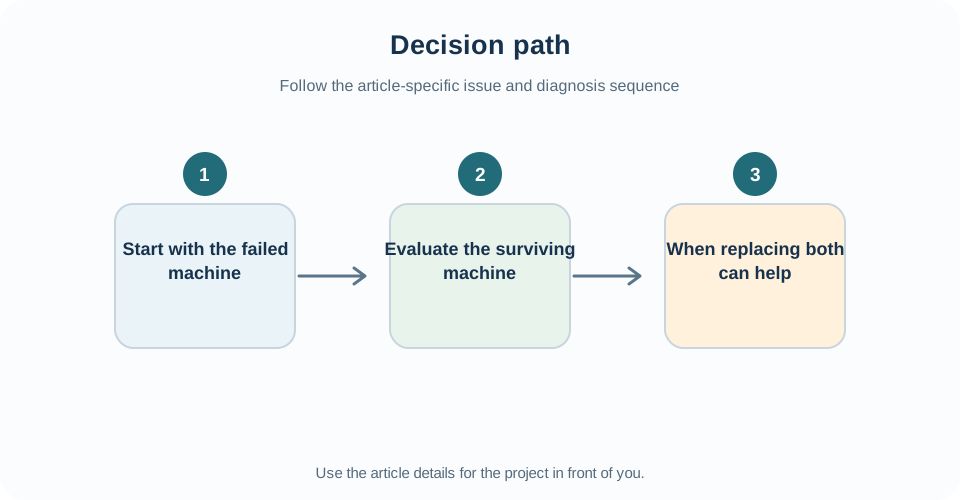
Start with the failed machine
Get a diagnosis before buying a pair. A washer may need a pump, bearing, tub, control, or plumbing correction. A dryer may need a belt, heater, motor, control, or vent repair. U.S. specialist sources report broad repair ranges, but they do not predict the exact model’s future failures or establish Canadian prices.
Ask what failed, whether the repair is covered, whether parts are available, and what other assemblies were inspected. Compare the confirmed repair with a replacement installed in the actual laundry space.
Evaluate the surviving machine
Record its age, model, use, maintenance, repair history, noise, leaks, corrosion, performance, and parts support. A working machine can still be a poor partner if it has recurring problems or a major component near failure. Conversely, a reliable machine with a sound cabinet and good service history may be worth keeping.
Do not assume the washer and dryer age together means they will fail together. Household use, design, installation, and failure mode differ. Use age as context, not an expiration date.
When replacing both can help
One delivery and installation appointment may reduce disruption, carrying, packaging, and haul-away coordination. A matched-size pair can simplify stacking, depth, door swing, and controls. Replacing both can also align warranties and allow the household to choose compatible capacity and efficiency.
Those benefits are real only if the second machine needs replacement or the avoided future trip has meaningful value. A sale price is not a saving if it causes a serviceable machine to be discarded early.
When separate replacement is better
Keep the working machine when it is reliable, properly fitted, serviceable, and not imposing unusual operating cost. Replacing only the failed unit preserves useful life and spreads the spending. It may also allow a heat-pump dryer or a different washer configuration later when the household has better information.
An unmatched brand does not inherently create a technical problem. Verify stacking, dimensions, vent or condensate, and control compatibility through the exact manufacturer instructions.
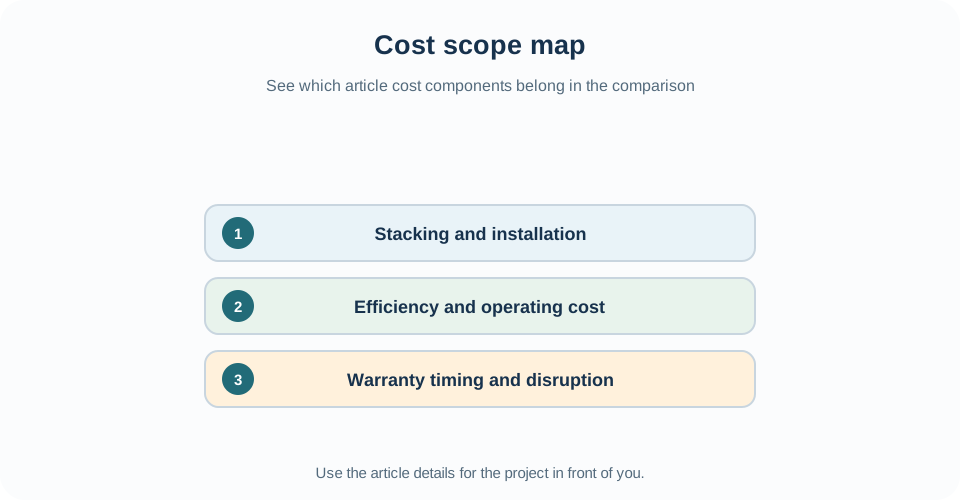
Stacking and installation
Stacking requires model-specific compatibility and usually a proper kit. Similar dimensions or the same brand are not enough. Confirm the washer and dryer models, kit, wall or closet stability, access, and service clearance before ordering.
Installation can include delivery, inside placement, leveling, hoses, cord, exhaust or condensate, removal, and disposal. If replacing both, ask whether the package truly includes both connections and both removals. A basement stair, tight closet, or floor repair can erase a presumed saving.
Efficiency and operating cost
Use exact model information. ENERGY STAR’s washer guidance uses IMEF and IWF, while heat-pump dryer guidance describes lower energy use and no conventional ventilation for qualifying models. The household’s utility rates, load frequency, cycle choices, and washer spin performance affect the result.
Replacing both may make sense when the working machine is unusually inefficient, the household uses the pair heavily, and the energy savings justify the premium. It may not make sense for light use or when a replacement introduces a large purchase and installation cost.
Warranty timing and disruption
Replacing together can align warranty periods, but it also concentrates spending and creates one larger delivery event. Keeping the working unit may create two appointments later. Value the disruption realistically: laundry access, laundromat cost, food or work schedule, and the risk of an unavailable model.
U.S. and Canadian prices
Retailer bundles, taxes, delivery, installation, products, service, and energy rates differ. Canadian decisions require Canadian prices and availability; do not convert U.S. figures into Canadian dollars. Use local quotes with the same scope.
A practical worksheet
For each machine, list repair, replacement, delivery, installation, stacking kit, hoses or cord, vent or condensate, removal, disposal, annual energy and water, service, warranty, and remaining-life uncertainty. Calculate the cost of replacing one now and both now. Mark assumptions instead of hiding them.
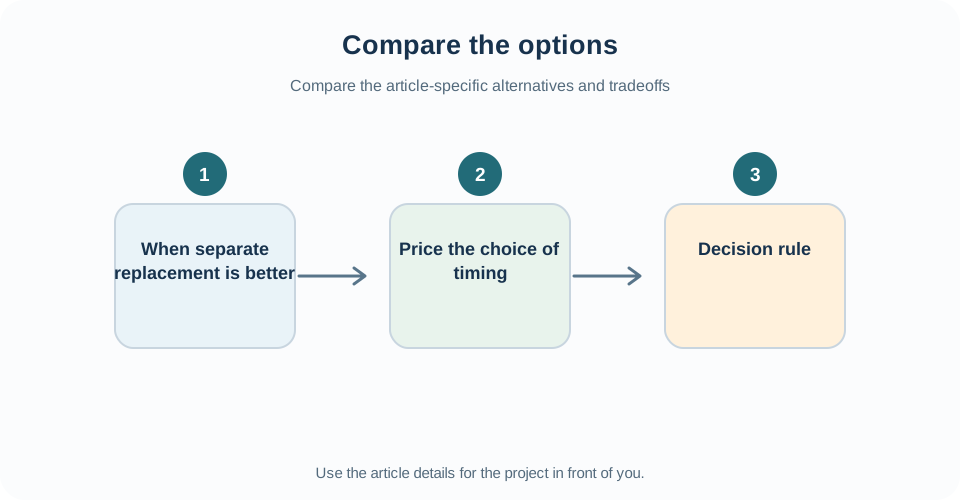
Price the choice of timing
Replacing both now can reduce the number of delivery events but concentrates spending and warranty periods. Replacing one now can preserve cash and the working machine, but may create a second installation later. Include lead time, temporary laundry, removal, disposal, stacking or side-by-side requirements, and the risk of a matching model becoming unavailable.
Decision rule
Replace together when the surviving unit has meaningful repair or reliability risk, the pair’s installation is materially simpler, capacity or efficiency gains have real household value, and the total cost is justified. Replace separately when the working appliance is reliable and the second replacement adds mostly aesthetic or speculative value.
The right answer is a household-specific optimization, not a rule that laundry machines must be replaced as a pair.
Compare the surviving machine with the replacement project
The working machine is not free simply because it is already owned. Estimate its likely repair, maintenance, operating cost, age-related uncertainty, compatibility with a new companion, and the inconvenience of a later delivery. At the same time, do not assign it a speculative failure probability. Ask for a diagnosis or service history when that information can materially change the decision.
Replacing only the failed washer or dryer may be the cleanest choice when the surviving unit is supported, in good condition, and compatible with the new model. Replacing both is stronger when the surviving unit is near a known service decision, the pair must be stacked with a matched kit, a major efficiency or capacity change has real value, or a single coordinated installation avoids a difficult second access event. Those are decision conditions, not universal rules.
Price the pair as an installed system
Confirm whether a new washer and dryer can share the existing space, stack safely, use the same connections, and remain serviceable. A new depth, door swing, control position, platform, vent, drain, or condensate arrangement can change the scope. Ask whether delivery includes moving both units, whether a stacked pair must be separated, who provides the kit, and whether floor, wall, electrical, plumbing, or ventilation work is excluded.
Use two timing scenarios: replace one now and the second later, or coordinate both now. Add delivery lead time, temporary laundry, removal, disposal, warranty start dates, and the risk that one model goes out of stock. In Canada, verify local stock, labels, service, and pricing in the Canadian market; do not infer them from a U.S. bundle.
Make the decision reversible where possible
If the household replaces one machine first, confirm that the selected model will not prevent a later companion from fitting, stacking, or being serviced. If both are replaced, keep the old units available until the new pair is delivered and tested when practical. Document the model numbers, kit, connections, warranty, and callback path before removal.
The comparison should show one total for replacing only the failed appliance, one for replacing both, and one for repairing the survivor while delaying the second purchase. This exposes the value of timing, avoids a bundle discount becoming the entire argument, and makes the household’s tolerance for disruption explicit.
Compare the household’s capacity need
Replacing both can make sense when the household needs higher throughput, a matched stack, a new capacity, or a technology change. It adds little value when the working machine is reliable and the second purchase is mostly cosmetic. Use actual loads, room constraints, and the cost of temporary laundry to determine which case is meaningful.
Record the reason for replacing the second machine
If the second machine is replaced for efficiency, capacity, matching appearance, stacking, or service alignment, state that reason and the evidence behind it. This keeps a bundle offer from becoming the decision by itself. The household can then revisit the choice if a model, price, rebate, or delivery assumption changes.
Make the energy comparison realistic
Use exact model data, local utility rates, number of loads, washer spin performance, cycle choices, and expected ownership. A washer with stronger water and energy metrics can change dryer use, while a heat-pump dryer can change vent and energy assumptions. Model the whole pair and show which savings are measured, estimated, or unknown. A bundle discount is not a saving if the second machine adds years of unwanted ownership.