
Front-load, top-load agitator, and top-load impeller washers can all be sensible choices. The lower-lifetime-cost option depends on purchase price, capacity, water and energy use, household loads, dryer interaction, maintenance, reliability, repair exposure, space, and stacking or pedestal costs. No configuration is guaranteed to be cheapest for every household.
Compare similar machines
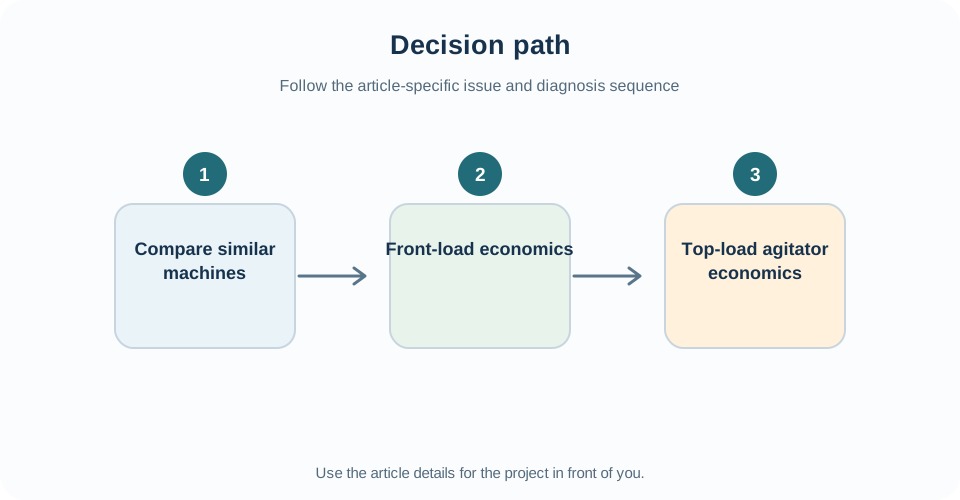
Start with comparable capacity, certification, cycle features, and expected load volume. A larger washer may reduce the number of loads but can cost more to buy and operate. A compact washer may fit the room but increase weekly cycles. Use the exact model’s energy and water data instead of a configuration stereotype.
ENERGY STAR identifies Integrated Modified Energy Factor and Integrated Water Factor as useful comparison metrics. Higher IMEF indicates better energy efficiency; lower IWF indicates better water efficiency. Both are most useful when comparing similar product classes and capacities.
For current status, ENERGY STAR Version 8.1 remains in effect; Version 9 is under revision and has no effective date. Do not apply draft criteria as if they were current. Compare the exact model’s current certification and label data in its market.
Front-load economics
Front-load washers can offer efficient use of water and energy, usable drum capacity without a central agitator, and stacking options. ENERGY STAR says certified front-load washers use about 50% less energy and water than top-load agitator washers, while still differing from model to model. The comparison is not a promise for every unqualified machine or household.
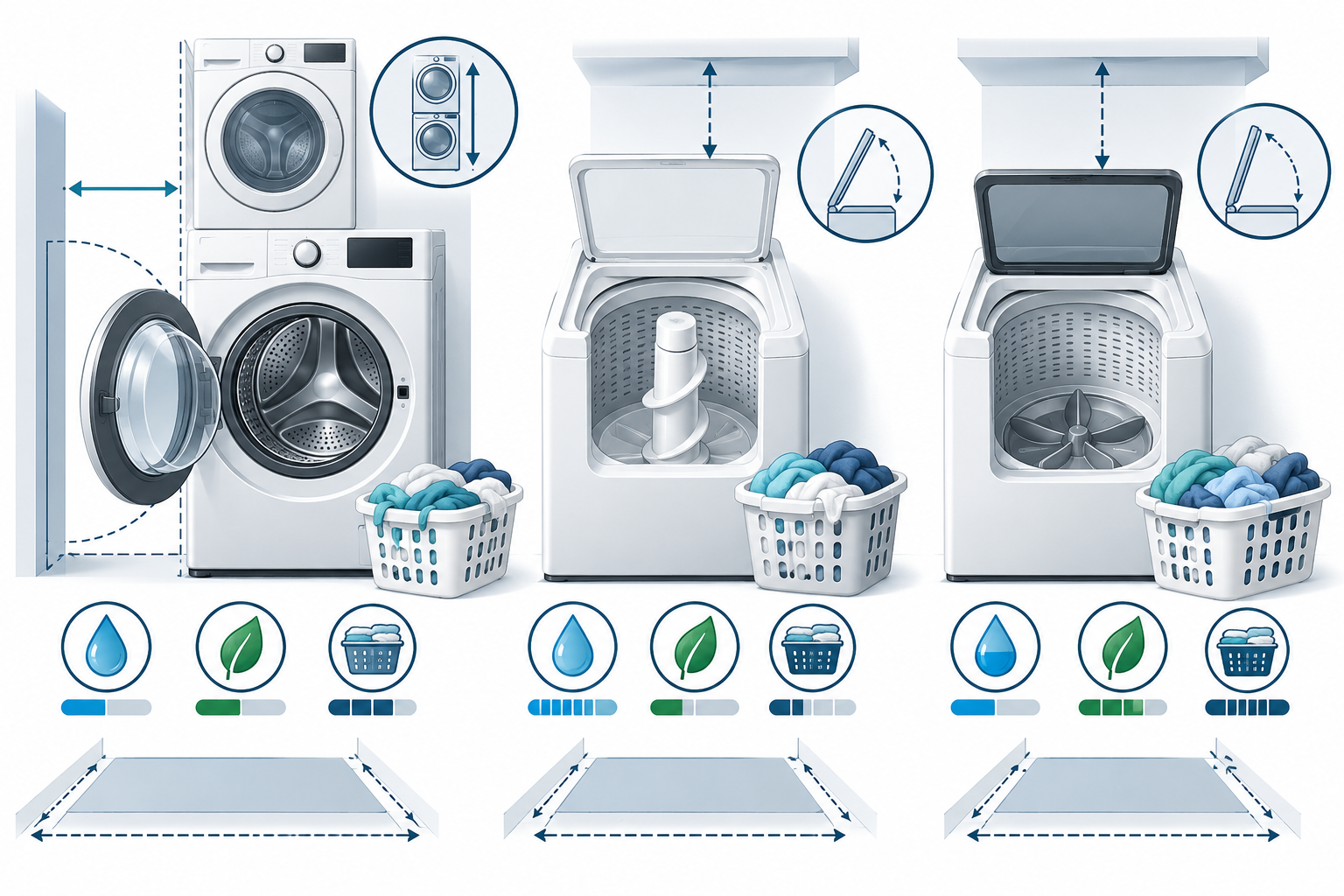
Front-load ownership can also involve a pedestal, stacking kit, door clearance, and attention to the door seal and manufacturer’s maintenance instructions. Those costs and tasks belong in the comparison. A stacked installation can save floor space while making service access more complicated.
Top-load agitator economics
Top-load agitator washers can have a familiar loading pattern and may cost less in some product tiers. The central agitator can change usable capacity and the model’s efficiency. Compare the actual IMEF, IWF, capacity, purchase price, and expected loads rather than assuming every top-load model performs alike.
The lid needs overhead clearance, and a top-load unit may not fit under a counter or in a tight shelf arrangement. A lower initial price can be offset by water heating, water charges, more loads, or a different dryer burden.
Top-load impeller economics
Top-load impeller washers use a low-profile disc or cone instead of a traditional agitator. ENERGY STAR describes them as a more efficient option than traditional agitator models, while noting that front-load certified washers can still be more efficient than top-load impeller machines. The exact model’s data remains the basis for a decision.
An impeller model may provide more usable space than an agitator washer but can have different cycle behavior and user expectations. A household that overloads it or uses different settings may not realize the modeled savings.
Water and energy modeling
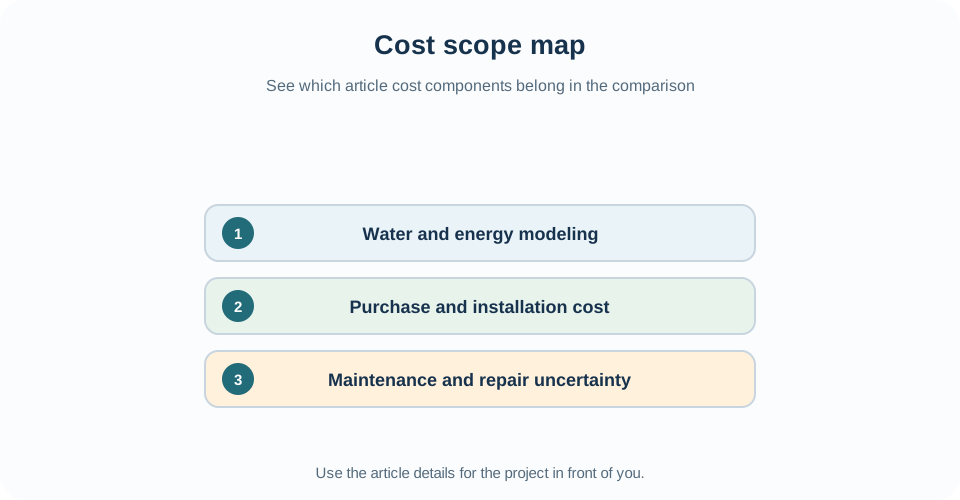
Estimate annual operating cost with the model’s annual energy use, water use, your electricity rate, water and sewer rates, water-heating cost, and expected loads. Use low, typical, and high usage scenarios. A washer’s IMEF includes energy associated with water heating and dryer operation in the metric, so avoid double-counting those inputs without understanding the product data.
High-spin performance can reduce moisture reaching the dryer, but the benefit depends on the washer, dryer, fabrics, settings, and usage. A household with many loads and high utility rates has more savings at stake than one with occasional cold-water loads.
Purchase and installation cost
Add equipment, delivery, hoses, installation, leveling, floor correction, stacking or pedestal, removal, and disposal. A front-load installation can require a compatible stacking kit; a top-load installation can require more lid clearance. The same laundry room may favor one layout because of doors, a closet, or service access.
In the United States and Canada, product availability, taxes, installation packages, and utilities differ. Use local prices and do not convert U.S. purchase costs into Canadian dollars.
Maintenance and repair uncertainty
Maintenance instructions are model-specific. Door seals, dispensers, filters, drain components, controls, bearings, and tubs have different repair consequences. U.S. specialist sources report broad washer repair ranges, but they do not establish a model’s failure probability or Canadian repair cost.
Do not treat online reliability anecdotes as a universal ranking. Check the exact warranty, service network, parts availability, and cost of a second visit. A more efficient model can be a poor lifecycle choice if its repair or fit risk is unusually high for the household.
Space and household fit
Choose the configuration that supports safe loading, door or lid clearance, laundry accessibility, ventilation around the equipment, and future service. Consider children, mobility, bending, noise, and whether the washer can be moved without dismantling cabinetry. These practical factors can have economic value even when they do not appear on an energy label.
When one option wins
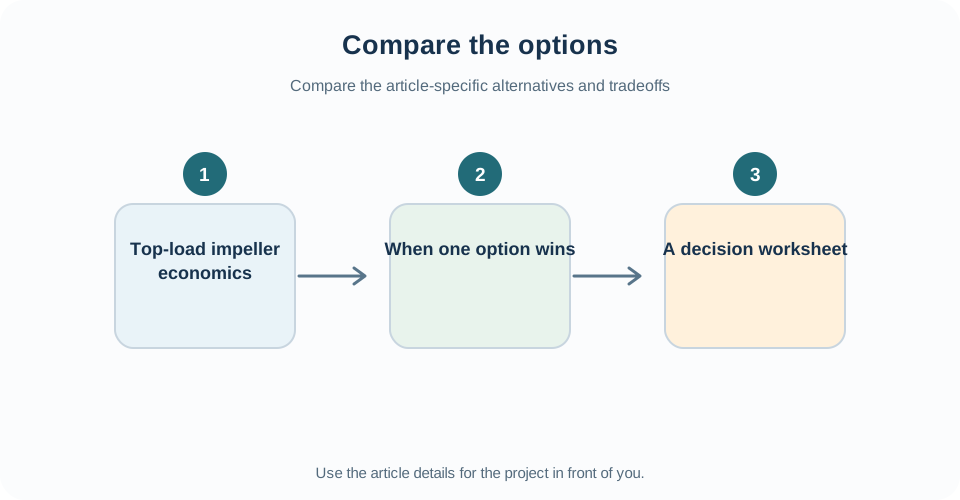
Front-load can be attractive when stacking, high load volume, water and energy savings, or large items matter. Top-load agitator can fit when a familiar open-top layout and lower initial price are more important. Top-load impeller can offer a middle path. The best choice changes with local rates, household use, space, purchase premium, repair terms, and replacement horizon.
A decision worksheet
Record the exact models, price, capacity, IMEF, IWF, annual kWh, water estimate, installation, stacking or pedestal, delivery, removal, warranty, service network, and local rates. Calculate five- and ten-year scenarios and mark uncertain inputs. Do not present the result as a guaranteed payback.
The question is not which washer type wins in the abstract. It is which machine provides the needed capacity and fit at an acceptable combination of purchase, operating, maintenance, repair, and disruption cost.
Add the costs that do not appear on the label
For a front-load machine, include a pedestal or stacking kit if needed, door clearance, access to the seal and dispenser, and the cost of servicing a stacked installation. For a top-load machine, include lid clearance, platform or closet constraints, and the extra room needed to load it safely. Both types may require hoses, floor correction, delivery, removal, and a different dryer arrangement.
Capacity changes the operating comparison. A larger machine may reduce the number of loads, but the benefit depends on whether the household fills it and whether the dryer can handle the resulting load. Model the actual weekly pattern instead of treating a higher capacity as automatic savings. Water and sewer rates, water heating, dryer energy, and cycle selection also affect the result.
Use household scenarios
Front-load may fit a household that stacks the laundry pair, washes bulky items, runs many loads, or places a high value on water and energy efficiency. A top-load agitator may fit a household that prioritizes open-top loading and a lower initial price. A top-load impeller may offer a compromise in capacity and efficiency. A reader who has mobility, noise, child-safety, or access concerns may value a configuration even when the label comparison is close.
Check the decision against the laundry room
The preferred washer must fit the room as well as the household. Confirm door or lid clearance, stacking, floor level, drain, supply, delivery route, and service access. Include the dryer interaction and the cost of a temporary laundry plan if an installation or callback takes longer than expected.
Make the installation choice part of the comparison
Check door or lid clearance, stacking, floor level, vibration, drain access, water valves, delivery route, service access, and the cost of hoses or a kit. A washer that wins on a label comparison may lose value if it needs a platform, cannot be stacked, or blocks a future repair. Include the dryer interaction: spin performance, load pattern, cycle time, and electricity use can affect the total laundry cost.
ENERGY STAR’s current comparison says certified front-load washers use about 50% less energy and water than top-load agitator washers. Treat that as an approximate program comparison, not a guarantee for every model or household. Compare current exact-model IMEF and IWF values, capacity, installation, repair support, and local rates before deciding.
Include the room and service cost
Front-load may require door clearance, a stable level installation, reachable controls, and a compatible stacking arrangement. Top-load requires lid clearance and may be less suitable under a counter or shelf. For either design, price hoses, valves, drain, floor condition, delivery route, removal, disposal, and future service access. A lower equipment price can disappear if the chosen configuration needs a platform, cabinet change, or difficult repair access.
Use ownership scenarios instead of a single payback
Model light, typical, and high load use. Add water, sewer, electricity, detergent, dryer interaction, maintenance, filters or cleaning, repair support, and the cost of a temporary laundry arrangement. A front-load advantage may be more meaningful for a high-use household; a top-load choice may be rational when access, loading preference, or a ready installation matters more. The decision should show which assumptions drive the result.