
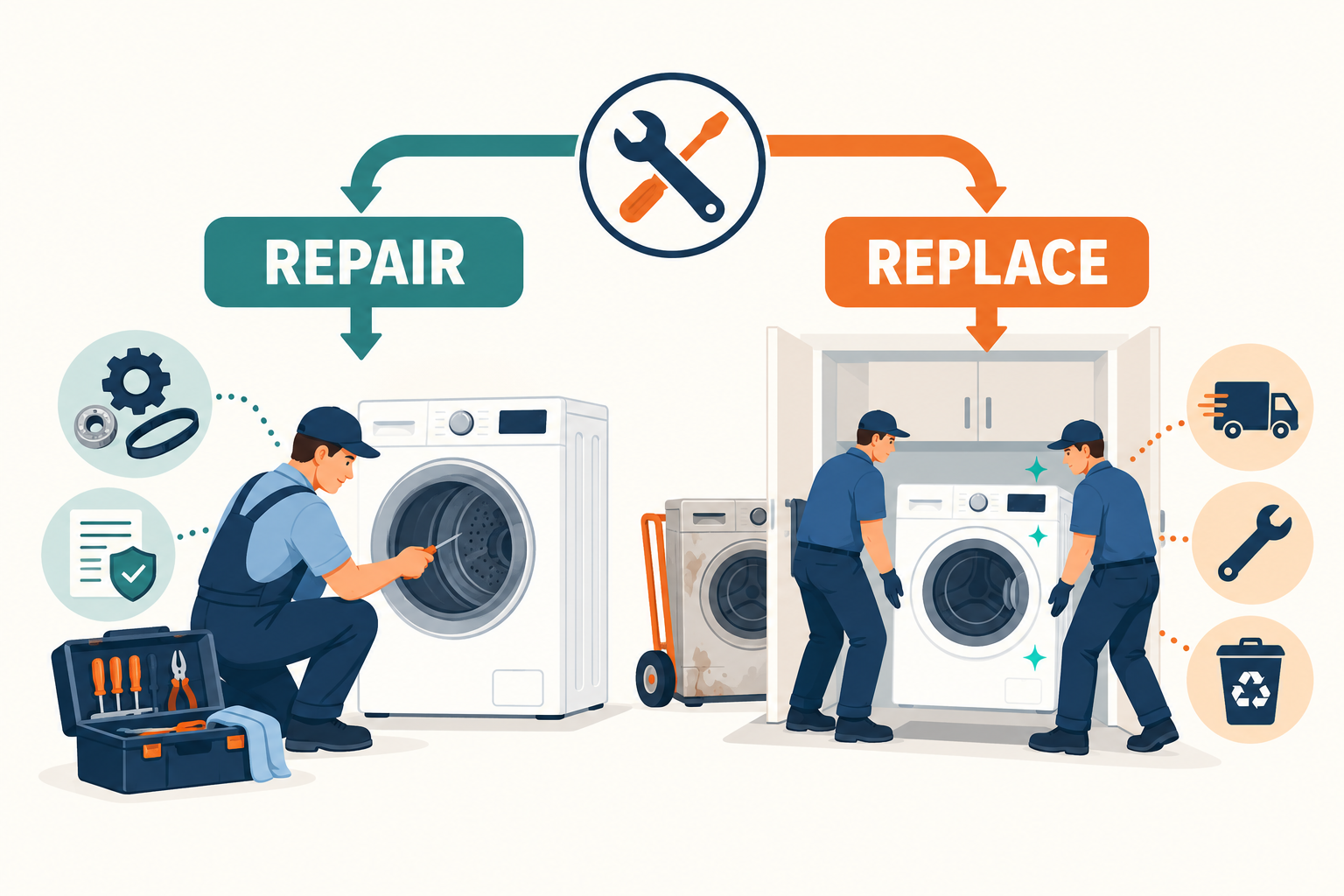
Repairing a major appliance can be the cheaper choice today while replacement can be the better economic choice over several years. The answer depends on more than the repair invoice. Compare the confirmed failure, the total repair cost, the appliance’s condition, the likely cost of future failures, energy use, warranty coverage, installation, disposal, and the disruption of being without the appliance.
Start with a confirmed problem
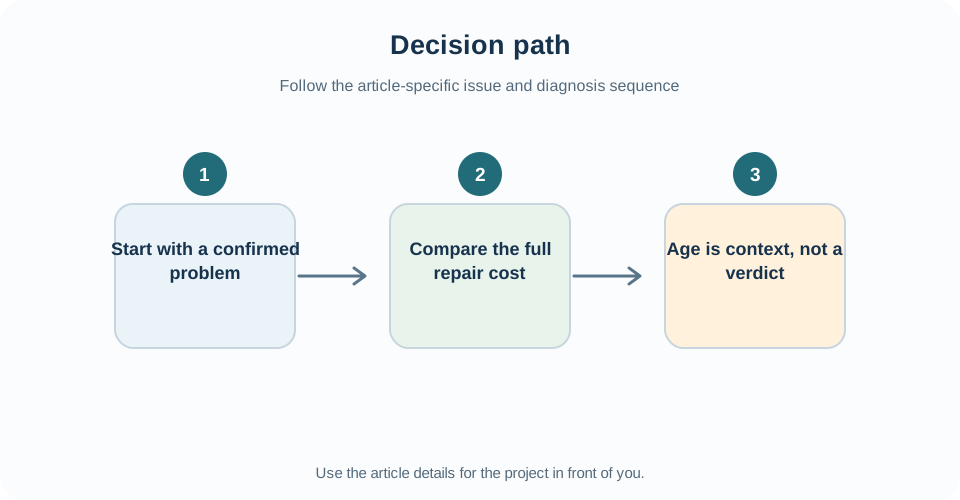
Do not compare a replacement product with a guessed part. A diagnostic visit may show that a washer will need a pump, a refrigerator has a sealed-system problem, or a dryer complaint actually comes from the exhaust path. The same symptom can produce a small repair, a major repair, or a building-side project.
Write down what was tested and what remains uncertain. Ask whether the estimate includes the part, labor, diagnostic charge, delivery, taxes, and a return visit. If a provider recommends replacement, request the reason in terms of failure severity, part availability, access, or total cost rather than accepting a generic age statement.
Compare the full repair cost
U.S. specialist sources publish broad appliance-repair signals of about $100 to $400 and $100 to $300, with category ranges that vary by equipment type and failure. They are useful for understanding relative scale, but they do not establish a Canadian price or a guaranteed local outcome. A refrigerator compressor, built-in wall oven, or control board can sit far outside a simple switch or seal repair.
Add every cost that belongs to keeping the existing appliance working:
- service call and diagnosis;
- parts and labor;
- a second trip or special-order shipping;
- access, panel removal, or reinstallation;
- food loss, temporary laundry, or other disruption;
- a short parts or labor warranty;
- related leaks, damage, or utility corrections.
Then compare that total with the installed replacement cost, not only the new unit’s advertised price.
Age is context, not a verdict
Age changes the probability that another component will fail, but it does not reveal the condition of the motor, compressor, tub, wiring, seals, insulation, controls, or cabinet. A well-maintained appliance with one localized defect may be a better repair candidate than a newer unit with a recurring design or installation problem.
Published service estimates sometimes use age thresholds or a repair-to-replacement percentage as a shortcut. Treat those as screening heuristics, not a universal rule. An inexpensive dishwasher and a difficult-to-replace built-in refrigerator have very different replacement economics. A repair that is a high percentage of a small appliance may still avoid cabinetry, delivery, or utility work that would make a replacement more expensive.
Remaining life is probabilistic. Ask what has already failed, what condition the other major components are in, whether parts remain available, and whether the repair changes the risk profile. Replacing a worn pump does not reset the age of the cabinet, motor, controls, or bearings.
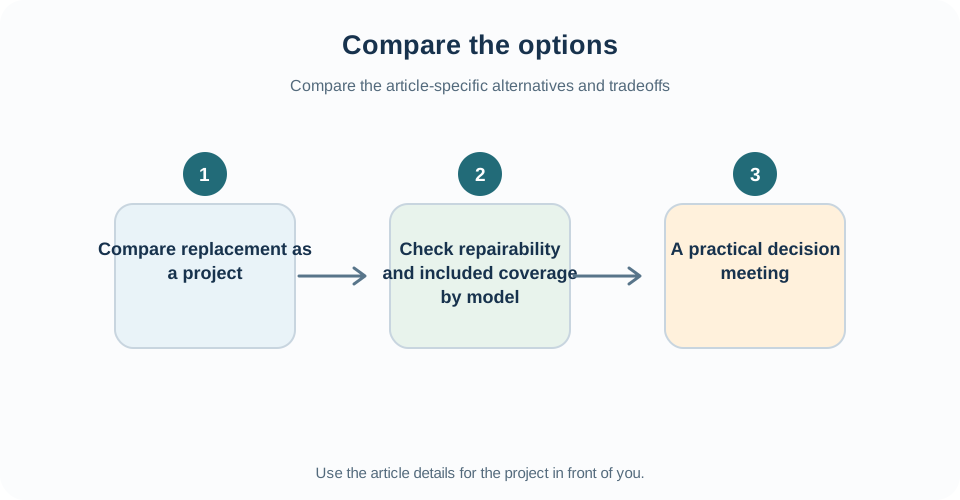
Compare replacement as a project
Replacement may include delivery, carrying, stairs, floor protection, leveling, hookup, new installation materials, old-unit removal, recycling, and commissioning. A refrigerator with a water connection may expose a household plumbing issue. A range may require model-specific safety hardware and a compatible fuel connection. A built-in wall oven or refrigerator may need cabinet work. A dryer may need an exhaust assessment or a different condensate arrangement.
For a like-for-like replacement, measure the opening and identify the existing connection before shopping. A product that fits the nominal width may still conflict with depth, door swing, ventilation space, floor height, trim, stacking, or service access. If the new technology changes the energy source, the project may belong partly in electrical or whole-home electrification planning.
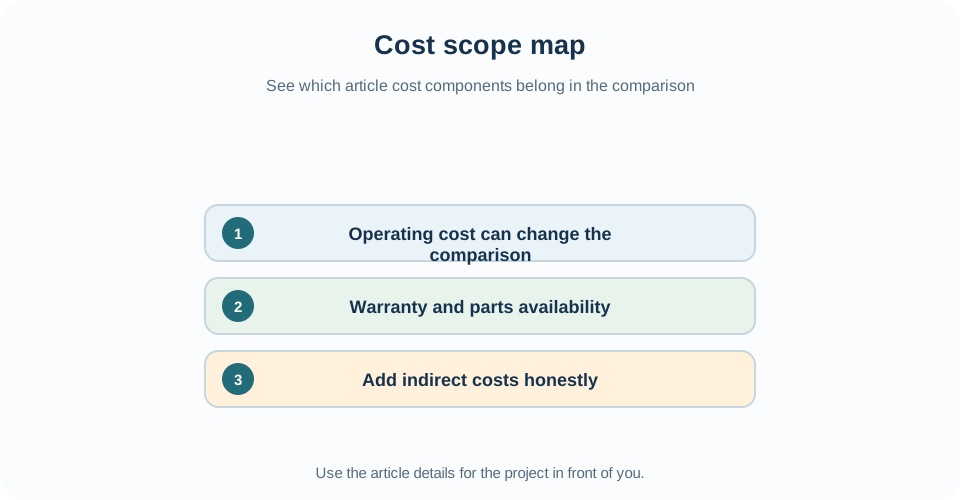
Operating cost can change the comparison
An efficient replacement may use less electricity, gas, or water, but savings depend on usage and local rates. Use the U.S. EnergyGuide or Canadian EnerGuide information for comparable product classes, then model the label consumption with your own tariff and expected use. A label estimate is not a household bill.
Operating savings are more likely to matter when the appliance runs frequently, the current model is unusually inefficient, the replacement will remain in service for years, or the home has high energy or water rates. They matter less when the replacement premium is large, usage is light, or the appliance may be replaced again before the modeled savings accumulate. Do not claim that one washer configuration or cooking technology always has the lowest lifetime cost.
Warranty and parts availability
Check the included manufacturer warranty, a paid service contract, remaining coverage, and the cost of using a restricted repair network. Coverage can apply to parts but not labor, or exclude damage, maintenance conditions, cosmetic issues, or specific components. Read the exact terms instead of treating “extended warranty” as a guarantee of low ownership cost.
For an older appliance, ask whether the failed part is still made, whether a substitute is approved, and how long the provider will stand behind the repair. A cheap repair with no parts path may only delay replacement. A more expensive repair from a qualified provider can be reasonable when the appliance is otherwise sound and replacement would trigger extensive installation work.
Check repairability and included coverage by model
Before deciding, record the exact model and serial number, manufacture date, original purchase and delivery date, and seller. Ask the manufacturer or service provider about the matching part number, stock or order lead time, authorized service options, repair warranty, and whether the quoted repair restores the appliance’s required fit and operation. A parts-access rule is not proof that a part is in local stock or that repair will be affordable.
Rules can change the comparison for a specific product cohort. Connecticut’s 2026 repair-material law covers defined major-appliance products first manufactured and first sold or used in the state on or after July 1, 2026, subject to statutory tests; it sets three- or five-year minimum periods for covered manufacturers to make parts, tools, and documentation available. Québec’s new good-working-order warranty applies to listed new appliances bought or leased from a merchant on or after October 5, 2026. The regulator lists five years from delivery for washers, dryers, and dishwashers and six years for ranges, refrigerators, freezers, air conditioners, and heat pumps; it includes parts and labor and transfers on resale, with exclusions. Check the exact model, dates, seller, and current terms before counting either protection in the repair-versus-replace calculation.
Add indirect costs honestly
Food loss can make a refrigerator or freezer failure urgent. Laundry disruption can affect a household with no nearby laundromat or a large volume of washing. A failed range can change meal planning. These are real economic effects, but their value depends on the household; do not present an illustrative loss as a universal amount.
Replacement also has indirect costs: delivery scheduling, temporary storage, cabinetry damage, floor repair, waiting for a model, and learning a new product. Repair can have indirect costs too if the unit remains unreliable or a second visit repeats the disruption. Include the cost of uncertainty when the decision is time-sensitive.
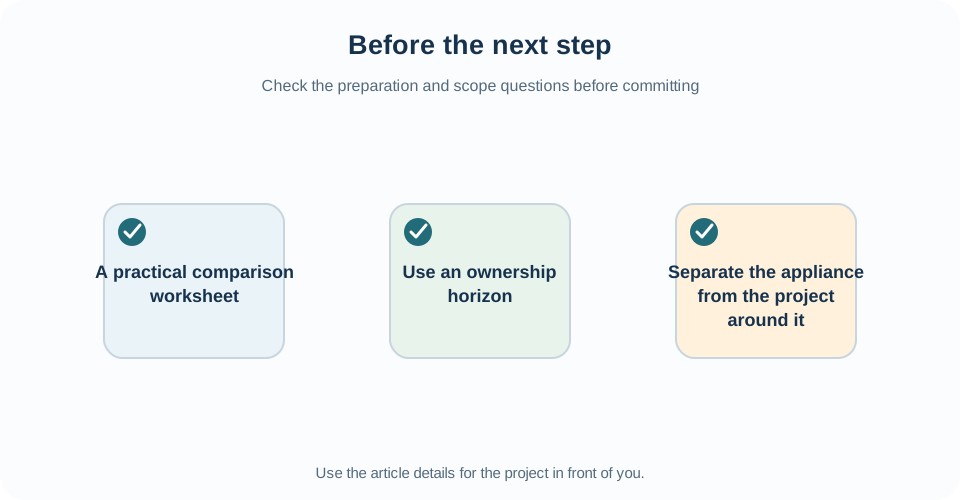
A practical comparison worksheet
Create two columns. Under repair, list the confirmed repair total, possible second-trip cost, repair warranty, likely remaining risks, operating cost, and disruption. Under replacement, list the product, delivery, installation, connections, access, removal, disposal, operating cost, warranty, and any building-system work. Mark each figure as confirmed, estimated, or still unknown.
Repair tends to be more defensible when the defect is localized, the appliance has a good service history, parts are available, the repair warranty is meaningful, and replacement would require difficult fit or trade work. Replacement deserves stronger consideration when failures are recurring, the cabinet or major assembly is deteriorated, the part is obsolete, the repair is high-cost and uncertain, energy or safety performance is materially outdated, or the installed replacement is straightforward.
The correct answer is not the lowest first invoice. It is the option that gives the household the best balance of cost, reliability, safety, performance, and disruption for the period it expects to own the appliance.
Use an ownership horizon
Choose a time horizon before comparing totals. A household expecting to move soon may value a contained repair and low disruption differently from one planning to keep the appliance for five or ten years. For each option, estimate the cost during that period:
initial cost + likely operating cost + expected service and parts - confirmed credits or coverage
Keep uncertain items visible instead of pretending they are known. A repair estimate may be fairly clear while the risk of another failure is not. A replacement may have a known purchase price while installation, service availability, or local energy cost remains uncertain. Show a low, middle, and high case when the uncertainty could change the decision.
Do not multiply a guessed failure probability by a repair price and present the result as a fact. Use the model as a way to ask better questions: what has already failed, which other parts are worn, how much would a second visit cost, and what evidence supports the expected remaining service? Manufacturer support and local service availability can be more useful than a generic lifespan table.
Separate the appliance from the project around it
Replacement often creates a coordination cost. The appliance must arrive, fit through the route, connect to the correct service, operate safely, and leave the old unit with an appropriate disposal path. The work may involve a retailer, appliance installer, plumber, electrician, gas professional, cabinet installer, or restoration contractor. Those scopes should be priced separately even when one company coordinates them.
Repair has coordination costs too. A technician may need to move a built-in unit, protect a finished floor, order a part, return for testing, or document a leak before another trade can work. A repair that appears inexpensive on paper can become disruptive when the household must repeat the process several times.
A practical decision meeting
Before authorizing either option, write down the failed component or unresolved symptom, the total confirmed price, the next unknown, the warranty, and the consequence of waiting. Then compare it with an installed replacement for the same function and capacity. Include removal, disposal, delivery, fit, connections, and temporary substitutes such as a laundromat, cooler, or alternate cooking arrangement.
Repair is usually the stronger candidate when the defect is contained and explained, parts and service are available, the rest of the appliance is sound, and replacement would trigger difficult work. Replacement gains weight when the diagnosis is uncertain, failures repeat, a major assembly is obsolete, the cabinet or insulation is damaged, or the complete replacement path is clear. Neither conclusion follows from age alone. The decision is strongest when every important assumption has an owner and a verification step.