
Dryer repair cost depends on whether the problem is inside the appliance or in its exhaust and connection. Electric and gas dryers have different heating systems, controls, and safety boundaries. U.S. specialist sources report broad dryer repair signals around $100 to $300 or $100 to $200, but those figures are not a Canadian price and do not diagnose a particular model. A Greater Toronto Area provider’s page, checked October 7, 2026, lists dryer repairs at $150–$350, including service, diagnosis, parts, and labor; it separately lists an $89–$129 diagnostic fee waived with repair. The source does not state an ISO currency code or fault-sampling method. Treat it as one local provider example, not a Canadian market range, and request a written quote for the exact dryer and symptom.
Start with the symptom
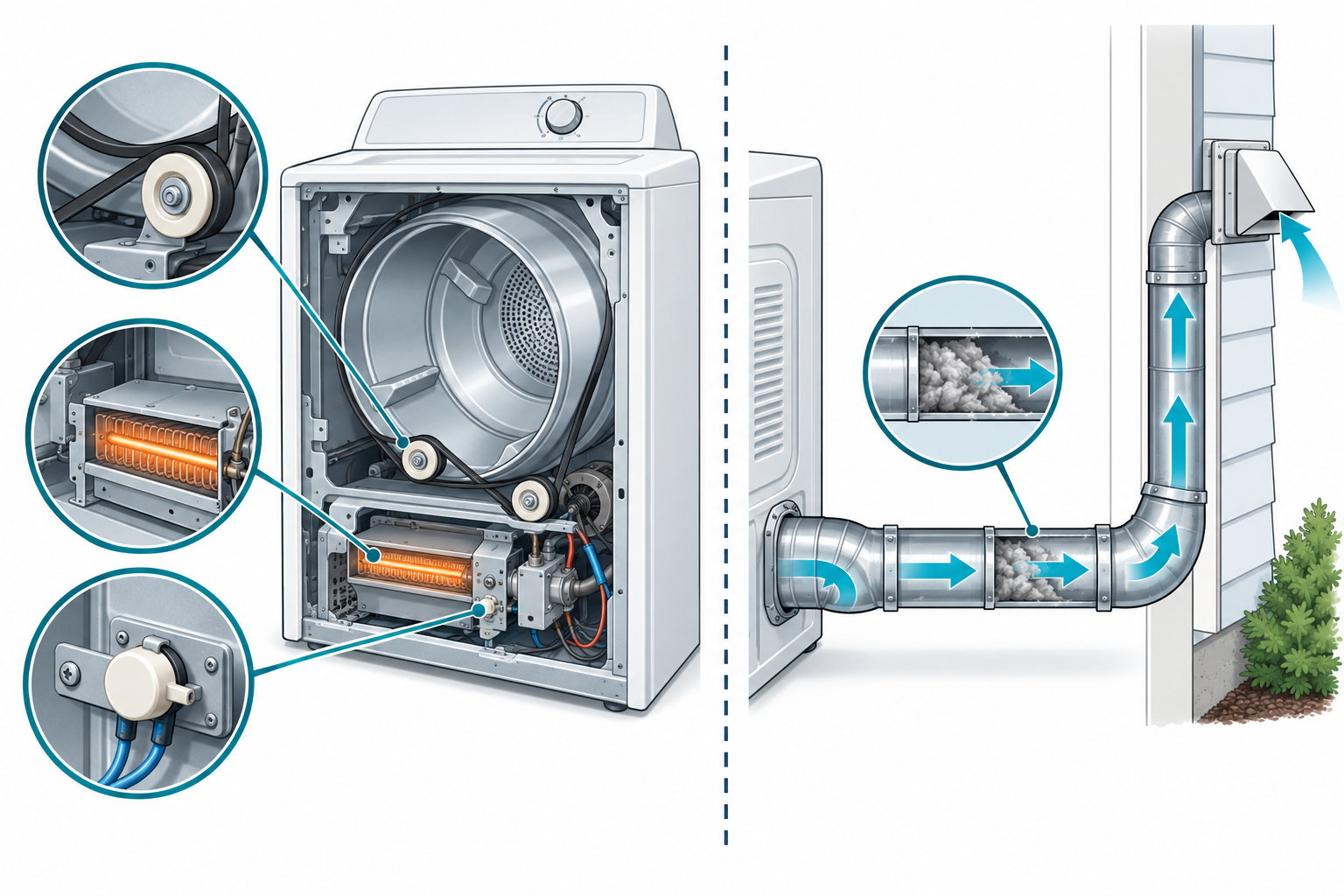
Common complaints include no heat, weak heat, long drying time, noise, failure to tumble, a drum that will not start, an error, overheating, or a burning smell. A belt, roller, motor, heating element, thermal device, igniter, control, sensor, wiring, or door switch may be involved. A blocked, damaged, or incompatible exhaust path can create a similar performance complaint.
Record the model, fuel, age, cycle, load, timing, error display, and whether airflow or room conditions changed. Do not bypass a safety device, open gas components, or perform electrical repairs from general advice.
No heat and poor drying
An electric dryer may have a heating element, thermal component, motor, control, or supply issue. A gas dryer may involve ignition, burner, valve, sensor, control, or fuel connection. Poor drying can also reflect an exhaust restriction, an incorrect termination, moisture sensing, load practices, or a room condition.
Ask the technician to distinguish appliance diagnosis from vent assessment. A repair quote that replaces a heater without checking the exhaust may not solve the problem.
Belts, rollers, motors, and controls
Belts, rollers, idlers, motors, door switches, controls, and drum supports create different labor and parts costs. A drum or control-board replacement can be a major repair compared with a smaller belt or switch repair. Special-order parts and a return visit add to the total.
Ask which part failed, whether the repair addresses the root cause, what other assemblies were inspected, and whether the repair includes a labor and parts warranty. U.S. specialist information is useful for relative scale but not for an exact local quote.
Vent-related symptoms and safety
Conventional dryers exhaust warm humid air. A damaged or restricted exhaust path can increase drying time and heat, but the appropriate inspection and repair depend on the model and local requirements. Dryer vent replacement is a separate installation dependency when the path, termination, or finished wall changes.
If there is a burning smell, smoke, abnormal heat, gas odor, or electrical concern, stop using the appliance and seek qualified help. Do not use a general repair article as a procedure for gas or electrical troubleshooting.
Repair versus replacement
Repair is more attractive when the failure is localized, the drum and cabinet are sound, the part is available, and the vent or connection is suitable. Replacement deserves comparison when repairs repeat, a major assembly or control is obsolete, the unit is near the end of its support, or the installed alternative avoids a difficult repair.
Include diagnosis, part, labor, return visit, vent work, delivery, installation, removal, disposal, energy use, and laundry disruption. A heat-pump dryer is a different alternative with different installation and operating economics; it is not a direct repair substitute.
Heat-pump distinction
ENERGY STAR describes heat-pump dryers as closed-loop systems that do not require conventional exterior ventilation, use lower-temperature drying, and may use less energy than standard dryers. They can still have condensate, electrical, maintenance, refrigerant, and model-specific service considerations. Compare the actual replacement, not a generic technology claim.
Warranty and parts
Check whether the manufacturer warranty covers the failed component, labor, and service area. A service contract may exclude wear, filters, vents, maintenance, or installation-related problems. Ask whether the technician can obtain the part and what happens if the diagnosis changes.
U.S. and Canadian uncertainty
The repair ranges are U.S.-weighted specialist signals. Canadian labor, parts, service coverage, taxes, and disposal differ. Do not convert U.S. dollars into Canadian dollars. Use a Canadian quote for Canadian budgeting.
Match the repair to the laundry setup
Before the appointment, note whether the dryer is gas or electric, conventional or heat-pump, freestanding or stacked, and connected to what appears to be a long or difficult exhaust route. Give the provider the model, age or service history, symptom, recent changes, and any odor or overheating. This helps separate an appliance fault from a route, utility, or access condition without assuming the answer in advance.
Service-call checklist
Have the model and symptom ready. Ask what the diagnostic fee includes, whether it is credited, whether the provider checks the exhaust, whether parts and return labor are included, what safety conditions stop the work, and what replacement costs when installed and removed.
A dryer repair decision is sound when it separates a heater or drive problem from a vent problem, treats gas and electrical work conservatively, and compares the total repair with a model-appropriate replacement.
Separate an appliance fault from an exhaust fault
No heat, weak heat, long cycles, or excess temperature can involve the heating system, controls, sensors, drive components, electrical or gas supply, or the exhaust path. A technician should state which tests support the diagnosis. Replacing a heater or igniter without addressing a restricted or damaged exhaust route may leave the underlying performance problem unresolved.
The route itself can be a cost driver. A stacked dryer, basement laundry room, long duct, roof or wall termination, or difficult access can add labor even when the component is inexpensive. Ask whether the service call includes an exhaust assessment, whether a return visit is likely, and where appliance repair ends and ventilation work begins.
Compare repair outcomes by household consequence
A contained belt, roller, switch, or sensor repair may be sensible when the drum and cabinet are sound and parts are available. A motor, control, major heating assembly, repeated fault, or unavailable part can change the repair-versus-replace decision. If the dryer is gas, the connection and combustion-related work require qualified service; if it is electric, wiring and supply issues remain separate electrical work.
Include laundry disruption, temporary drying, delivery, installation, removal, disposal, vent correction, energy use, and warranty in a replacement comparison. A heat-pump dryer is a different technology with different condensate and service requirements, not a generic substitute for every repair. Canadian prices and service support require local verification rather than converted U.S. ranges.
Read the diagnosis as a sequence
Ask what the technician observed, which tests separated the appliance from the supply or exhaust, and what repair is being proposed first. A no-heat complaint can involve a heating component, sensor, control, gas or electrical supply, airflow, or a combination. A drum that will not turn can involve a belt, roller, motor, obstruction, or control. The symptom narrows the search but does not identify a part by itself.
Ask whether the diagnostic fee is credited, whether the quoted repair includes return labor, how long the part will take, and what happens if the first repair does not restore operation. If the dryer is stacked or built into a tight room, price access and reassembly explicitly. If the route needs cleaning or correction, keep that scope separate from the appliance repair so a second provider’s work is not mistaken for a failed component repair.
Decide what a useful quote contains
The estimate should name the failed function, diagnostic work, part or assembly, labor, access, return visit, warranty, taxes, and any separate exhaust, gas, or electrical scope. If the provider cannot yet confirm the failed part, treat the amount as a diagnostic stage rather than an authorized repair total. Ask what evidence will move the job from diagnosis to repair and who decides whether a second visit is worthwhile.
For a replacement branch, use the exact opening and utility conditions. Include delivery, installation, removal, disposal, vent or condensate work, operating cost, service, and warranty. This makes a repair quote and a replacement quote comparable without implying that a broad U.S. specialist range predicts the local job.
The cheapest repair on paper may be a poor household result if the part is unavailable, the unit is needed daily, or the technician cannot return quickly. Compare the repair with a replacement that includes a measured fit, delivery, installation, removal, vent or condensate work, disposal, and warranty. Add temporary laundry, travel, and the value of preserving or changing the existing utility setup.
Do not infer a life expectancy or failure probability from a broad U.S. repair range. Use the exact model, service history, local parts support, and current local quotes. Stop using the appliance and seek qualified help for smoke, burning odor, gas odor, abnormal heat, or repeated overheating.