
Portable dehumidifier cost includes more than the appliance. Capacity, room conditions, runtime, electricity, bucket emptying, continuous drainage, a pump, filter maintenance, noise, repair, and eventual disposal determine ownership cost. A portable unit can manage moisture in a room, but it is not automatically a cure for a leak, groundwater, envelope defect, or whole-home humidity problem.
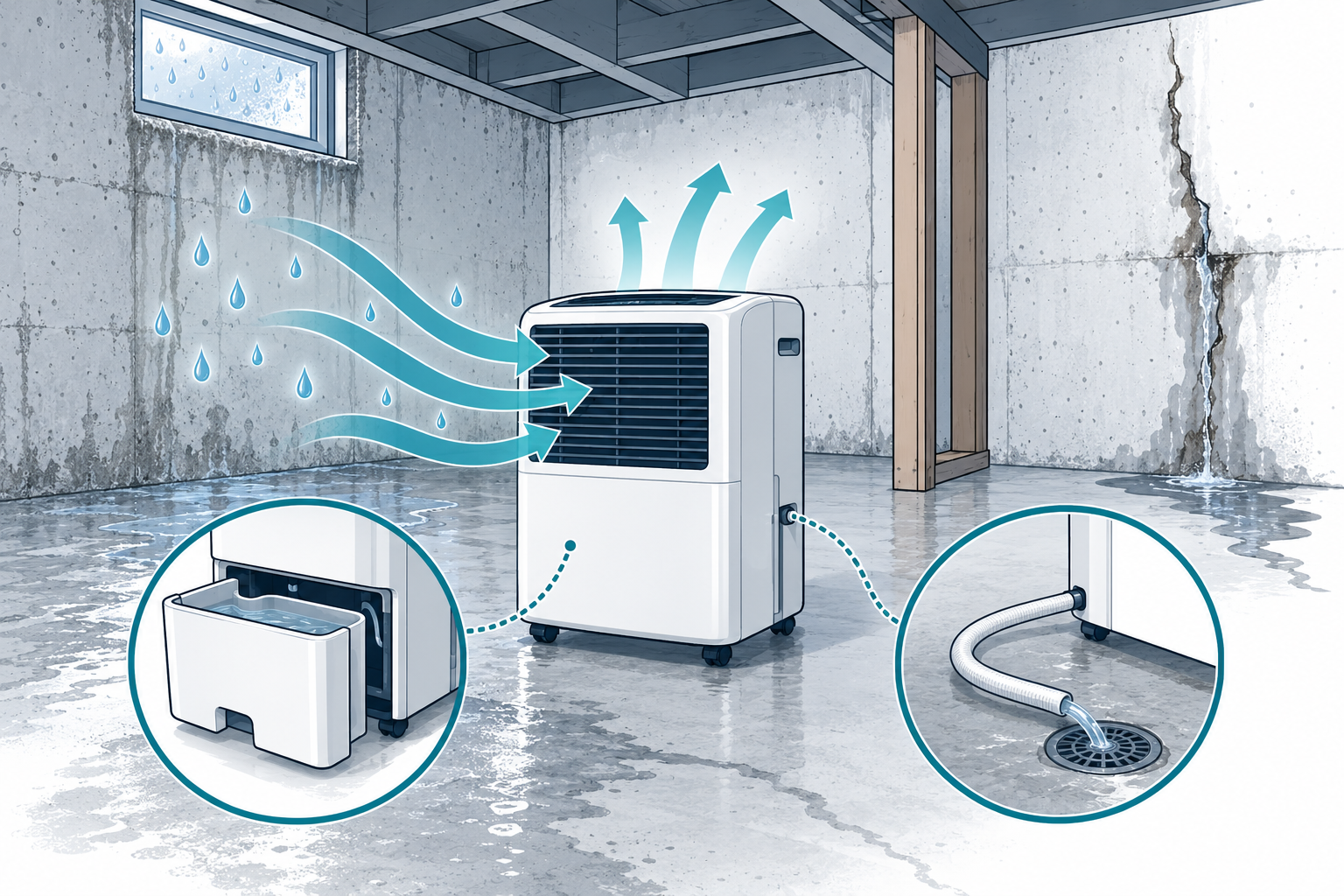
Match capacity to the moisture load
Room size is only one input. Basement moisture, laundry, condensation, air leakage, groundwater, climate, temperature, and the desired humidity all affect runtime. ENERGY STAR describes certified dehumidifiers as using refrigeration coils, compressors, and fans to remove moisture with less energy, but its product category does not determine the capacity your building needs.
Choose a model using current manufacturer or retailer information and the actual conditions. An undersized unit may run continuously without resolving the load. An oversized unit may cost more than needed and use more power at its operating pattern.
Purchase and delivery cost
Product prices vary by capacity, controls, pump, bucket, noise, warranty, and certification. Add delivery, floor protection, a drain hose or pump if required, and any platform or access needs. Canadian and U.S. products and prices differ; do not convert one market’s price.
For a dated Canadian catalog sample checked October 12, 2026, Frigidaire Canada showed six models from $239 to $499: 22-pint FHDD2233Y1 ($239); 35-pint Wi-Fi, ENERGY STAR FHDD3534Y1 ($289); 50-pint FHDD5033Y1 ($329); 50-pint Wi-Fi ENERGY STAR FHDD5034Y1 ($329); 50-pint pump and Wi-Fi FHDP5033Y1 ($379); and 50-pint Gallery/filter Wi-Fi GHDD5035W1 ($499). The displayed currency code and tax treatment were not stated. This is one manufacturer’s catalog snapshot, not a market range or installed cost.
Check the model’s temperature, clearance, drainage, and placement instructions. A basement unit may need room to discharge air and be accessible for filter and bucket service.
Bucket versus continuous drain
A bucket is simple but requires regular emptying and can stop the appliance when full. A continuous drain can reduce handling but needs a suitable route, slope, connection, or pump. The model manual controls whether the unit supports a hose, pump, or particular drain arrangement.
Pump availability is model- and market-specific. The Midea Canadian 50-pint Cube listing and U.S. 50-pint Cube-with-pump listing describe regional variants; verify the exact model number and manual before assuming a built-in pump or area coverage. Manufacturer area claims vary by conditions, and the U.S. listing contains inconsistent figures, so select by measured moisture load and installation needs rather than treating a square-foot claim as a guarantee.
Do not route water into an unsuitable drain or assume a nearby floor drain will work. New plumbing or drainage work is a separate scope. A pump adds purchase, maintenance, and failure considerations.
Energy and runtime
ENERGY STAR says a certified dehumidifier can remove the same moisture as a similarly sized conventional unit while using less energy. Actual cost still depends on runtime, setpoint, temperature, humidity, filter condition, and local electricity rates. Calculate:
annual operating hours × average watts ÷ 1,000 × electricity rate per kWh
ENERGY STAR Version 6 took effect October 1, 2025. The Department of Energy page still describes a May 2025 rescission as a proposal, not a final change; this does not create a replacement deadline. Verify the current status and exact model certification in the market where it is sold.
Use the product’s current data where available and model low, typical, and high runtime. A unit that runs all season can cost much more to operate than one used after occasional laundry or rain.
Maintenance and filter cost
Follow the model’s cleaning and filter instructions. A dirty filter or blocked airflow can reduce performance and increase runtime. Include replacement filters or cleaning supplies, bucket and drain care, and the value of regular attention.
Do not assume maintenance will solve a chronic moisture source. If the unit runs continuously, inspect the building condition and seek appropriate diagnosis rather than simply buying a larger appliance.
Repair versus replace
Repair is more attractive when the unit is relatively new, the fault is clear, the part is available, and the repair cost is small compared with a new appliance. Replacement is stronger when the compressor or sealed system is involved, the appliance is corroded, repair is uncertain, or a new efficient model fits the same use.
U.S. specialist repair figures are broad and do not establish portable-dehumidifier repair cost in Canada. Ask for diagnosis, parts, labor, warranty, and disposal. Do not open or service a refrigerant circuit yourself.
When a portable unit is not enough
Persistent dampness, visible water, condensation, musty odors, mold, seepage, or a high continuous runtime can indicate a building or HVAC problem. Below-grade water, envelope moisture, and whole-home humidity control belong to their specialist scopes. A portable unit may provide temporary comfort while the source is investigated, but it should not be presented as a repair for a leak or structural moisture path.
Refrigerant and disposal
Portable dehumidifiers can contain refrigerant and other components. In the United States, EPA appliance-disposal guidance explains safe channels for relevant refrigerated equipment and directs consumers to utilities, municipalities, retailers, and recyclers. Canadian disposal and recycling requirements must be checked locally.
U.S. and Canadian differences
Product availability, electricity rates, retailer warranties, disposal programs, and building moisture conditions differ. Use Canadian product and service information for Canadian decisions. Keep market assumptions explicit.
Budget checklist
Record capacity, placement, price, delivery, drain or pump, electricity, runtime, filter, noise, warranty, repair, replacement, and disposal. Ask what evidence shows the unit is appropriately sized and what happens if moisture persists.
The right portable-dehumidifier budget pays for useful moisture control without disguising a building problem as an appliance problem.
Verify the operating case and the source of moisture
For each candidate, record capacity under its stated test condition, room temperature, intended room, drain arrangement, noise, energy use, filter, service, and disposal. Estimate low, typical, and high runtime with local electricity rates. Continuous operation, recurring dampness, visible water, or musty odor may justify investigating a leak, drainage, ventilation, or HVAC issue instead of buying a larger appliance. A portable unit can manage room moisture while the source is assessed, but it does not repair the building condition.
Before purchase, check exact model number and manual for pump, hose, placement, temperature, and area claims. Ask whether local service and parts are available, and confirm the municipality’s end-of-life route for refrigerant equipment. Keep U.S. specialist pricing and U.S. disposal guidance separate from Canadian local quotes and recycling rules.