
Washing-machine repair cost varies with the failure group, washer configuration, access, parts, labor, and whether the symptom comes from connected plumbing. U.S. specialist sources report broad washer repair signals around $100 to $400 or $150 to $300. These are market observations, not a local guarantee or a Canadian price. A Greater Toronto Area provider’s page, checked October 7, 2026, lists washer repairs at $150–$400 including service, diagnosis, parts, and labor; it separately lists an $89–$129 diagnostic fee waived with repair. The provider does not state an ISO currency code or fault-sampling method, so treat this as one local example and compare its inclusions with your written quote.
Start with the symptom
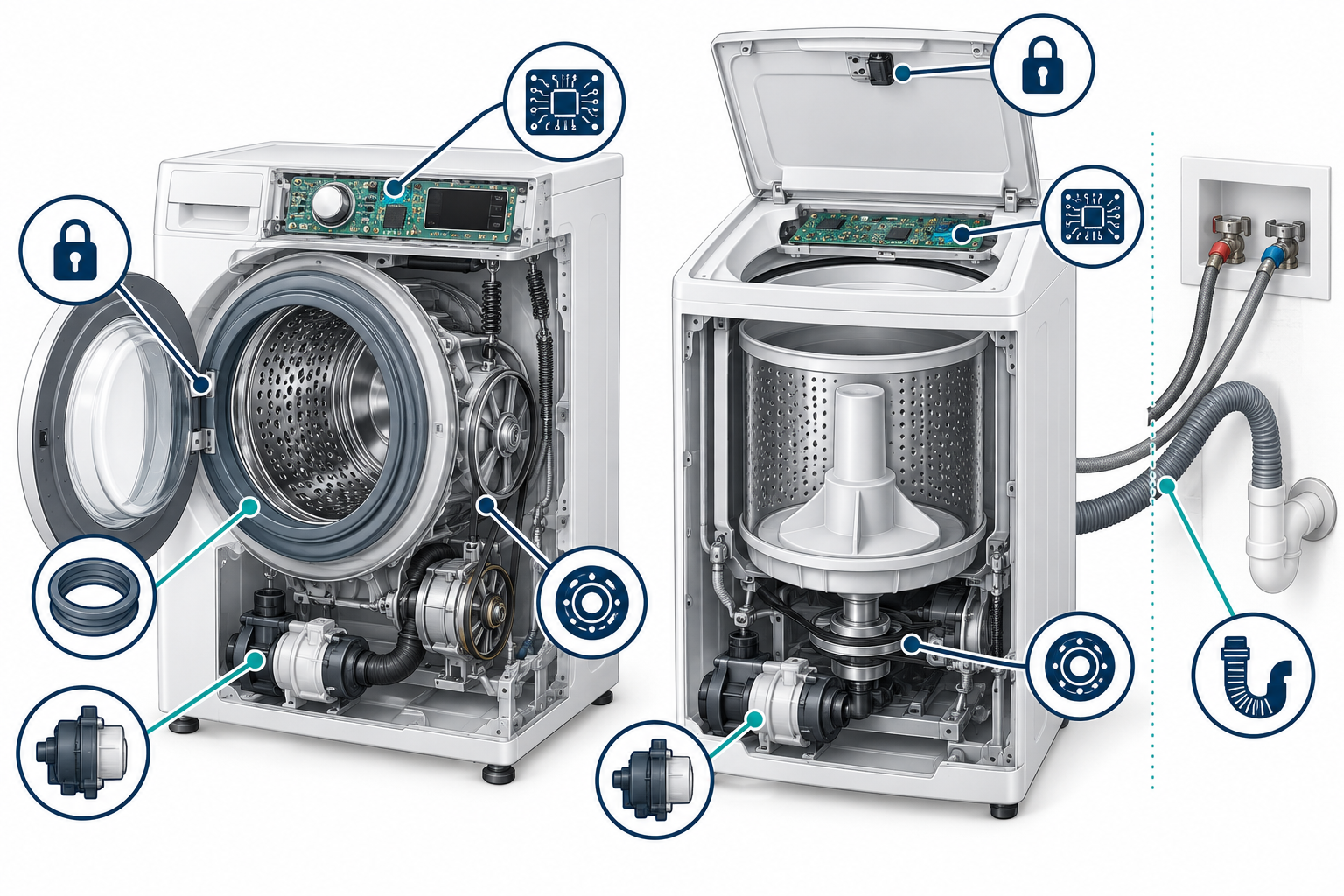
A washer may fail to fill, drain, spin, agitate, lock, balance, heat, or complete a cycle. It may leak, make noise, show an error, or clean poorly. The cause can be a pump, motor, belt, bearing, tub, control, lid or door assembly, sensor, seal, hose, valve, or building-side connection.
Record the model, age, front-load or top-load configuration, symptom, load conditions, error display, and where water appears. Do not open electrical covers, bypass a safety lock, or dismantle the appliance based on a guessed part.
Drain and fill problems
A washer that retains water may have a pump, filter, hose, control, drain, or building-side issue. A slow fill can involve an inlet valve, supply, screen, pressure, or control. A household shutoff or drain problem can mimic appliance failure.
Ask the technician to explain what was tested at the appliance and at the connection. Plumbing work on a valve, supply, standpipe, or drain belongs to the relevant plumbing or wastewater scope. The appliance repair quote should not hide a building-side correction.
Spin, agitation, and drive failures
Drive components, suspension, bearings, motor, belt, clutch, transmission, tub, or control can affect noise, vibration, spin speed, and load movement. A small belt replacement and a tub or bearing assembly have different economics. An unbalanced load can create a symptom without a permanent component failure.
Request a diagnosis rather than paying for an assumed component. Ask whether the proposed repair addresses the root cause and which other major assemblies were inspected.
Door, lid, seal, and control issues
A door or lid that will not latch can involve the latch, hinge, lock, alignment, or control. A leak can originate at a door seal, hose, dispenser, tub, pump, valve, or connection. A display or cycle error can involve a control board, sensor, wiring, or an underlying mechanical problem.
Water damage makes urgency higher. Stop using a leaking washer when continued operation can damage flooring or electrics, and obtain qualified help. Restoration of the building is separate from repairing the washer.
Front-load versus top-load repair
Configuration affects access, parts, capacity, maintenance, and the consequences of a bearing, tub, door, or lid failure. Do not import one configuration’s repair experience into the other. A front-load repair can also affect the door seal and stacking arrangement; a top-load repair can involve lid, agitator, or balance components.
Repair or replace
Repair is more attractive when the fault is localized, the tub and cabinet are sound, the washer has a good service history, the part is available, and replacement would require stacking or plumbing changes. Replacement deserves comparison when bearings or the tub are failing, failures repeat, controls are obsolete, the cabinet is corroded, or the repair warranty is weak.
Compare diagnosis, part, labor, return visit, warranty, replacement, delivery, hoses, stacking kit, removal, disposal, water and energy use, and household laundry disruption. There is no universal age or percentage rule.
Efficiency and ownership cost
ENERGY STAR’s washer guidance uses Integrated Modified Energy Factor and Integrated Water Factor to compare models. IMEF accounts for cycle, standby, water-heating, and dryer-related energy; IWF expresses water use relative to capacity. Use these metrics among comparable models and keep their scope visible.
Operating savings depend on loads, water temperature, local rates, dryer use, and household behavior. A repair may be preferable to replacement even when a new washer is more efficient if the repair is contained and the household uses few loads.
Compare the water and laundry boundaries
Ask whether the estimate includes appliance diagnosis only or also a hose, shutoff, standpipe, floor, drain, or restoration condition. A washer can be repaired correctly while a building-side leak remains. Keep the parts-and-labor warranty, return visit, water-damage responsibility, and temporary laundry plan explicit.
Warranty and parts
Check the included warranty, service contract, labor coverage, tub or bearing terms, and provider network. Ask whether a special-order part will require a second visit and whether a repair warranty covers the entire work.
U.S. and Canadian uncertainty
Specialist repair figures are U.S.-weighted. Canadian labor, parts, taxes, and service availability differ. Use Canadian quotes for Canadian budgeting and do not convert U.S. dollars.
Separate appliance symptoms from room conditions
The provider should state whether a no-fill, slow drain, leak, vibration, or noise was traced to the washer or to the hose, valve, standpipe, floor, or building drain. A machine can be mechanically sound while a connected condition creates the complaint. Price any plumbing, flooring, cabinet, or restoration work outside the appliance repair.
Sort the symptom into a repair path
No fill or slow fill can involve a valve, screen, hose, pressure, control, or household supply. A machine that will not drain can involve a pump, filter, hose, control, standpipe, or building drain. Noise and vibration can come from loading, leveling, suspension, bearings, a motor, or a tub assembly. A door or lid problem can affect both operation and the safety interlock. The symptom narrows the investigation but does not select the part.
Ask the provider to state which tests separated the appliance from the connected plumbing. If water appears at a hose, shutoff, standpipe, or drain, the washer repair quote may not include the building-side correction. If a leak has reached the floor or wall, preserve the surrounding restoration decision rather than treating a replacement part as the entire fix.
Compare a contained repair with a repeat-visit risk
A contained repair is easier to evaluate when the part is available, the appliance has a sound tub and cabinet, access is straightforward, and the provider offers a clear warranty. A repair with special-order parts, a stacked or built-in installation, uncertain diagnosis, or a likely second visit needs a wider total. Ask what happens if the first component does not solve the problem and whether return labor is included.
Repair or replacement should also account for laundry disruption, a temporary laundromat, delivery, removal, installation, stacking, water and drain work, and operating cost. U.S. specialist ranges describe market scale but do not establish a Canadian price or a model’s failure probability. Use the exact machine and local quote for the decision.
Decide when the repair branch is no longer contained
A repair can stop being contained when the diagnosis expands to building plumbing, water damage, a second visit, special-order parts, stacked access, or a tub, cabinet, control, or bearing assembly. Ask the provider to identify the stop condition before authorizing additional work. Do not use a generic repair percentage or age rule in place of the exact model, service history, local parts support, and installed replacement comparison.
The replacement branch should include the measured opening, delivery, disconnection, hoses or valves, drain, stacking, electrical, removal, disposal, testing, warranty, and temporary laundry. Keep U.S. specialist ranges separate from Canadian local quotes and do not convert them into a false local estimate.
Compare the outage with replacement timing
If the household needs laundry immediately, include laundromat, delivery lead time, temporary storage, and a second visit in both the repair and replacement branches. A contained repair may win even when replacement is attractive in the long term if a compatible model is not locally available. A replacement may win when the repair diagnosis is uncertain and the current installation already needs correction.
Keep a replacement fallback ready
If the diagnosis changes to a tub, bearing, control, cabinet, repeated leak, or unsupported part, obtain a replacement comparison before spending further. Include the measured room, delivery, stacking, water, drain, floor, removal, disposal, service, warranty, and temporary laundry. This avoids treating a sequence of small authorizations as though it were still a contained repair.
End with a written decision
The service record should state the diagnosis, tests, parts, labor, access, warranty, remaining risk, connected plumbing boundary, and replacement comparison if one was considered. A written decision makes it clear whether the next step is a repair, a second opinion, a room correction, or replacement.
What to ask
Ask what failed, how it was tested, whether plumbing is involved, what parts and labor cost, how return visits are handled, what warranty applies, and what the replacement would cost installed. A sound washer decision accounts for both the machine and the water, drain, access, and laundry conditions around it.