
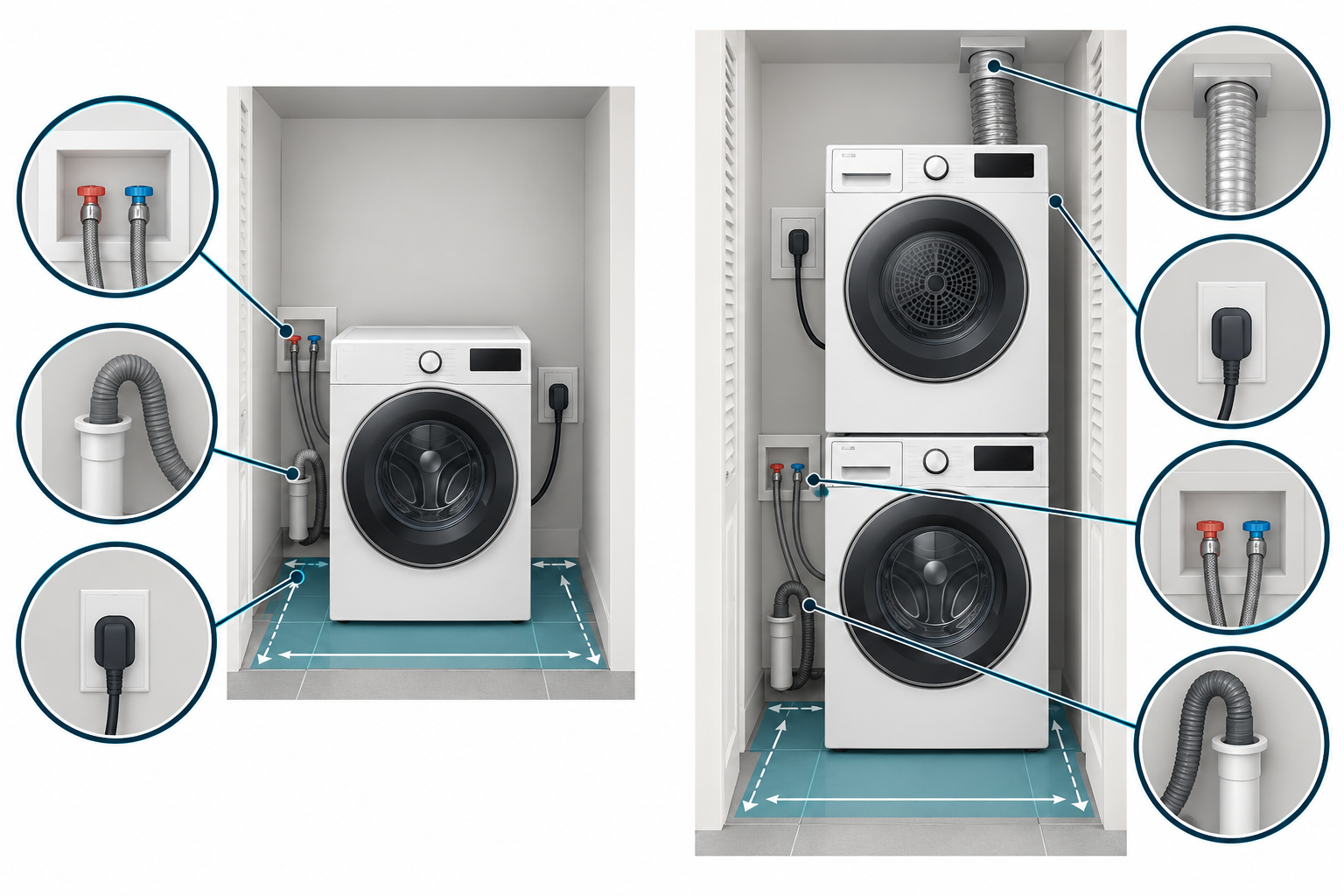
An all-in-one washer-dryer combines washing and drying in one appliance. It can save floor space and avoid moving laundry between machines, but it may have different capacity, cycle time, water, drain, electrical, venting, service, and replacement economics from a stacked pair. The market includes materially different condenser and heat-pump designs, so the exact model matters.
What the combo changes
A combo can fit a small laundry room, apartment, accessory dwelling unit, or closet where a separate pair will not. It may run a complete wash-and-dry sequence without manual transfer. The tradeoff can be longer total cycles, a smaller drying capacity than washing capacity, or more disruption if one machine failure removes both functions.
Identify the household’s weekly loads, largest items, schedule, storage space, and tolerance for waiting. A unit that fits the room but cannot handle the household’s volume may create a hidden time cost.
Purchase and installation cost
Compare the combo’s purchase price with a stacked or side-by-side pair that has similar capacity and features. Add delivery, inside placement, water hoses, drain, electrical connection, leveling, floor condition, removal, and installation. A ventless combo may avoid conventional exhaust construction, but it can still need a drain or condensate arrangement.
The model manual controls connections and clearances. Do not generalize one combination appliance’s electrical or drainage requirement to all products.
Space-saving value
Measure width, height, depth, door swing, service clearance, closet ventilation, and delivery path. The combo may save floor area, but it needs enough front clearance to load and service. A stacked pair may use vertical space and have separate machines that can run simultaneously.
Value the saved space according to the actual home. In a small room, avoiding construction or moving a wall can justify a purchase premium. In a larger room, separate machines may produce more capacity and faster throughput.
Water, drain, and electrical connections
The combo needs water supply, a drain, and an electrical connection suited to the chosen model. An existing compatible connection may support a basic replacement. A missing valve, changed drain, damaged outlet, or building-side correction is separate plumbing or electrical work.
Do not use general advice to decide whether a model can share a connection or fit a closet. Have the installer verify the manual, local requirements, and the actual space.
Ventless and heat-pump variants
Some combos use condenser or heat-pump drying. ENERGY STAR describes heat-pump dryers as closed-loop, lower-temperature systems that do not require conventional exterior ventilation and produce condensate. This does not mean every combo has identical performance or installation.
Check whether the unit uses a collection tank or drain, how filters are maintained, what the drying capacity is, and whether the model’s energy certification applies in the purchase market. Canada’s EnerGuide and ENERGY STAR eligibility context can differ from U.S. labeling.
Energy, water, and cycle cost
Use exact model data. ENERGY STAR washer guidance uses IMEF and IWF for comparable washer models, while labels may provide annual energy use. Add water, sewer, detergent, and drying energy where the model data permits. Actual cost depends on loads, temperatures, settings, local rates, and cycle behavior.
Do not assume a combo always saves energy because it uses one cabinet. A longer cycle, repeated drying, or smaller effective capacity can change the household result. Compare with the actual stacked pair and the household’s use.
Repair and replacement risk
One combo can concentrate the failure risk of two functions in one appliance. If a shared control, drum, pump, or drying system fails, both washing and drying may be unavailable. That does not prove that a combo is less reliable; it changes the consequence of a repair.
Ask about service coverage, parts availability, warranty, repair access, and replacement lead time. Canadian service availability should be confirmed in the local market. Do not rely on a universal life expectancy.
All-in-one versus stacked pair
Choose a combo when footprint, transfer-free operation, and a compatible installation are the main values. Choose a pair when simultaneous washing and drying, higher throughput, independent replacement, or quicker cycles matters more. Aesthetics and matching brands are secondary to model compatibility and total cost.
U.S. and Canadian differences
Product prices, availability, taxes, energy rates, labels, installation packages, and regulations vary. NRCan identifies integrated washer-dryers in its Canadian appliance and regulation context, but category-level information does not prove current local stock or model suitability. Use local prices and current model data; do not convert U.S. figures.
In the United States, the ENERGY STAR HEAR resource identifies eligible heat-pump all-in-one washer-dryers for rebates of up to $840; only heat-pump models qualify under this product category. A combo with another drying design is not eligible on that basis. Local program availability, remaining funds, household rules, and exact model certification still need confirmation. This U.S. ceiling does not establish a Canadian rebate.
Decision worksheet
List combo and pair equipment, delivery, installation, water, drain, electrical, vent or condensate, removal, disposal, capacity, annual energy and water, cycle time, service, warranty, and expected ownership. Include the cost of losing both functions during a repair.
The best combo decision is not about saving a cabinet alone. It is whether the space, capacity, connection, operating cost, repair support, and household schedule justify concentrating laundry in one appliance.
Compare the complete laundry sequence
A combo can remove the transfer between washer and dryer, but the household still pays for water, drain, electricity, detergent, drying time, and maintenance. Write down the real weekly pattern: number of loads, largest load, bedding, back-to-back use, and how long laundry can remain in the machine. A smaller effective drying capacity or a longer combined cycle can change the value of the space saving. Compare those consequences with the cost of a stacked or side-by-side pair.
The installation quote should identify the water supply, drain, electrical connection, floor, clearances, door swing, delivery route, and service access. A ventless design may change the exhaust scope but not the need to follow the exact model instructions. Condensate, filter, or drain access that is difficult to reach can become an ownership cost. If the unit is built into cabinetry, reserve a service path rather than assuming the cabinet can stay untouched during a future repair.
Model downtime and replacement risk
With one appliance doing two jobs, a shared pump, control, drum, or drying assembly can interrupt both washing and drying. This is a consequence-of-failure issue, not proof that every combo is unreliable. Ask how quickly the local service network can diagnose the model, whether parts are stocked, how warranty callbacks work, and what replacement lead time looks like. Include a temporary laundromat or alternate laundry plan in a high-outage scenario.
Compare the combo with three alternatives: keep the current setup, install a new combo, or install a separate pair. For each, show equipment, installation, connections, removal, disposal, annual utility cost, maintenance, service, and the expected ownership period. Mark unknowns, especially Canadian stock and service, instead of filling them with converted U.S. prices.
Decide how much convenience is worth
Value the avoided transfer between washer and dryer, the footprint, and the simplicity of one control system against longer cycles, shared downtime, capacity limits, and a concentrated replacement event. A combo can be a strong fit for a small room or a household that values transfer-free operation; it can be a poor fit for frequent back-to-back loads or a household that needs one function while the other is being serviced.
Write the decision in those terms before comparing brands. Then obtain a quote tied to the measured room and the exact model, with the connection, service, warranty, disposal, and fallback plan visible.
Test the household’s fallback plan
Before committing, decide what happens if the combo is unavailable, delayed, or in service. A household that cannot easily use a laundromat may value independent washer and dryer functions more than a household with flexible access. Include the cost of an alternate laundry arrangement, service lead time, and replacement logistics in the ownership comparison.
The final decision should state why the combo’s space, transfer-free operation, and connections justify concentrating both functions in one cabinet. If that reason disappears when cycle time, service, or capacity is included, a separate pair may be the more resilient project.
Confirm the exact capacity, cycle behavior, drain arrangement, electrical requirements, door clearance, stacking or cabinet limitations, warranty, filter access, and disposal path. ENERGY STAR and Canadian label information can support model comparison, but category-level certification or availability does not prove that a particular unit fits the room or is stocked locally. The final quote should be tied to that model and measured space.
Before ordering, ask how a full wash-and-dry sequence affects the household’s schedule. A combo may reduce handling, but a delay in one long cycle can delay every load behind it. Compare the number of loads that need to be completed on a normal day, whether laundry can remain in the machine, and whether an alternate laundry option exists during service. Those practical constraints can outweigh a small difference in advertised capacity.