
Energy labels help compare appliances, but they do not predict your exact household bill. The U.S. EnergyGuide label and Canada’s EnerGuide label use related ideas while presenting different information. The most reliable comparison starts with similar product classes, similar capacity, and the actual model number, then applies your local energy or water rate to the labeled consumption.
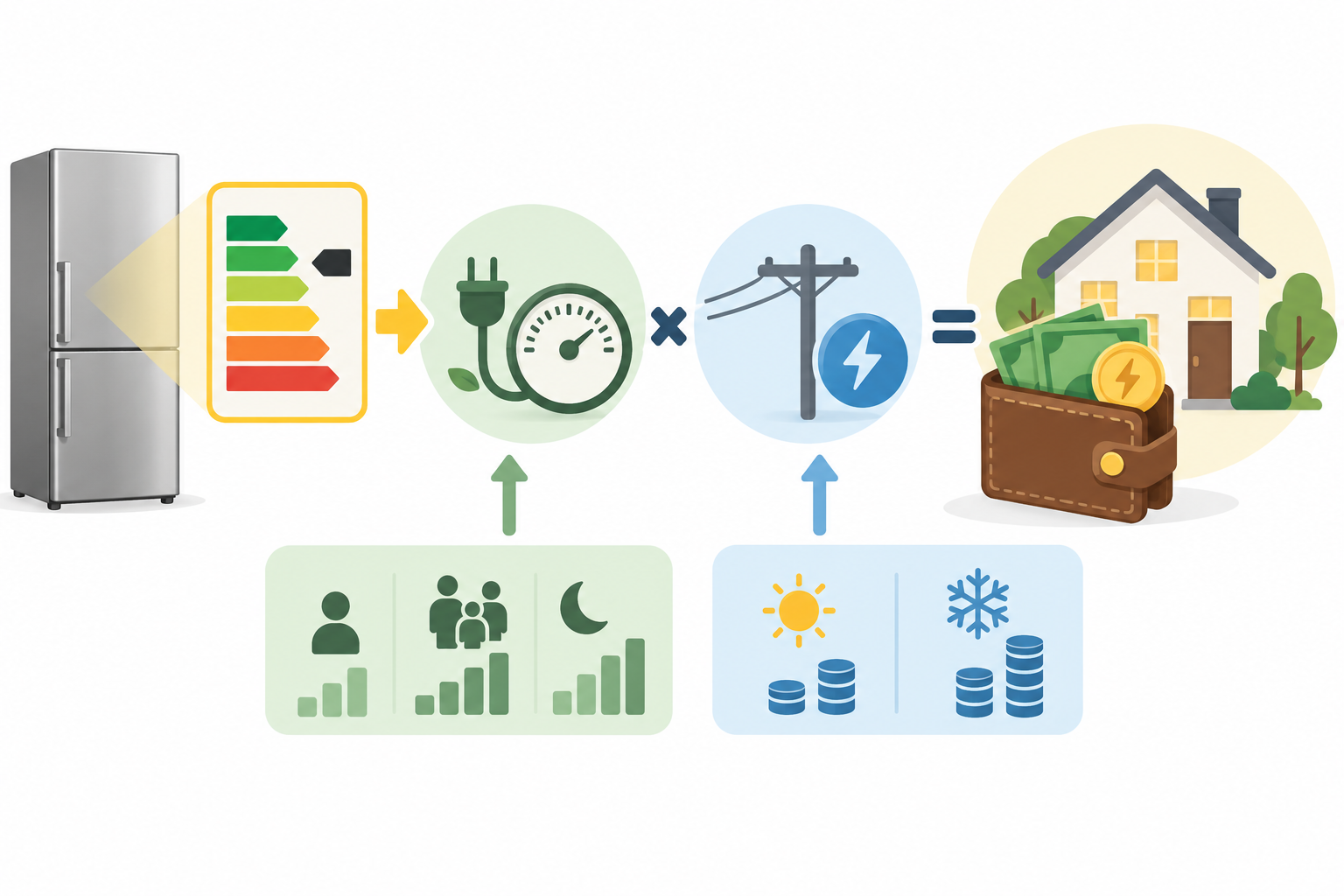
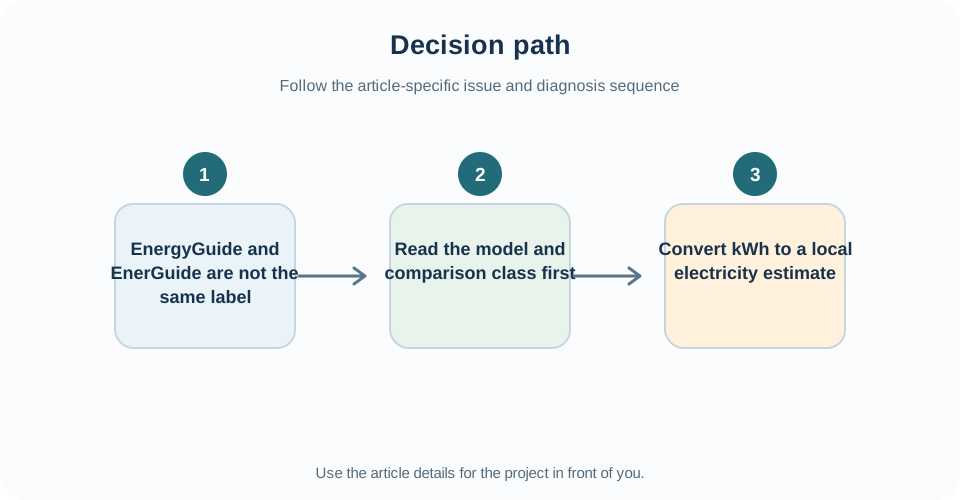
EnergyGuide and EnerGuide are not the same label
The U.S. EnergyGuide label commonly shows the make, model, size or key features, annual energy use, an estimated operating cost based on stated assumptions, and a comparison with similar products. The Federal Trade Commission warns that the operating-cost estimate uses typical use and an average energy price, so your cost changes with local rates and behavior.
The Canadian EnerGuide appliance label shows annual energy consumption in kilowatt-hours, an indicator placing the model relative to efficient and inefficient models in the same class, the comparison class and capacity, and the model number. It is not simply a Canadian version of the yellow U.S. label. Natural Resources Canada notes that the two countries generally use similar test methods, while the comparison scales can differ because the model populations and rules differ.
Read the model and comparison class first
A lower annual kWh number is useful only when the compared appliances perform a similar job. Compare a compact refrigerator with compact refrigerators, not with a full-size French-door model. Compare washer metrics within a comparable capacity and configuration. A larger unit may use more energy per year while serving more loads or replacing two smaller machines.
Check the model number, capacity, configuration, and label date or product-finder entry. Regulatory coverage and specifications can change. A label attached to one model does not establish the consumption, certification, installation, or operating cost of a nearby model in the same product line.
Convert kWh to a local electricity estimate
The simple electricity calculation is:
annual kWh × electricity price per kWh = annual electricity cost
If a utility charges a flat energy rate, this is straightforward. If the bill has delivery charges, time-of-use periods, demand charges, taxes, fixed fees, or tiered rates, the calculation is only a planning estimate. Use the marginal rate that best represents the added consumption, and state the assumption.
For example, a model labeled at 400 kWh per year would cost about $80 per year at an assumed $0.20 per kWh before other bill components. That is a deliberately illustrative calculation, not a quote or a claim about a particular household. If the actual tariff is $0.12, $0.30, or time-sensitive, the result changes.
Gas appliances require a separate approach. A label may present energy information in a way that is not directly comparable with an electric appliance’s kWh. Use the model’s stated consumption, the fuel’s billing units, and the local delivered fuel price. Do not compare a label’s electricity estimate with a gas bill without normalizing the units and assumptions.
Water use is part of washer and dishwasher cost
For a washer or dishwasher, energy is only part of ownership cost. Water consumption, sewer charges, water heating, detergent, drying, and usage frequency can matter. ENERGY STAR’s washer guidance uses Integrated Modified Energy Factor and Integrated Water Factor for model comparisons. IMEF accounts for washer cycle, standby, water-heating, and dryer-related energy in its metric; IWF expresses water use relative to capacity.
Use the label or product-finder values for similar models rather than assuming that front-load, top-load, or a larger capacity always wins. A household that runs many full loads can realize more savings than one that runs occasional small loads. A washer that extracts more water can also affect dryer energy, although the final outcome depends on the models and use pattern.
EnergyGuide is not ENERGY STAR
EnergyGuide is a comparison and consumption label. ENERGY STAR is a certification program with product-specific efficiency criteria. A product can have an EnergyGuide label without being ENERGY STAR certified. In Canada, EnerGuide and ENERGY STAR can also appear together when a model meets the relevant certification requirements.
Use the label to compare consumption within a class. Use ENERGY STAR status as an additional qualification when it applies to the product and market. Do not treat a logo as proof of lower total cost, installation compatibility, availability, or suitability for your home.
Estimate lifetime operating cost
Multiply the annual estimate by the number of years you expect to own the appliance, then add purchase, installation, repair, maintenance, filter, water, gas, and disposal costs. Discounting future costs may be appropriate for a formal investment analysis, but a simple household comparison should at least show the assumptions.
Suppose an efficient model costs more to buy but saves an estimated $25 per year. A five-year ownership horizon suggests $125 in energy savings before maintenance and rate changes. That premium may be attractive for a frequently used appliance and a long expected ownership period, but it may not pay back if the premium is much larger, the home may move, the model needs costly repairs, or the household uses the appliance lightly.
Never describe the result as guaranteed savings. Rates, loads, ambient conditions, settings, maintenance, and product performance can differ from the test conditions. Keep a range when a single scenario would create false precision.
Canadian label and regulation limits
Natural Resources Canada identifies mandatory EnerGuide labeling for several appliance classes, including washers, integrated washer-dryers, dryers, dishwashers, freezers, electric cooking products, miscellaneous refrigeration, and refrigerators. NRCan’s regulations guide also explains that regulated products must meet federal standards when imported into Canada or shipped between provinces or territories for sale or lease, and that some provinces have additional requirements.
Those statements do not replace model-level or province-level verification. A product-finder entry does not guarantee local stock, installation approval, or a rebate. Verify the current model, label, certification, and local rules when purchasing in Canada.
Check current program and rule status
As checked October 11, 2026, ENERGY STAR lists Clothes Washers Version 8.1 as in effect and Version 9.0 as under revision, with no effective date shown for Version 9.0. Do not use draft Version 9.0 thresholds as current certification criteria. Natural Resources Canada’s Amendment 19 was pre-published in Canada Gazette, Part I on June 20, 2026, with a 70-day comment period; that is a proposal-stage record, not a final appliance requirement or compliance date. For a purchase decision, check the current exact-model listing and the rule for its product class and market.
A label-based shopping checklist
Record the exact model number and compare annual kWh with similar capacity and configuration. Note whether the U.S. label’s estimated cost uses a rate that resembles your utility. For a Canadian product, record annual kWh and the EnerGuide comparison class. Add water or fuel use where relevant. Then calculate a low, expected, and high operating-cost scenario using your local rates.
Finally, combine that result with purchase price and installation. A highly efficient refrigerator that does not fit the opening is not a low-cost choice. A washer with better metrics may require a stacking kit or floor correction. A heat-pump dryer may reduce energy and avoid conventional exhaust but have a higher purchase price and a condensate plan.
Labels make the operating-cost part of an appliance decision more transparent. They do not remove the need to compare like with like, check current rules, or ask how the equipment will behave in your home.
Build an apples-to-apples comparison
Start with the exact model number and the comparison class printed on the label. Compare similar capacities and configurations before comparing annual energy use. A compact refrigerator, a full-size refrigerator, and a wine chiller may all be refrigeration products but do not serve the same job. A front-load washer and a top-load agitator washer also have different capacity and efficiency comparisons.
Record the label’s annual kWh, capacity, product class, and any assumptions supplied by the program. For a washer or dishwasher, add the household’s water, sewer, and water-heating costs when those charges matter. For a dryer, consider how much moisture the washer leaves in the load and how often the dryer runs. For a refrigerator or freezer, usage, ambient conditions, door openings, and ice-making can affect the household result.
Use a simple scenario model
For electricity, a first-pass estimate is:
annual kWh × local electricity price per kWh = annual electricity cost
If a label or program gives an annual operating-cost estimate, treat it as a comparison under its stated assumptions, not as your bill. Run at least a low-use and high-use case. Then compare the purchase premium with the annual difference over the period you expect to own the appliance. Include delivery, installation, removal, and financing or rebate assumptions when they materially change the decision.
For example, if two comparable models differ by a known amount of annual energy use, multiply that difference by the household’s actual tariff rather than by a national average. If the rate has tiers, demand charges, time-of-use periods, or separate gas and electric components, say which simplified assumption you used. A rough transparent model is more useful than a precise-looking result built on an unknown rate.
Common label mistakes
Do not compare a certified product with an unrelated size and call the lower number a guaranteed saving. Do not treat ENERGY STAR as the same thing as EnergyGuide or EnerGuide: ENERGY STAR is a qualification program, while the labels communicate energy-use or cost-comparison information. Do not use a U.S. label’s estimated operating cost as a Canadian estimate, and do not use Canadian EnerGuide comparison indicators as a promise of a particular operating bill.
Canadian label and regulation details can change. NRCan identifies product classes and current verification paths, but model eligibility, availability, and provincial requirements still need checking at purchase. The label is a starting point for a cost model, not a substitute for the exact model, local tariff, installation quote, or household usage pattern.