
Heat-pump dryers trade a potentially higher equipment price for lower energy use and a different installation path. ENERGY STAR describes them as closed-loop systems that recirculate heat, do not require conventional exterior ventilation, and can reduce energy use by at least 28% compared with standard dryers. The household’s result depends on purchase premium, dryer usage, local energy prices, existing vent conditions, condensate handling, maintenance, and service support.
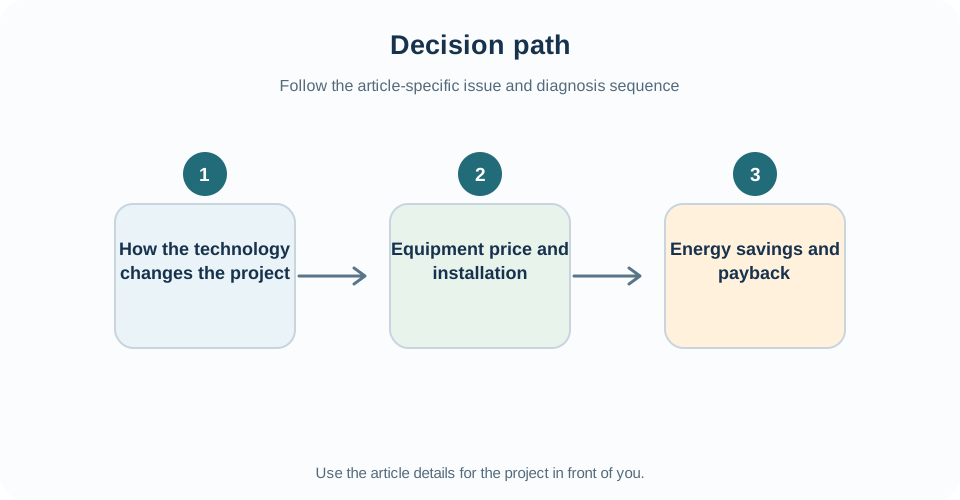
How the technology changes the project
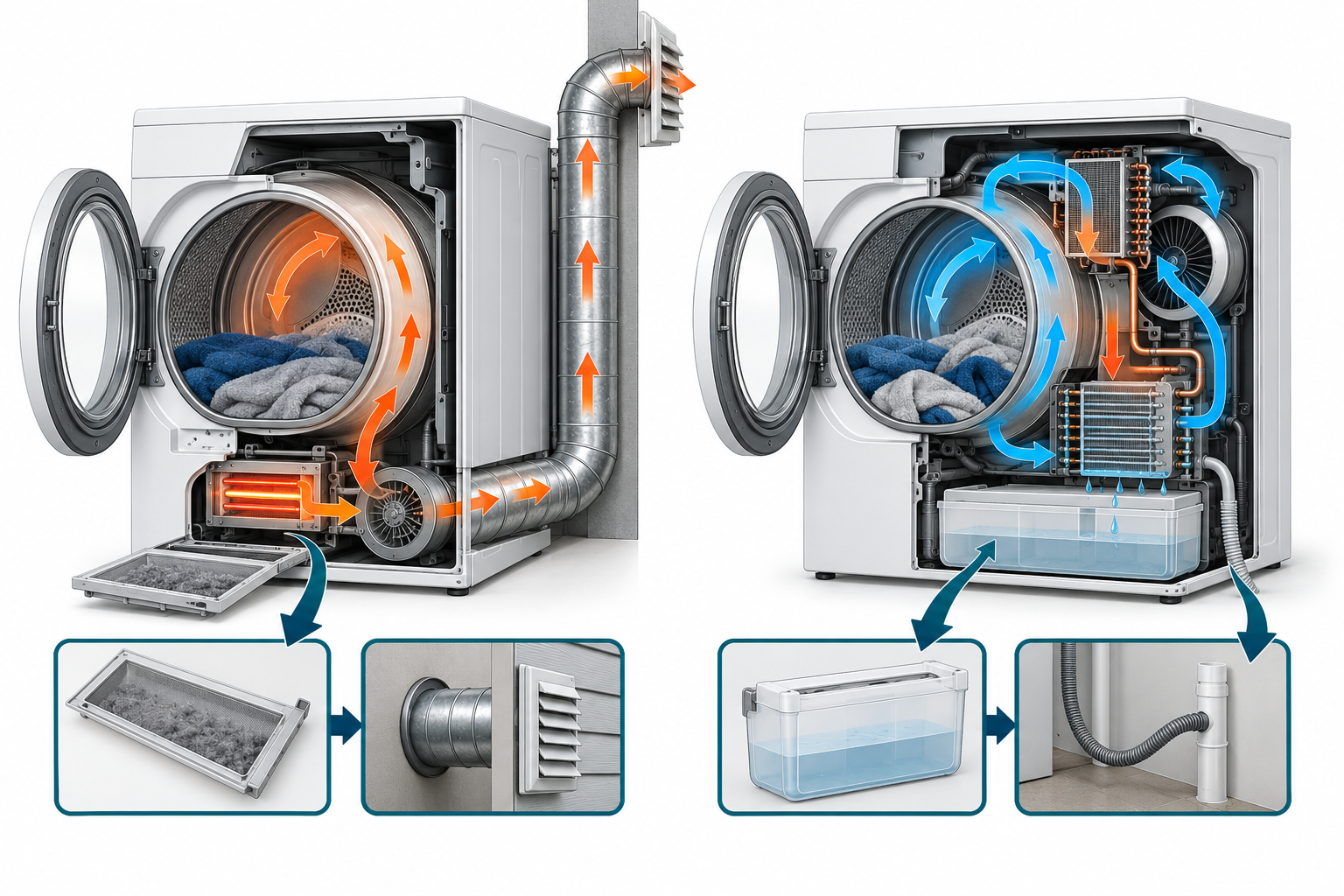
A conventional dryer exhausts warm humid air through a vent. A heat-pump dryer uses an evaporator and refrigerant loop to remove moisture and reuse heat. Water still has to go somewhere: the model may use a collection tank, a manufacturer-provided hose, a nearby sink or drain, or a compatible washer-drain arrangement.
The absence of a conventional vent can reduce construction cost where no suitable route exists, but it does not mean the unit can be installed anywhere without checking the manual. Electrical connection, clearance, condensate, floor, service, and stacking requirements remain model-specific.
Equipment price and installation
Compare the exact heat-pump model with a comparable conventional electric or gas dryer by capacity, features, and installation. Add delivery, removal, stacking, cord or connection, condensate hose or drain arrangement, and any electrical or cabinetry work.
If a conventional dryer would require a new vent through finished walls, the heat-pump option may avoid that construction. If an existing compliant vent is ready, the conventional installation may be less expensive initially. A quote should show both situations rather than assuming that “ventless” is always cheaper.
Energy savings and payback
Use annual model energy data and a local electricity rate. A simple planning formula is:
annual kWh savings × electricity price = annual energy saving
Divide the additional purchase and installation cost by the modeled annual saving for a rough payback. This is only a scenario. Load size, cycle choice, moisture remaining from the washer, electricity tariff, and household behavior affect actual results.
ENERGY STAR notes that high dryer usage and high electricity rates make the energy case more compelling. A lightly used dryer or a home with low electricity rates may not recover a large purchase premium. Do not state a universal payback period.
Drying time, capacity, and household fit
Heat-pump dryers operate at lower temperatures and can have different cycle times and capacity patterns. Choose based on the household’s weekly load, fabrics, schedule, room, and tolerance for longer cycles. A larger drum may cost more but reduce the number of loads; a compact model may fit a small space but require more cycles.
Pairing with a washer that extracts more water can change drying time and energy use. The exact washer and dryer models matter; do not assume any matched brand or configuration delivers the same result.
Condensate handling
Decide whether the household will empty a tank or use a model-approved drain arrangement. A drain hose can reduce daily handling but may require a suitable nearby drain and a secure route. ENERGY STAR lists several possibilities but emphasizes that the model instructions control.
Do not route condensate into an unsuitable drain or make a connection beyond the installer’s scope. If new drainage or plumbing is needed, price it separately.
Electrical, refrigerant, and service considerations
The exact model controls electrical requirements. A new circuit or wiring correction belongs to electrical planning. A heat-pump dryer uses refrigerant as part of its process; do not open or service the refrigerant circuit yourself. Ask about qualified service, parts, warranty, and end-of-life disposal.
In the United States, EPA appliance-disposal guidance addresses refrigerant-containing appliances and safe disposal channels. Canadian disposal, recovery, and recycling practices require local verification. Do not use another country’s rules as a universal instruction.
Maintenance and repair
Filters, airflow, condensate, sensors, and heat-pump components affect performance. Follow the exact manual. U.S. specialist repair estimates are broad and U.S.-weighted; they do not establish Canadian price or a heat-pump model’s failure probability.
Ask the retailer or installer who services the model in your area. A higher-efficiency appliance can have a poor economic result if parts and qualified service are difficult to obtain.
Rebates and market differences
Rebates change by utility, state, province, product qualification, and date. Verify the current program before relying on it. Canadian availability and incentives must be checked in the Canadian market. Never convert a U.S. incentive or product price into a Canadian estimate.
In the United States, an eligible ENERGY STAR heat-pump clothes dryer may qualify for up to $840 through the HEAR framework. The local program must be open and funded, and household and exact-model requirements apply; confirm certification and eligibility with the program administrator before counting a rebate. The $840 ceiling is not guaranteed and does not establish a Canadian incentive.
Puget Sound Energy provides a local example checked October 12, 2026: its listing offers $350 for a qualifying ENERGY STAR dryer or $400 for Efficiency Boost customers, with a temporary $400 promotion through November 30, 2026. Terms require a current PSE electric account, purchase and installation by December 31, 2026, and application within 60 days. The listing does not establish whether the temporary offer stacks with other incentives, so do not combine the amounts.
As checked October 12, 2026, Québec’s LogisVert program lists CAD $250 toward one new heat-pump dryer per eligible address, bought from a Québec retailer and installed in an eligible Québec home. Condenser dryers and drying cabinets are excluded; the application requires an invoice and an installed-product photo. Check the current model, address, dates, and funding before counting this local offer.
When heat-pump is most compelling
The option deserves close attention when the dryer runs often, electricity is expensive, a conventional vent would require construction, the household values lower-temperature drying, or the room cannot accommodate an exterior exhaust. It is less compelling when use is light, the existing conventional installation is ready, the purchase premium is high, or service support is uncertain.
Plan for the installation handoff
Ask the quote to identify the exact model, delivery, electrical work, condensate or vent arrangement, stacking, access, removal, disposal, commissioning, warranty, and service contact. A heat-pump option may reduce construction in one room and add drain or service requirements in another. Compare those lines with the conventional option using the same assumptions.
A two-option worksheet
For each dryer, list product, delivery, installation, electrical, vent or condensate, stacking, removal, disposal, maintenance, annual energy, local rates, repair support, rebate, and expected ownership period. Mark unknowns and model a range.
The right choice is the dryer with the best total fit for the household and room. Heat-pump technology can reduce energy and construction scope, but those benefits must be compared with the actual purchase premium and service path.
Build the payback around the project you actually have
Start with two installed scenarios: a conventional dryer using the existing route and a heat-pump dryer using the selected model’s electrical and condensate arrangement. For each, list equipment, delivery, stacking, electrical, vent work or drain work, removal, disposal, rebates, annual energy, maintenance, and service. If the conventional option requires a new route through finished construction while the heat-pump option fits an existing drain, the avoided construction is part of the heat-pump comparison. If both installations are already ready, the equipment premium carries more weight.
Use a low-, typical-, and high-use case rather than promising a payback date. A household that runs several loads each week may value lower energy use more than a household that dries infrequently. Local electricity rates, cycle selections, moisture extraction by the washer, and the exact model all matter. A rebate is an assumption until the current program confirms product eligibility, purchase date, location, and application requirements.
Compare cycle and capacity consequences
A dryer that uses less energy per cycle can still change the schedule if its cycle behavior, capacity, or moisture handling does not suit the household. Compare the largest regular loads, bedding, delicate items, and back-to-back use. Consider whether condensate must be emptied or drained, whether the chosen drain is accessible, and whether the installation leaves room for filter maintenance and service.
Do not use a general technology comparison to predict a specific model’s performance. Read the current manual and product data for cycle limits, clearances, electrical requirements, condensate routing, stacking compatibility, and service access. Keep the purchase decision separate from claims about universal reliability or life expectancy.
Compare the first-load experience
Ask how the selected model handles condensate, filter access, cycle selection, stacking, noise, and service notifications. A lower-energy option should still fit the household’s largest regular loads and schedule. Include a temporary laundry plan if delivery, commissioning, or a callback will leave the household without a working dryer.
State the assumptions that drive the result
The comparison should show the electricity rate, loads per week, expected ownership, cycle behavior, installation readiness, rebate status, service availability, and disposal path. If changing one assumption reverses the result, report both cases. This is more useful than assigning a universal savings amount to heat-pump or conventional technology.
Keep the technology claim bounded
ENERGY STAR’s technology description can support a comparison of ventilation and energy characteristics. It does not establish the selected model’s fit, cycle time, local service, rebate, or household bill. Verify each of those with current model information and local providers.
Treat service and end of life as part of the premium
Heat-pump equipment has a refrigeration-based process and may need a service path that is less familiar in a particular market. Ask the retailer or installer who supports the model, where parts are sourced, what the warranty excludes, and how a refrigerant-containing appliance will be handled at disposal. In the United States, EPA guidance describes safe disposal channels for relevant refrigerated appliances; Canadian requirements and programs need local verification.