
A room air cleaner’s ownership cost depends on whether its clean-air delivery rate (CADR) fits the room, how often it runs, filter availability, electricity, noise, and the pollutant the household is trying to reduce. A portable unit is not a building repair or a medical treatment, and its CADR or certification does not promise a health outcome.
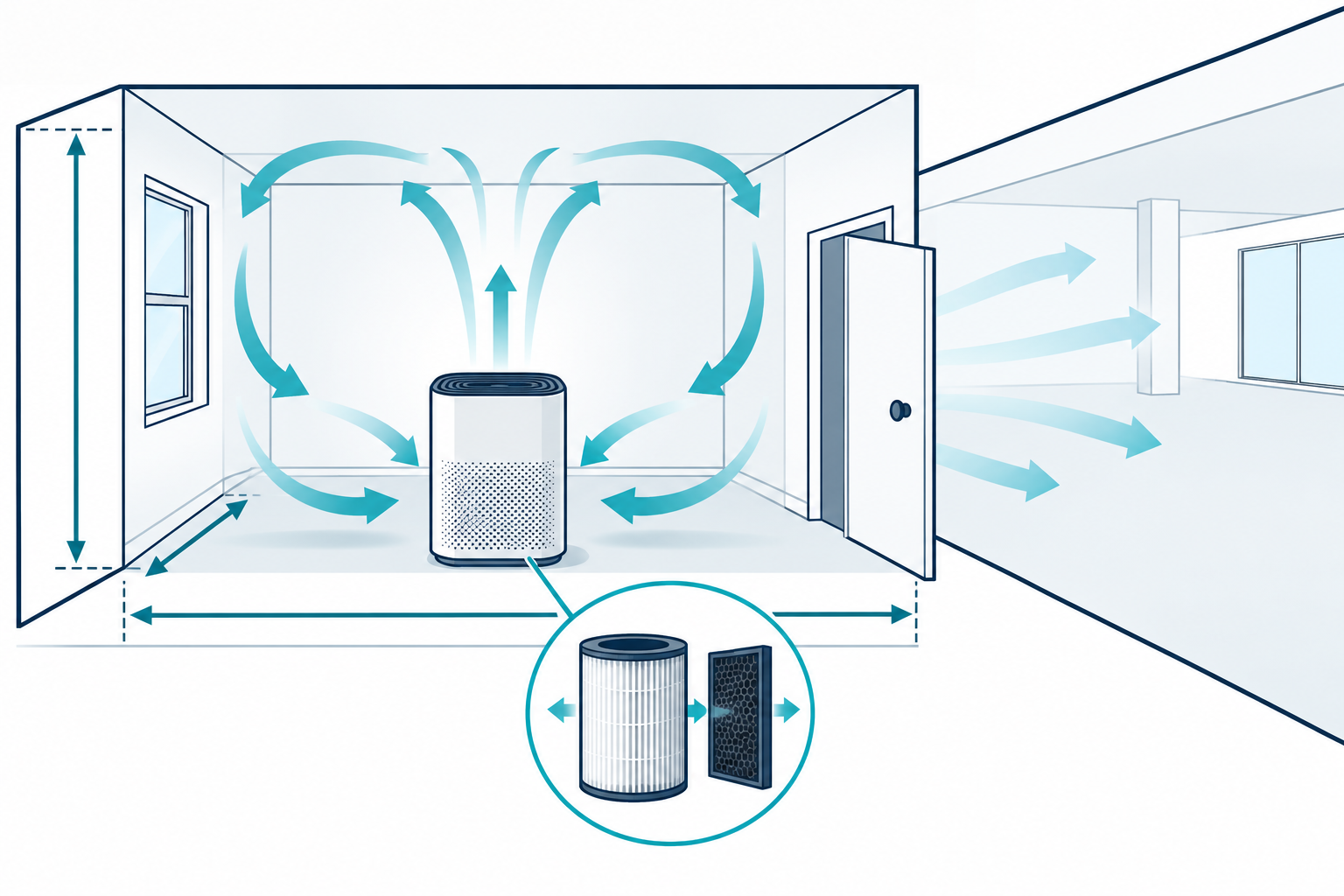
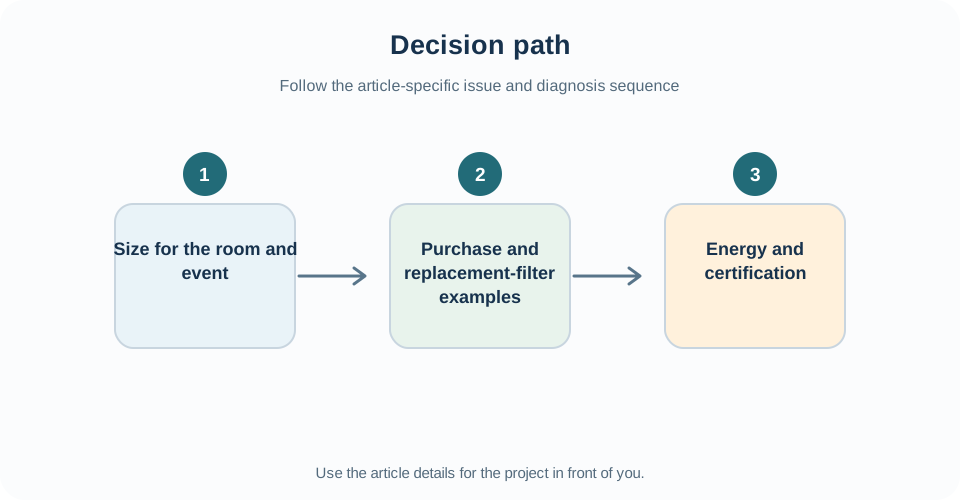
Size for the room and event
For wildfire smoke, EPA and Health Canada use a practical smoke-sizing target of CADR at least two-thirds of the room’s floor area in square feet for an eight-foot ceiling. Health Canada advises choosing a larger unit for higher ceilings. Check the exact model’s smoke CADR, room size, and filter; an open doorway or connected space increases the area to serve. (EPA indoor air filtration, Health Canada portable air cleaner guidance)
Health Canada’s separate cleaner-air-space guidance for wildfire events describes two to three air changes per hour. That is a room-volume target, not the same expression as the floor-area rule; use room volume and consistent units if applying it. Do not combine the two shortcuts as if they were interchangeable. (Health Canada cleaner-air-space guidance)
Purchase and replacement-filter examples
Retail examples checked October 12, 2026 are individual product points, not a comparable market range. Home Depot Canada’s listing showed a Winix 5520 at CAD $329. Blueair Canada’s catalog showed a Blue Pure 211i Max at $489.99; its price display did not state an ISO currency code. Compare CADR, room, speed, noise, and included filter rather than treating those listings as like-for-like.
Consumables can change the result. Blueair’s 211i Max filter page listed $89.99, said replacement may be needed up to every nine months, and showed a notify/backorder status; its displayed currency code was not explicit. Coway’s AP-1512HH/200M set was listed at $59.79 and contains one HEPA filter plus two custom filters; the page says custom filters are changed every six months and HEPA annually, with shipping limited to the United States. These prices are not a matched annual-cost comparison, and currency, shipping, tax, stock, and household runtime must be confirmed. (Blueair purifier catalog, Blueair replacement filter, Home Depot Canada Winix listings, Coway filter set)
Before buying, find the exact filter part number, local stock, price, and the manufacturer’s replacement interval. Runtime, smoke, dust, pets, and speed can change filter life. Model a low, typical, and high replacement schedule instead of converting one manufacturer’s interval into a universal annual cost.
Energy and certification
Estimate electricity as watts ÷ 1,000 × hours per day × days × local electricity rate. Use the selected model’s measured or published power at the speed the household will use. Ordinary daily operation and a short wildfire-smoke event should be separate scenarios. No exact model, filter price, operating speed, runtime, and household tariff were available as one matched set here, so this article does not invent an annual total.
ENERGY STAR Version 3.0 for room air cleaners took effect October 9, 2025. It updates particulate CADR and energy-efficiency criteria and includes an ozone-emissions test. Certification helps compare energy performance; it is not a health endorsement or a guarantee that a particular room will reach a health target. Verify current certification and the exact model in the market where it is sold. (ENERGY STAR Version 3.0 specification)
What filtration can and cannot replace
A portable HEPA cleaner can reduce particles in the room it serves when correctly sized and maintained. During smoke, follow local public-health advice, reduce smoke entry where practical, and run a properly sized cleaner in a cleaner-air room. Portable filtration does not remove every gas or vapor and does not fix a combustion source, moisture, leak, or other building problem. For central HVAC, EPA says a MERV 13-or-higher filter may help only if the system can accommodate its pressure drop; consult the system manufacturer or a qualified technician before changing the filter. A portable unit may be a stand-alone option or supplement where central filtration is unsuitable. (EPA indoor air filtration, Health Canada wildfire guidance)
DIY box-fan cleaners have a limited role
EPA chamber research tested five DIY air-cleaner configurations and reported mean CADR results from 111±1 to 401±31 cubic feet per minute. Those study results describe tested setups, not commercial product ratings, certification, a price comparison, or a blanket safety equivalence. EPA describes a newer box fan (manufactured since 2012) with a recognized safety certification as a condition for considering a DIY cleaner. Health Canada’s smoke-event guidance further advises using a newer certified fan with a safety fuse, keeping it clear of curtains and other combustibles, never leaving it running unattended or while asleep, and not using an extension cord. Treat this only as a short-term emergency option under current official guidance; it is not a substitute for a certified room cleaner or source control. (EPA DIY air-cleaner research, Health Canada cleaner-air-space guidance)
Warranty and replacement risk
Check exact warranty exclusions, filter availability, replacement cost, and local service before purchase. In July 2024 the FTC sent warning letters to eight companies about warranty representations; five letters concerned specified parts or provider conditions, including four air-cleaner sellers. Those letters were warnings, not final adjudications. They do not establish a blanket result for every manufacturer or warranty. Read the current terms for the exact device and keep proof of purchase. (FTC warning letters)
Build the household comparison
For each candidate, record the room and ceiling, pollutant, CADR, operating speed, noise, energy, exact filter part, purchase-market price, shipping, replacement cadence, warranty, and service path. Compare a typical daily schedule with the bounded smoke-event schedule. If the concern is a suspected hazard, recurring moisture, a leak, or combustion, include source investigation or qualified repair instead of assuming a purifier addresses it.
The useful purchase is a supported device with enough CADR for the intended room, affordable replacement filters, tolerable noise, and a clear role in the household’s source-control plan. Confirm current stock and terms in the local market; do not infer whole-home coverage or a health result from a product listing.