
Getting rid of an old appliance can be free, included with a replacement, or more expensive than expected when access, refrigerant handling, or local collection rules complicate the job. The practical question is not only “who will carry it away?” It is also where the appliance is going, what preparation is required, and whether the quoted service includes the entire disposal chain.
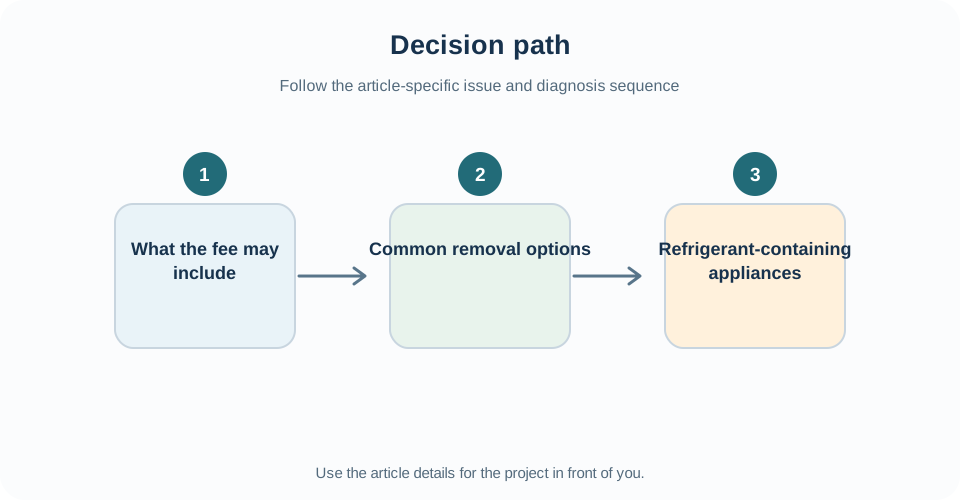
Common removal options
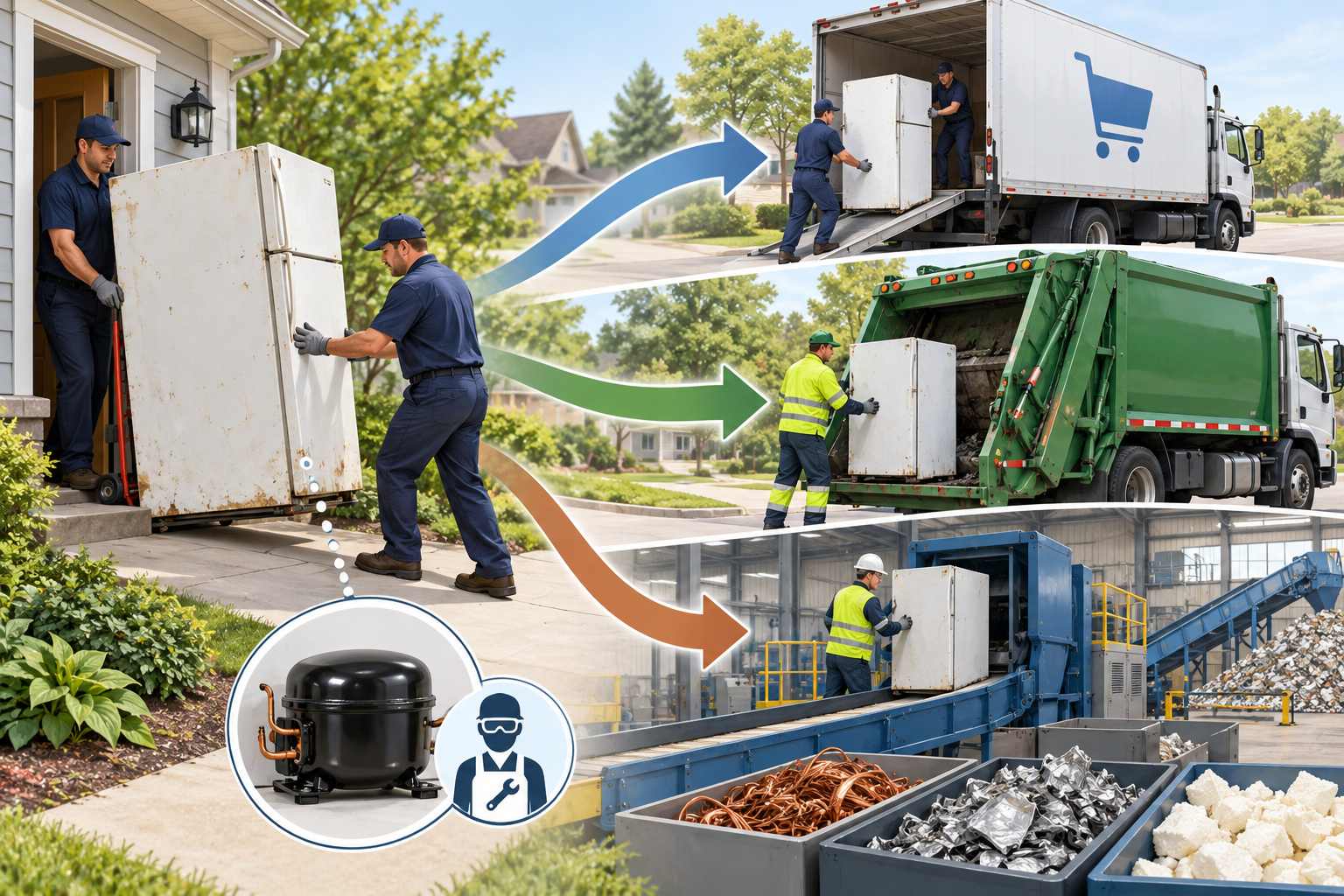
Retailer haul-away is convenient when you buy a replacement. The fee may be included, discounted, or charged separately, and eligibility can depend on whether the old unit is in the same location and accessible to the delivery crew. Ask whether the retailer accepts refrigerators, freezers, dehumidifiers, washers, dryers, dishwashers, ranges, and built-in units under the same terms.
Municipal pickup may be free or fee-based. Some programs require an appointment, curb placement, proof of residence, or preparation that the homeowner should not perform on a refrigerant circuit. A private junk or recycling service may offer faster collection but can price by appliance, volume, stairs, distance, or difficulty. A scrap dealer may accept a unit for material value, but the disposal chain still needs to handle regulated components properly.
What the fee may include
An itemized quote should state whether it includes disconnection, inside carry-out, stairs, door or panel removal, floor protection, loading, transport, recycling, landfill charges, and documentation. Many haul-away offers assume a freestanding appliance on the ground floor. A built-in refrigerator or wall oven can require an installer, cabinet work, or separate construction logistics before a hauler can access it.
Ask whether the old appliance must be empty, defrosted, disconnected, or placed outside. Do not disconnect gas, electrical, water, or refrigerant systems beyond what you are qualified and authorized to do. The safest plan is often to have the installer or a qualified service provider handle the connection and removal sequence.
Refrigerant-containing appliances
In the United States, EPA safe-disposal rules apply to household refrigerators and freezers entering the waste stream with a refrigerant charge intact. The final person in the disposal chain must ensure refrigerant recovery before final disposal, and documentation may be required when recovery occurred earlier in the chain. EPA also directs consumers to utilities, municipalities, retailers, and recyclers that can provide proper handling.
These rules are U.S.-specific. They do not establish Canadian provincial, territorial, municipal, or retailer requirements. Canadian disposal arrangements should be checked with the local municipality, utility, retailer, or qualified recycler. Do not vent, puncture, cut, or dismantle a refrigerant circuit to make removal cheaper. A technician or approved recycling channel should determine the appropriate handling.
Refrigerators, freezers, some wine chillers, portable dehumidifiers, and heat-pump dryers can involve refrigerant or other components that affect the disposal route. Product type alone does not tell you which local program will accept the unit. Ask the collector what equipment it is prepared to process.
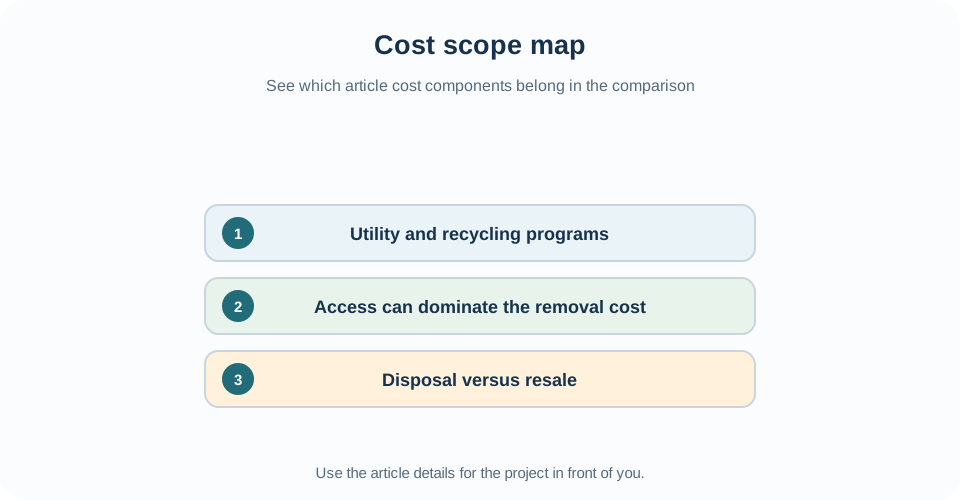
Utility and recycling programs
Some U.S. utilities offer rebates or bounties for qualifying old refrigerators or freezers. Eligibility may depend on age, working condition, size, ownership, or whether the appliance is collected directly. A rebate can reduce the net disposal cost but should not be treated as a permanent nationwide program. Availability and requirements change by utility.
Canadian utilities and municipalities may have different programs, and some may accept appliances only during scheduled events. Confirm the current program, service area, qualifying equipment, appointment process, and payment timing. A general statement that “recycling is free” is not enough to budget a project.
Local fee schedules show why a household needs its own collection quote. Portland’s schedule, updated July 1, 2026, lists an $18 trip charge plus $6 each for a washer, dryer, dishwasher, or stove/oven and $51 for a refrigerator, freezer, or portable air conditioner in its coolant-containing category. El Cerrito’s 2026 solid-waste schedule lists additional large-item charges of $109.74 for a dishwasher, washer, dryer, or stove and $137.18 for a refrigerator, freezer, or air-conditioning unit. The source dollar symbols do not state an ISO currency code. These are local schedule entries, not comparable national prices; Portland’s hauler can add time or staffing charges, and El Cerrito’s line is not established as a complete household total. Check the current local program, accepted item, and full fee before booking.
For bounded local examples, Saskatoon lists a $20 charge per refrigerant appliance and includes refrigerant removal; several other appliance types are accepted free. Muskoka’s 2026 schedule lists $28 each for appliances with cooling chemicals and no charge for large appliances excluding refrigerators; a $15 minimum applies to chargeable loads, subject to local eligibility. Whitehorse’s 2026 schedule lists scrap-metal appliances at $146 per tonne plus a $50 refrigerant-appliance surcharge. These are facility fees under different local rules, not pickup prices or comparable household totals; confirm the current accepted item, fee basis, and eligibility with the municipality.
Access can dominate the removal cost
Measure the path before scheduling pickup. Check doorways, stair widths, turns, elevators, thresholds, railings, ceiling height, and the appliance’s actual dimensions with doors or handles attached. An installer may need to remove an appliance door; a hauler may refuse a built-in or unsafe route. A narrow passage can turn ordinary haul-away into a separate access or demolition project.
Protect floors and adjacent cabinets during removal. A leaking refrigerator, damaged washer, or rusted range can leave water, oil, sharp edges, or broken glass. If the removal reveals water damage, mold, fire damage, or a damaged finish, the larger restoration scope belongs with the appropriate specialist rather than the disposal quote.
Disposal versus resale
Working equipment may be sold, donated, or reused, but resale is not automatically the lowest-cost or most responsible outcome. Check model identity, recalls, condition, energy use, transport, and whether installation hardware is included. Refrigerated appliances can consume more energy as they age, and a buyer may not know whether the refrigerant and hazardous components will be handled responsibly later.
If resale is the plan, disclose the age, known faults, missing parts, and service history. Do not represent an untested appliance as working. The small amount recovered may not justify the risk, moving cost, or delay if a replacement is waiting.
Building-side and construction work
The appliance category owns the equipment removal decision, not every demolition or disposal operation around it. Removing a built-in unit may require cabinet disassembly. Pulling a dishwasher can expose flooring that needs repair. A wall oven or microwave may reveal a cutout or duct issue. Unusual wall, door, railing, crane, or staging work can require a construction-logistics scope and a separate quote.
Clarify whether the provider will leave the opening clean, reconnect a replacement, cap an unused service, or simply remove the item. Disposal of damaged building materials, insulation, or hazardous material is not ordinary appliance haul-away.
Questions to ask before booking
- Is the price for curbside or inside removal?
- Are stairs, long carries, panels, and door removal included?
- Does the provider accept refrigerant-containing equipment?
- Who recovers refrigerant and where is the unit processed?
- Is recycling guaranteed or only offered when practical?
- Does a retailer require a replacement purchase?
- Are taxes, transfer-station charges, and failed-pickup fees included?
- What happens if the appliance is built in or cannot be safely moved?
Keep the answer in writing. In the United States, use EPA guidance for refrigerant-related questions; in Canada, verify local requirements rather than importing U.S. assumptions. The lowest disposal quote is not a saving if it leaves you responsible for a rejected appliance or unsafe disposal.
Budgeting the whole sequence
Add removal to the replacement budget before approving the product. Include disconnecting, carry-out, access, haul-away, recycling, possible utility or municipal charges, and any finish work revealed after the appliance leaves. If the replacement quote includes haul-away, ask whether the old appliance must be disconnected and accessible at the time of delivery.
A responsible disposal plan protects the household from surprise fees and keeps refrigerant, oils, electrical components, and recyclable materials out of an unsafe disposal route. Local rules and current program terms should control the final choice.
Price the chain of custody
Removal is not one task. A useful quote identifies the handoff from the home to the final destination:
- disconnecting water, gas, or electrical services when qualified work is required;
- emptying, defrosting, or securing the appliance;
- carrying it through the actual route, including stairs and doors;
- loading and transporting it;
- recovering refrigerant when the equipment requires it;
- recycling, resale, scrap processing, or final disposal; and
- repairing or cleaning the area left behind.
A retailer haul-away fee may cover only the appliance after it is accessible and disconnected. A municipal pickup may have curbside rules, an appointment window, or a limit on what it accepts. A private service may quote by volume, labor, distance, or appliance type. Compare these conditions before comparing the fee.
Prepare the old unit for removal
Confirm whether the appliance must be empty, dry, disconnected, or accessible at the time of pickup. Refrigerators and freezers may need defrosting and careful handling, but the household should not vent, puncture, cut, or dismantle a refrigerant circuit. A gas appliance should not be disconnected by an unqualified person. If water or electricity has reached the appliance, ask the appropriate professional how to make the area safe before the removal crew arrives.
Photograph the condition of floors, cabinets, walls, and the appliance before the crew moves it. This does not create a legal claim by itself, but it clarifies pre-existing damage and helps identify whether the removal quote includes protection or restoration. If the unit leaked, burned, or contains suspected hazardous material, tell the provider before accepting a routine haul-away service.
Choose the channel that fits the decision
Resale can reduce the disposal cost when the appliance is functional, identifiable, and safe to transfer, but an old or unreliable unit should not be represented as dependable. Recycling may be preferable when the appliance has little resale value or includes refrigerant. A utility or retailer program may offer a credit, but eligibility, pickup, and processing terms are program-specific. Municipal options can be economical but may not provide inside removal.
Keep U.S. and Canadian rules separate. The U.S. EPA evidence supports safe handling of relevant refrigerant-containing appliances in the U.S. disposal chain; it does not establish Canadian law or local fees. In either country, ask the final provider what it accepts and how it handles the appliance rather than assuming the first transport company is the final recycler.