
An appliance installation quote is only useful when “installation” has a clear scope. A basic replacement hookup may cover positioning, leveling, connecting to existing compatible services, testing, and packaging removal. It may exclude new hoses, cords, valves, drain changes, gas work, circuit changes, cabinetry, permits, stairs, unusual access, haul-away, and finish repair.
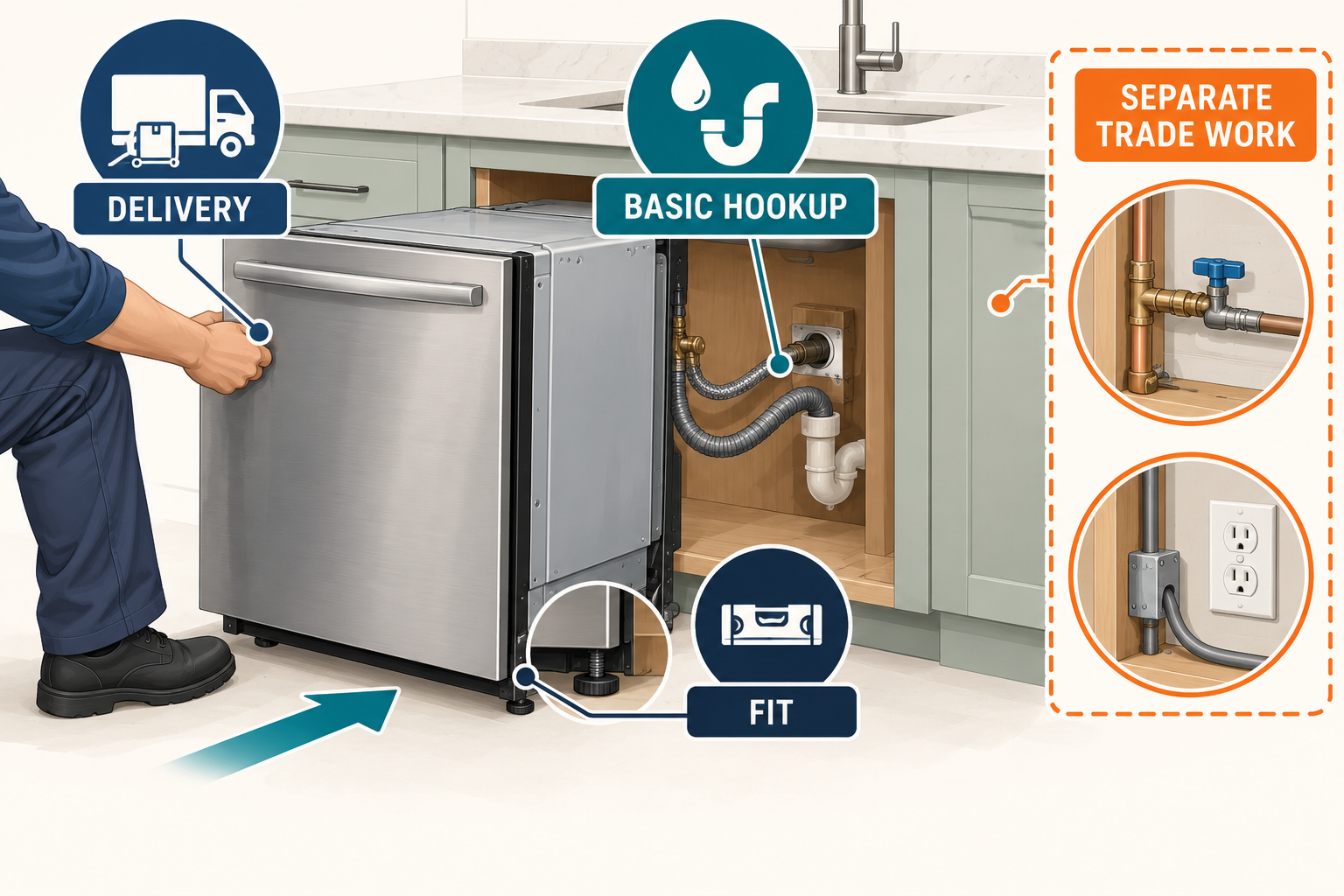
Delivery is not installation
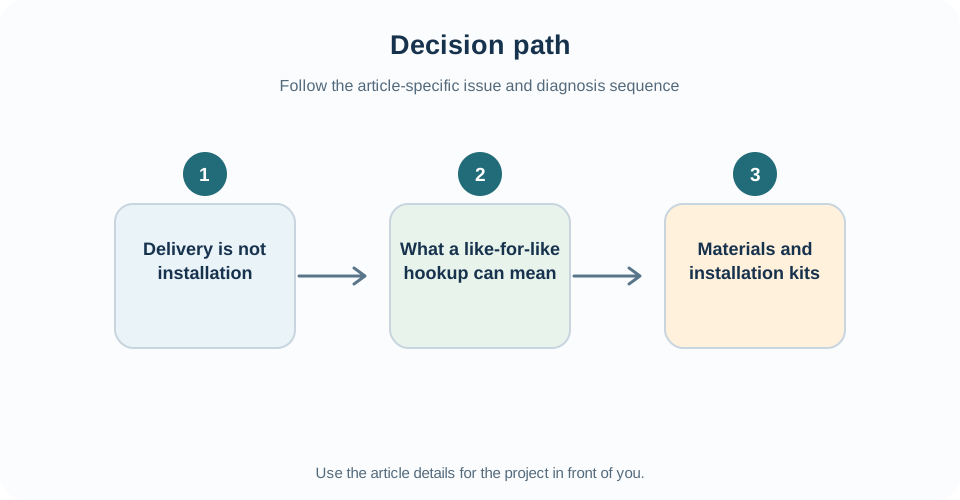
Delivery usually means transporting the appliance to the property and bringing it to an agreed location. Installation adds labor to place and connect it. A retailer may sell delivery and installation as one package, while an independent installer may price them separately. Ask whether the crew will carry the appliance through stairs, remove doors, protect floors, reverse the door swing, level the unit, and remove packaging.
The cheapest package may end at the threshold. Another may bring the appliance inside but require a second trade to make the connection. Read the exclusions before choosing a price. “Installation included” is not a standardized promise across retailers, brands, or countries.
What a like-for-like hookup can mean
A straightforward replacement assumes the opening is ready, the existing services are compatible, shutoffs and connections are usable, and the new appliance’s instructions allow the arrangement. Labor may include disconnecting the old appliance, setting the new one, connecting existing services with approved materials, leveling it, checking operation, and leaving the area broom-clean.
That assumption fits some freestanding appliances better than built-in equipment. It also depends on the model. A refrigerator water connection, dishwasher drain loop, washer supply, dryer exhaust, range restraint, and wall-oven cutout each have different model-specific requirements. The installation provider should inspect the actual manual and the actual opening.
Materials and installation kits
New hoses, power cords, shutoff valves, drain components, anti-tip hardware, brackets, trim, stacking kits, water filters, and manufacturer-approved connectors may be extra. Some appliances are sold without a cord because the required configuration depends on the home and model. Others require a new kit for warranty or installation reasons.
Do not assume that an old hose or connector is reusable because it still appears intact. Ask which materials are included, whether the installer supplies them, and whether the quote covers only replacement of an existing compatible item or correction of the building-side connection. Materials that connect to gas, electricity, water, or drainage deserve model- and jurisdiction-appropriate verification.
When plumbing becomes separate
Appliance-side installation can identify a plumbing dependency without owning the plumbing work. A refrigerator may need a new water supply. A dishwasher may need a water or drain connection corrected. A washer may need a service valve, hose, standpipe, or drain arrangement changed. A dedicated ice maker may require both water and drainage.
If a compatible shutoff and connection already exist, the appliance installer may connect them. If the line is missing, leaking, inaccessible, improperly located, or not accepted by the installer, a plumber may need to perform separate work. Ask the provider to state exactly where its appliance scope stops. A small connection can become a larger plumbing project if finished walls, cabinets, or flooring conceal the route.
When electrical work becomes separate
The appliance installer can confirm whether a connection is present and compatible within its permitted scope, but a missing circuit, damaged receptacle, wiring repair, service change, or load-management project belongs with electrical or whole-home capacity planning. Appliance product pages and general retailer packages do not establish a universal circuit or breaker requirement.
When changing from gas to electric cooking or drying, ask for an electrical assessment before ordering the appliance. Induction, wall ovens, and some dryers can change the demand and connection requirements. The cost of capacity, panel, or service work may outweigh the product price difference. Do not ask an appliance installer to improvise an electrical correction outside its qualifications.
Gas connections and safety provisions
Like-for-like gas replacement still requires a compatible, inspected fuel connection and appliance-specific instructions. Local rules may determine who can perform gas work, whether a permit or inspection is needed, and which connector or shutoff arrangement is acceptable. A retailer’s basic package may exclude all gas-line changes.
Ranges also have a safety-device question. The GE anti-tip instructions used for a representative manufacturer example state that a range must be secured with a properly installed anti-tip bracket and that installation must meet local codes. This is manufacturer-specific guidance, not a complete universal code rule. The chosen model’s instructions and the local authority control.
Fit, access, and surrounding finishes
Measure width, height, depth, door swing, service clearance, counter height, floor height, and the path from the delivery vehicle to the final location. A nominally matching appliance can fail at the doorway, stair turn, counter opening, or cabinet face. Built-in refrigerators, wall ovens, cooktops, and over-the-range microwaves have an especially high risk of panel, trim, mounting, or cutout work.
Finished surfaces add risk. Removing an old dishwasher can expose a raised floor. Pulling a built-in refrigerator can damage a panel or reveal an opening that no longer suits current models. A microwave can require mounting support or duct adaptation. Decide whether finish repair and cabinetry are part of the appliance quote or separate work.
Permits and inspections
Permit and inspection requirements vary by jurisdiction, product, fuel, and whether the project changes a building system. Do not treat a retailer’s package as evidence that no permit is required. Ask the local authority or a qualified trade when the work involves new gas piping, a new circuit, service capacity, structural changes, ventilation routes, or concealed plumbing.
The quote should identify who obtains approvals, who schedules inspections, and what happens if an inspector requires additional work. A permit fee can be small compared with the cost of reopening finished surfaces or delaying a kitchen or laundry project.
How to compare installation quotes
Request a line-by-line scope with equipment excluded or clearly separated. Confirm delivery, inside placement, stairs, floor protection, disconnection, installation materials, connection limits, leveling, testing, old-unit removal, disposal, taxes, and warranty. Ask whether the installer will stop and obtain approval if the existing service is not safe or compatible.
Compare the assumptions, not just the totals. One quote may include a new hose but exclude a shutoff; another may include haul-away but not a difficult-access surcharge. If a quote cannot state what happens when the opening, connection, or model does not match, it is not yet a complete project price.
U.S. and Canadian pricing
U.S. market sources provide useful broad installation signals, but retailer packages and labor markets differ within the United States. Canadian installation prices, taxes, availability, and trade requirements require Canadian examples or a local quote. Do not convert U.S. dollars into Canadian dollars. In both countries, access, existing infrastructure, and model-specific requirements can matter more than the nominal installation fee.
One current Canadian service-list example shows why “installation” needs a product and task beside the price. GE Appliances Canada’s catalog lists a $237 gas cooktop or range installation, $184 refrigerator waterline hookup, $190 over-the-range microwave installation, $155 washer and/or electric-dryer installation, $243 single wall-oven installation, and $205 dishwasher installation with a new hose kit. The page displays dollar symbols without an ISO currency code. These are separate provider service listings, not a market range or complete project total; the catalog does not settle postal-code eligibility, tax, all parts, site readiness, or local trade requirements. Confirm the exact service SKU and scope before using a listed amount in a budget.
The best installation budget begins with the exact model, exact opening, exact services, and a written list of exclusions. A basic hookup is inexpensive only when the property is already ready for that appliance.
Read the quote as a sequence
An installation quote should explain what happens before the appliance arrives, during delivery, at the connection, and after testing. Ask the provider to identify:
- who confirms the model, opening, and delivery route;
- who disconnects and removes the old appliance;
- who supplies hoses, cords, connectors, brackets, trim, or a stacking kit;
- which existing water, drain, gas, electrical, or exhaust services must already be ready;
- who performs the connection and commissioning; and
- what happens if the appliance cannot be installed safely on the scheduled visit.
This sequence exposes costs that are easy to miss when a retailer labels a package “installation included.” A package may cover a short, like-for-like connection while excluding a corroded shutoff, an inaccessible receptacle, a new drain, a gas conversion, a new circuit, an opening modification, or a difficult carry. The exclusion is reasonable if it is stated. It becomes a budgeting problem when the homeowner discovers it only after delivery.
Signals that basic installation does not apply
Treat the following as a reason to request a model-specific site check rather than a standard package: the appliance is built in or panel-ready; the opening is tight or out of square; the route includes stairs, elevators, or narrow turns; the service connection is concealed; the fuel source changes; a dishwasher or washer has a questionable drain; or the old unit leaked or damaged surrounding finishes.
These conditions do not automatically make the project expensive. They identify where the quote needs an assumption. A refrigerator may need only a compatible existing water line, while a wall oven may require cabinet and electrical coordination. A dryer may need a vent inspection, while a heat-pump model may use a different condensate arrangement. Let the selected model and the applicable qualified trade define the work.
Compare installers on responsibility
Ask whether the installer is responsible for measuring, protecting floors, leveling, testing, packaging, haul-away, and documenting damage. Ask who owns a failed inspection or a connection that does not meet the model instructions. For gas, electrical, plumbing, and ventilation work, verify the provider’s qualifications and the local requirements instead of accepting a generic “hookup” description.
The best quote is not necessarily the shortest or the cheapest. It states the exact appliance, the ready conditions, the included materials, the excluded work, the sequence, the warranty, and the price of a second visit. That detail lets you compare a retailer package with an independent installer without confusing different scopes.