
A like-for-like range replacement is straightforward only when the new appliance uses the same energy source, fits the opening, and can connect safely to existing services. The project budget can include the range, delivery, inside placement, floor protection, removal, anti-tip hardware, gas or electrical verification, ventilation considerations, installation labor, disposal, and taxes.
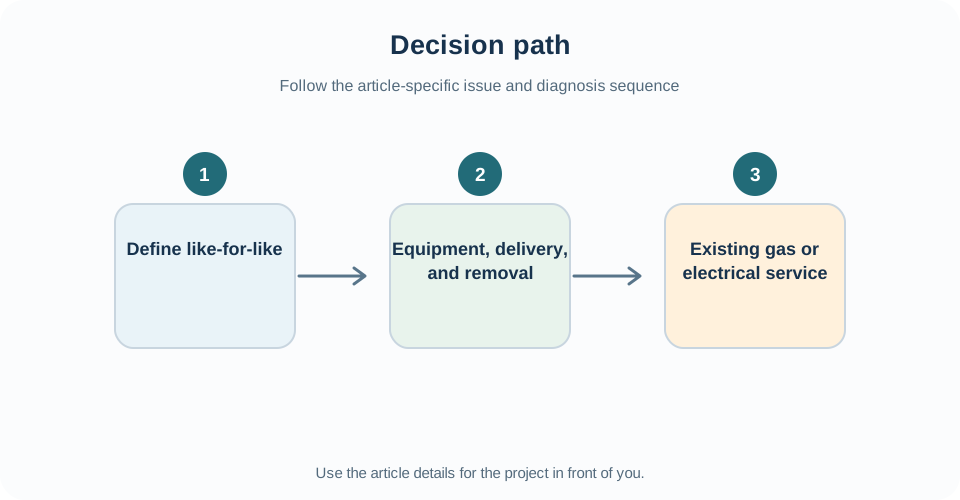
Define like-for-like
Confirm whether the existing unit is freestanding or slide-in, gas or electric, and whether it includes a conventional, convection, or specialty oven. Record width, height, depth, counter relationship, control location, door swing, fuel connection, electrical connection, and venting arrangement.
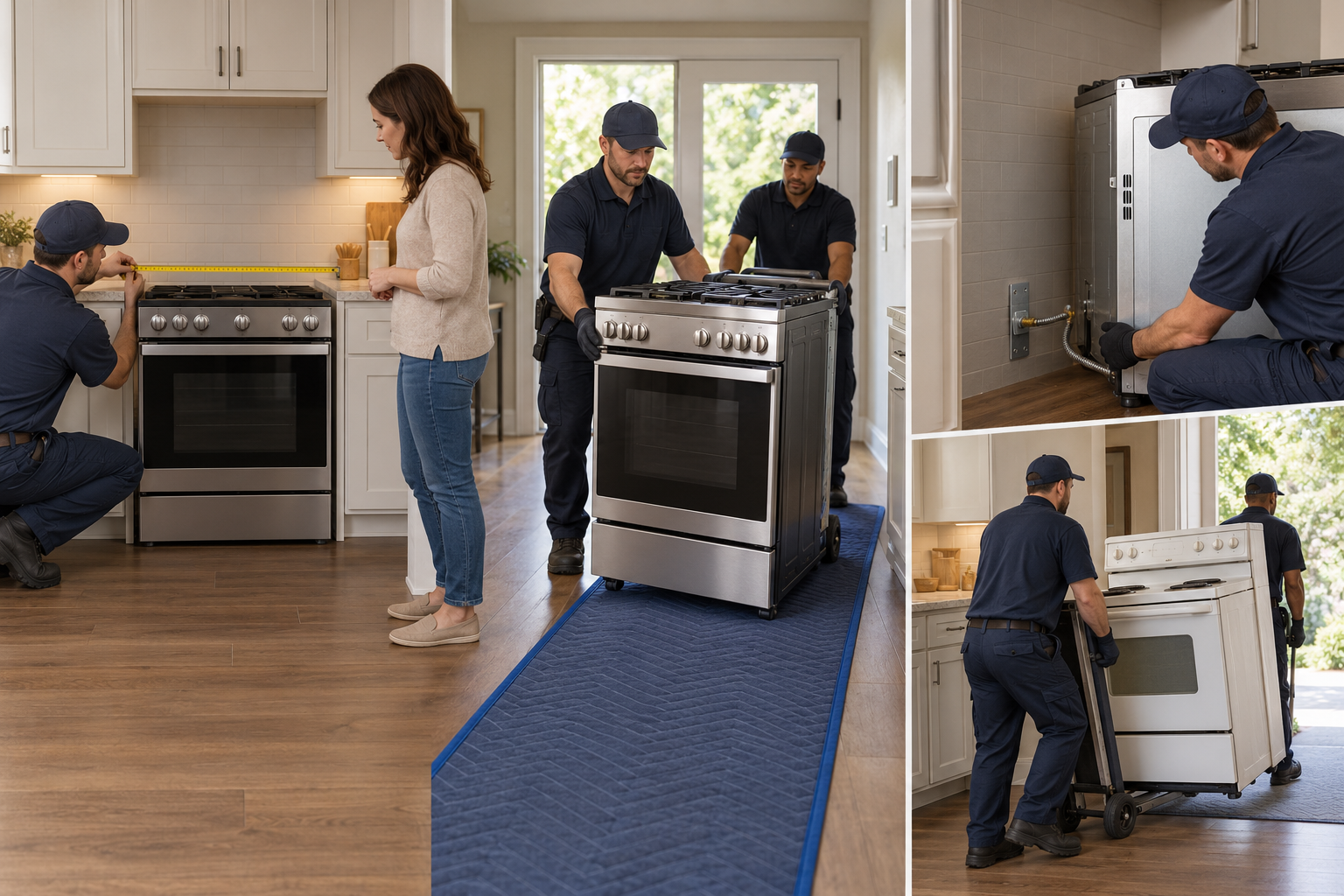
A model with the same advertised width can still differ in depth, rear clearance, control position, or trim. Slide-in products often depend more closely on the counter and backsplash. Measure the delivery route as well as the final opening.
Equipment, delivery, and removal
Product price varies by fuel, features, finish, oven capacity, controls, and brand tier. Delivery may be curbside or inside. Ask whether the crew removes doors, protects floors, positions and levels the unit, removes packaging, tests it, disconnects the old range, and hauls it away.
Do not assume removal is included because delivery is included. Gas and electrical disconnection may be restricted to qualified personnel. A built-in-looking or heavy slide-in unit can require more care than a basic freestanding replacement.
Existing gas or electrical service
The simplest installation uses a compatible existing service. A missing or unsuitable circuit, damaged receptacle, gas shutoff, connector, pressure condition, or fuel conversion is separate trade work. Local rules determine who may perform gas or electrical work and whether a permit or inspection is required.
Do not use a generic range listing to establish a universal circuit, breaker, cord, gas connector, or clearance rule. Check the chosen model’s instructions and have the qualified installer verify the home. A gas-to-electric or electric-to-gas change is not a basic hookup.
Anti-tip and other safety provisions
The representative GE anti-tip instructions state that a range must be secured with a properly installed anti-tip bracket and that installation must meet local codes. The exact model instructions control the hardware and installation. This is a safety requirement worth confirming, not a DIY installation procedure.
Ask whether the anti-tip bracket is included, whether the existing bracket is compatible, and whether the floor or wall can accept it. The installation quote should identify who installs and checks the safety provision.
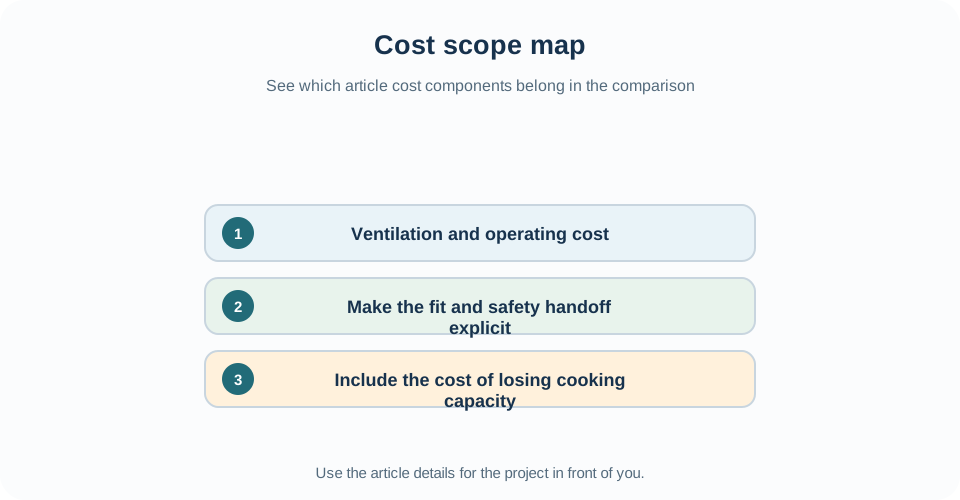
Ventilation and operating cost
A range may be served by recirculating or ducted ventilation, but substantive kitchen exhaust work belongs to the ventilation scope. If the replacement changes the cooking technology or location, check how the exhaust and indoor-air considerations change without assuming one universal solution.
Compare energy information where the exact product and market provide it. Energy use depends on cooking frequency, settings, fuel tariff, and household behavior. A higher-efficiency product is not automatically the lowest total-cost option when installation or conversion costs are high.
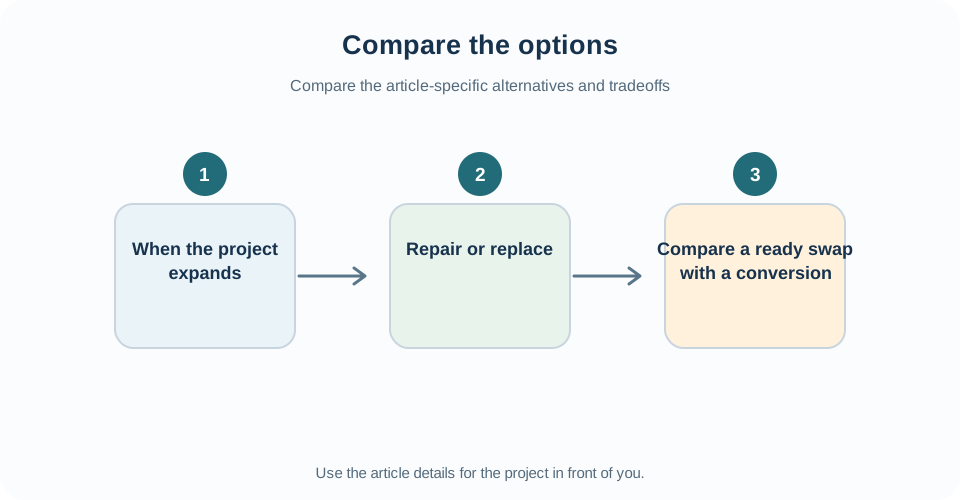
When the project expands
Cabinet fillers, counter adjustments, backsplash changes, floor repairs, new circuits, panel capacity, gas piping, and ventilation changes can exceed the appliance installation fee. Kitchen-layout work belongs with cabinetry and kitchen renovation; service-capacity or fuel-switching work belongs with electrification and electrical planning.
Ask the installer to list exclusions rather than placing them under “miscellaneous.” A low equipment price can be misleading if it does not include the infrastructure needed to use the range.
U.S. and Canadian differences
Retail prices, taxes, labor, installation packages, fuel and electrical rules, permits, and disposal programs vary. Canadian price comparisons should use Canadian suppliers and Canadian dollars. Do not convert a U.S. appliance price into a Canadian estimate.
Repair or replace
If the current range still operates, compare a confirmed repair with the installed replacement. A localized element, igniter, control, or sensor issue may be worth repairing. Repeated failures, obsolete parts, unsafe damage, or a difficult repair can favor replacement. Include the cost of temporary cooking arrangements and the timing of delivery.
Compare a ready swap with a conversion
The ready-swap scenario keeps the same general fuel source and configuration, fits the measured opening, has a clear delivery route, and uses an existing service that the installer confirms as compatible. Its main cost lines are the range, delivery, inside placement, installation, safety hardware, removal, disposal, and testing.
A conversion changes the decision. Moving from gas to induction or another electric range may require electrical assessment, capacity work, new wiring, cookware, ventilation changes, or a different counter and backsplash relationship. Moving in the other direction may require qualified gas work, approval, ventilation review, and a new connection. These are not ordinary hookup allowances. Price them separately and confirm the exact model before relying on any savings claim.
Make the fit and safety handoff explicit
Ask who measures the opening, who confirms the counter and backsplash, who installs or checks the anti-tip bracket, who reconnects the fuel or electrical service, and who tests the range. The referenced GE instruction says the range must be secured with a properly installed bracket and that local codes govern the installation. The exact model and local requirements control the final method.
At completion, the range should sit level, the doors and controls should operate, the connection should be checked by the responsible qualified installer, and the old unit should have a defined disposal route. Photograph the surrounding finish before delivery and ask how damage or an out-of-tolerance opening is handled.
Include the cost of losing cooking capacity
If the replacement is delayed, the household may need temporary cooking equipment, meals away from home, or storage for a removed appliance. These costs depend on the household and should be described as scenarios rather than universal allowances. A repair of the existing range may be worth reconsidering when a conversion quote is large and the current failure is contained.
The strongest range comparison shows the exact product, fuel and utility scope, fit, safety provision, delivery route, operating assumptions, disposal, and service support. It does not treat the appliance listing as the project budget.
Compare a same-location replacement with a conversion
First confirm the current opening, fuel, electrical service, gas connection, ventilation, counter, backsplash, and delivery route. A same-type replacement may be a contained installation if the exact model fits and the services are verified. A fuel change or format change can add qualified trade work, electrical capacity, utility modification, cookware, cabinetry, ventilation, approval, and downtime. Ask the installer to state which assumptions make the quote a basic replacement.
Protect the safety and service handoff
The exact model instructions and qualified installer control the connection, securing, clearances, and testing. For a range, include anti-tip provisions where the model and installation require them; do not turn one manufacturer’s instruction into a universal code claim. At commissioning, confirm the controls, burners or elements, oven, door, ventilation, and surrounding finish. Ask who owns a callback if the appliance operates but the utility or fit condition fails later.
Compare the replacement with a confirmed repair, not only with a retail listing. Add food or cooking disruption, removal, disposal, future service, warranty, and the cost of repairing the opening. U.S. and Canadian prices, codes, product availability, and incentives need current local verification.
Plan the delivery and commissioning window
Coordinate measurement, appliance availability, utility work, delivery, removal, installation, testing, and disposal. Keep the existing range available until the replacement and opening are confirmed when practical. Add temporary cooking and food-storage disruption if a conversion or counter correction can delay the job. Ask who protects the floor, counter, backsplash, and surrounding cabinets during the carry and connection.
Keep the replacement reversible until fit is confirmed
When practical, do not remove the existing range until the selected model, measured opening, connection plan, and delivery route are approved. Record the appliance model and installer scope. If a fuel conversion or counter change is involved, keep a repair or same-location fallback until the utility and approval path are clear.
Save the model-specific record
Keep the model, manual, measurement, utility assessment, safety hardware, installer scope, test result, warranty, and disposal receipt together. This record supports future service and shows which assumptions were verified. It also helps distinguish a later appliance failure from a building-side connection or ventilation condition.
Quote checklist
Request separate figures for appliance, delivery, inside placement, removal, gas or electrical disconnection, installation, cord or connector, anti-tip hardware, ventilation, cabinet or counter work, haul-away, disposal, testing, taxes, and warranty. The best range replacement budget is model-specific and makes every conversion or trade dependency visible.