
A utility-funded offer can reduce what you pay before work begins while adding a charge or loan payment to future utility bills. The label alone does not tell you how much work is included, whether the payment is personal debt, what happens if equipment fails, or what you owe if you move. Compare the written offer and its payment terms with the same project paid directly before accepting it.
This decision is about a specific project package. It is separate from choosing a heat pump, deciding how to phase electrification, or estimating the home’s regular electricity rate.
First identify the payment structure
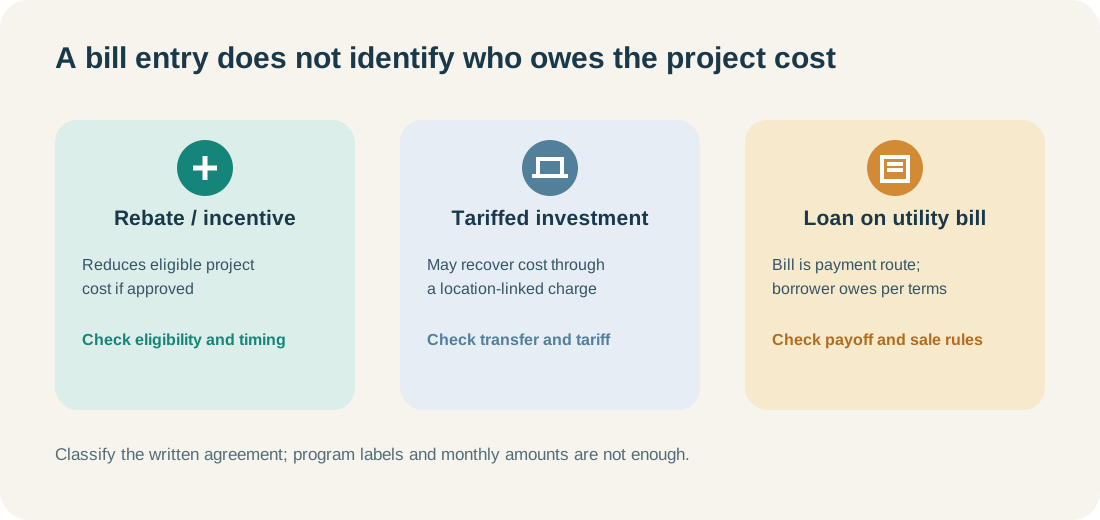
Some programs provide utility capital for work and recover it under an approved tariff. ENERGY STAR describes Inclusive Utility Investment as a site-specific investment recovered by a fixed charge tied to service at the upgraded location. Its design principles include a site-specific savings estimate and a charge intended to remain below estimated annual energy savings. Those principles describe the model; a modeled saving is not a guarantee that a household’s actual bills will fall.
Other offers are loans that happen to be collected through a utility bill. In that structure, a borrower still owes a loan, and the utility bill is the payment channel. A recurring bill entry by itself does not prove that the obligation follows the property or is free of a credit decision.
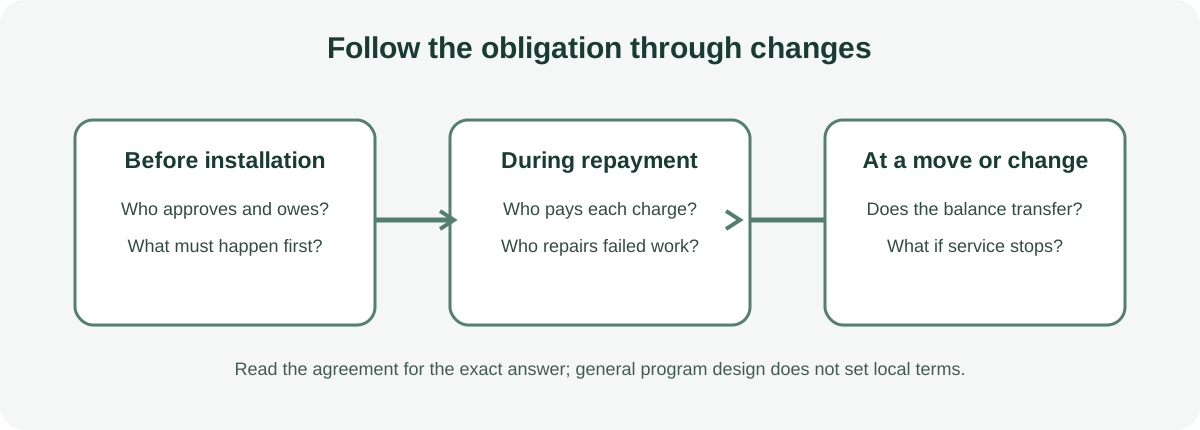
Program names are not enough to classify an offer. Ask for the tariff or loan agreement and find the exact language describing who owes the money, what account or location is charged, and what happens after a sale, move, or service change.
Check the work package before comparing prices
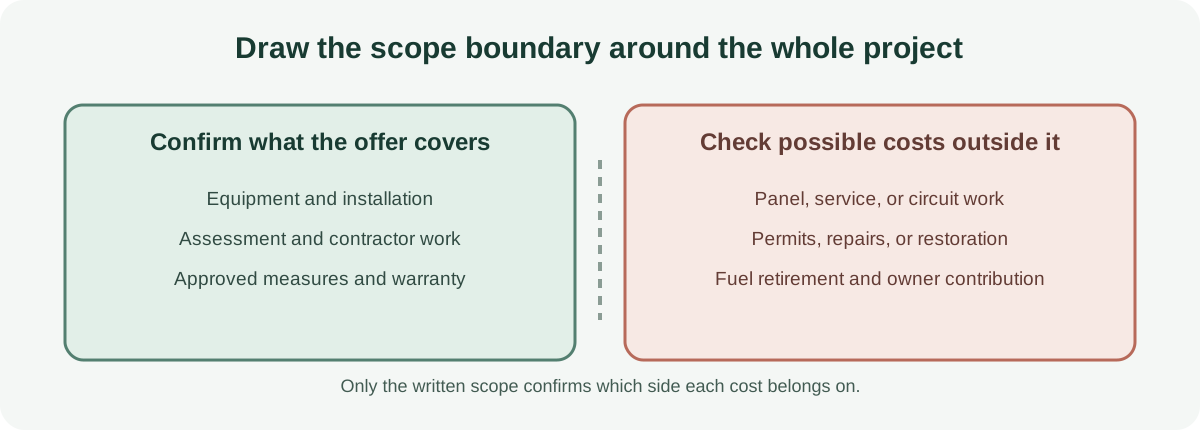
Request the proposed scope, equipment list, contractor price, and exclusions in writing. The offer may cover heating, water heating, insulation, air sealing, or controls, but not every program funds every measure. Confirm who selects the contractor, who verifies installation, and which warranties apply.
Ask whether the package includes all work needed for the equipment to operate: electrical capacity review, panel or service changes, branch circuits, duct or distribution work, fuel retirement, permits, restoration, and any repairs needed before the retrofit. A low upfront contribution can still leave expensive required work outside the offer.
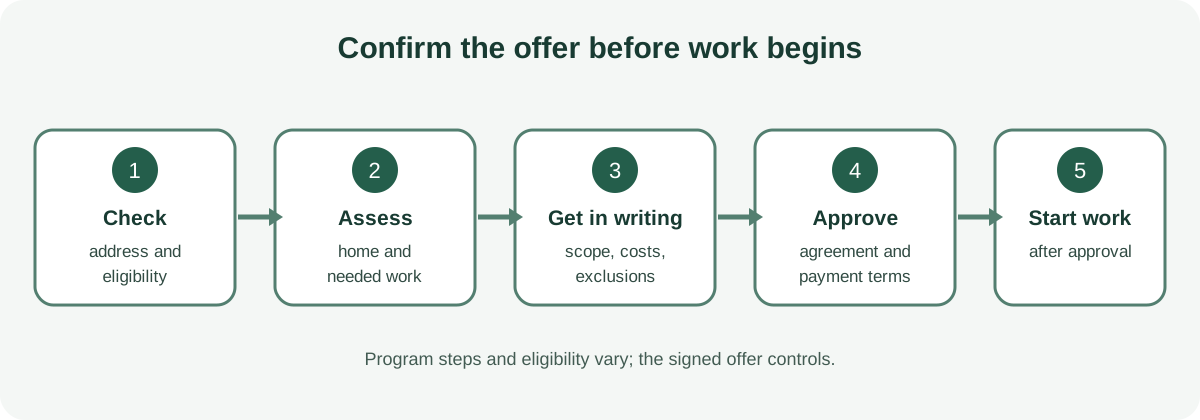
Find out what happens if the home does not meet program conditions. An assessment may identify health or safety repairs, an electrical constraint, or enclosure work that needs to happen first. Ask whether those costs are included, eligible for separate assistance, or entirely your responsibility. Confirm that a proposed project is not being treated as approved until the utility has confirmed the address, customer class, measures, and final offer.
Put every cost on one comparison sheet
Separate these items so that rebates, utility capital, and future charges do not blur together:
| Line | What to record |
|---|---|
| Gross project price | Installed work, equipment, labor, and program fees before assistance |
| Incentives | Amount approved for this property and when it is applied |
| Upfront payment | Required co-pay, deposit, owner contribution, or work outside the offer |
| Ongoing obligation | Monthly charge or loan payment, term, interest, fees, and any variable terms |
| Excluded work | Capacity, envelope, fuel retirement, permits, restoration, and other uncovered work |
| Total comparison | Expected scheduled payments and outside costs versus the same defined work paid directly |
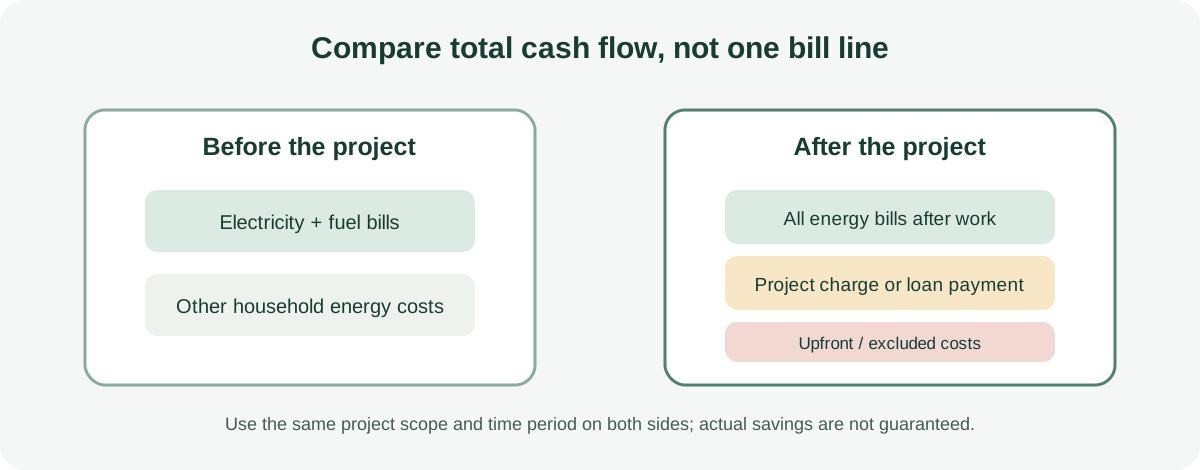
Do not call a repayable balance a rebate. A bill charge for project cost recovery is also different from the household’s charge for using electricity. When you compare the new bill with the old bill, show both energy charges and the project payment. Otherwise an energy saving can look larger than the household’s actual monthly cash-flow change.
Ask whether the offer permits early payoff, how the amount is calculated, whether fees continue, and whether the charge can be reduced or paused. If the provider gives a single monthly number, request the term and total scheduled amount behind it. Compare that total with an equivalent cash or loan quote for the same equipment, installation, and warranty.
Test the savings estimate against actual bills
Ask how the estimate uses the home’s past energy use, weather, equipment, and expected operation. Does it cover electricity alone, or also natural gas, propane, or another fuel? Does it include the new equipment’s full operating cost, fixed charges that remain, and any additional load such as an electric vehicle? Is the charge based on modeled savings, actual measured results, or a stated repayment schedule?
Compare the full utility bills before and after the project, including the project charge. Request an expected case and a less favorable case for weather, energy prices, equipment performance, and household use. If the program requires the modeled charge to be below estimated savings, ask how much difference remains between those amounts and what happens if actual savings are lower.
An estimate may use a different fuel or rate than the one that matters to your household. For example, reduced gas use does not help the electric bill if the program counts only electric savings, and a heat pump may raise electricity use while lowering a different fuel bill. Review each energy account and tariff used in the calculation. A program’s savings test is not the same thing as a guaranteed reduction in every bill or in the household’s total energy spending.
Read the local offer and its current tariff
Ameren Missouri’s posted Pay As You Save page describes a free assessment followed by eligible upgrades and a fixed bill charge; it says the offer is not available to Illinois customers. The page’s FAQ describes a charge that includes installation cost, 3% interest, and a small program close-out fee. It also says the charge is initially set at no more than 80% of estimated average monthly savings, while noting that actual savings are not guaranteed.
A Missouri tariff sheet available in Ameren’s rates materials is labeled MEEIA 2025–27 and effective December 27, 2024. It describes a service charge tied to the premises, includes program costs and 3% capital cost, and sets a maximum recovery period of 15 years. Two details differ from the FAQ: the tariff describes savings across all major fuel sources, including gas and propane, while the FAQ says only electric-bill savings are used to calculate a co-pay. The FAQ states that a mobile home on a permanent foundation cannot be more than 35 years old; the tariff sheet says no more than 25 years.
Those differences matter to eligibility and the savings calculation. The published material does not establish which exact version applies to an individual offer or whether a newer filing changes the terms. Ask the utility which tariff sheet and agreement govern your address, and get the answer in writing before relying on the stated savings or eligibility. Do not assume that the more favorable line applies.
Ask what happens after installation
Find out who owns the equipment while charges remain, who arranges maintenance, and who pays if a measure fails. Ask how promptly a repair is required, whether a charge is suspended while an upgrade is not working, and whether the payment period extends after a pause. Check whether the customer must perform routine maintenance and what the agreement treats as damage caused by the occupant.
Also ask what happens if the utility service is disconnected, the account becomes past due, the home is vacant, or the owner changes. The notice to a buyer or renter should identify the remaining amount, payment duration, measures installed, responsibilities, and whether the next occupant pays the charge. Confirm what happens if the sale closes before the next customer assumes utility service. General program-design protections do not establish the exact rules in your local contract.
A no-upfront program is different from a utility tariff
Newfoundland and Labrador’s TakeCharge Greener Homes Program is a bounded example of a different arrangement. A federal funding announcement describes assessed, coordinated upgrades for eligible households with no upfront payment for approved work; measures may include heat pumps, insulation, air sealing, remediation, and panel work when the assessment identifies a need. This is a local program pathway, not a standard utility tariff charge. The announcement does not establish an individual award, that every measure is available to every applicant, or the final terms for a particular household. Confirm current eligibility, approved work, and whether any later payment obligation applies in the written offer. Its stated savings examples are not household forecasts.
Some repayment offers use a property-tax bill instead. Drayton Valley, Alberta’s local CEIP page describes financing up to approved project costs with repayment through a Clean Energy Improvement Tax charge. That is a municipal property-tax financing structure, not a utility tariff or a charge for energy use. The page states a 4.16% rate for new agreements, subject to annual reassessment, and terms up to 20 years; the signed agreement and current program availability control. Approval and agreements must precede work. Do not assume another municipality uses the same terms.
A Manitoba bill payment can still be a loan
Manitoba Hydro’s Home Energy Efficiency Loan is a separate Canadian example of a repayable loan added to the energy bill. The public terms list 6.20% interest for the first five years on approved credit and a maximum of $12,500 per residence. The page does not state an ISO currency code, so the amount is kept in its displayed form. The homeowner must receive approval before work starts or materials are purchased. The loan is not transferable: it becomes due when the home is sold or ownership transfers. After the initial five-year rate period, the remaining balance may use then-available market rates.
This is not a rebate or evidence that Canada has a tariffed utility-investment equivalent. The homeowner remains responsible for repayment even though monthly installments appear on the utility bill. Check current terms and the exact project eligibility before including this financing in a budget.
Make the decision on the agreement in front of you
Before accepting, make sure you can answer these questions from the offer documents:
- What work and equipment are included, and what remains outside the price?
- What will I pay upfront, and what total amount will be charged later?
- Is the obligation a personal loan or a charge linked to service at this property?
- Which fuels, rate schedules, and operating assumptions support the savings estimate?
- Who owns, maintains, repairs, and replaces the installed measures?
- What happens if the upgrade fails, the home is sold, or service stops?
- Which tariff and signed agreement control the offer today?
Compare that answer with the same scoped work paid directly, including equipment, installation, rebates you are approved to receive, and any outside repairs. The useful offer is the one whose work, payment obligation, and failure or transfer rules you understand and can afford under a less favorable outcome—not simply the one with the smallest payment shown at enrollment.