
Neither strategy is always cheaper. An all-at-once project can share assessment, design, mobilization, permits, access, and restoration. Phasing can preserve cash, avoid replacing sound equipment, and let each decision use better information. The economic answer depends on what is urgent, what must be coordinated, and whether future work will require reopening the same systems.
The all-at-once case
A comprehensive project may coordinate heating, water heating, cooking, capacity, fuel retirement, and enclosure work. It is strongest when several systems are near end of life, walls are open, the household can tolerate disruption, and the capacity plan is known. It may also make it easier to retire a fuel service once the final load is gone.
The risk is capital concentration. A broad scope can include measures with weak near-term value, and a change in one design assumption can affect several trades. Require a base scope, options, dependencies, and contingency rather than accepting one package total.
The phased case
Phasing can align each conversion with equipment failure, planned remodeling, or available capital. A roadmap can reserve capacity, protect future equipment locations, and identify enabling work that should be done early. It avoids paying to replace a serviceable appliance merely to make the package look complete.
Its cost is not just repeated equipment installation. Later phases may repeat mobilization, permits, design, demolition, patching, utility coordination, and contractor search. A first phase can also lock the household into an equipment choice or service assumption that makes the next phase harder.
Compare the same future state
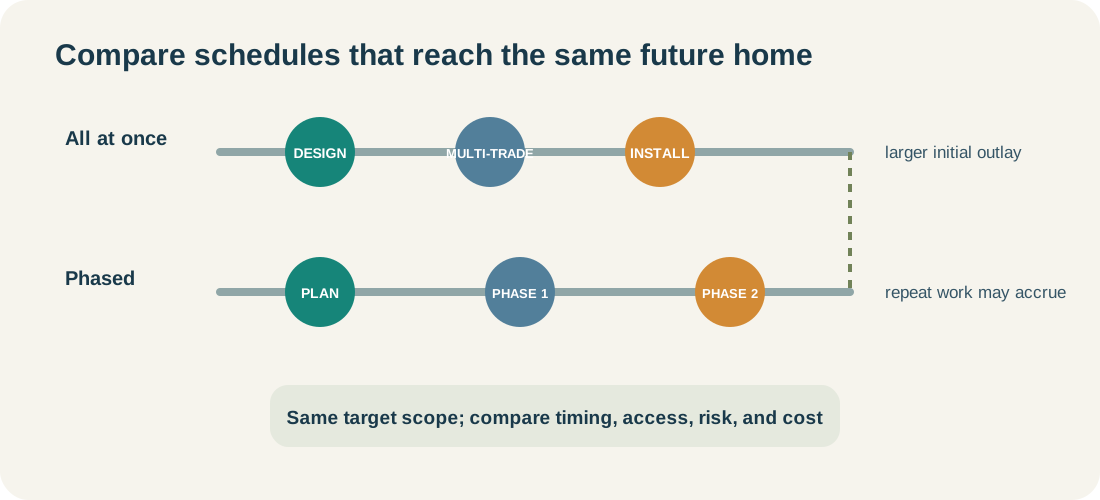
For each strategy, list:
- total installed work and likely repeat work;
- financing and opportunity cost of capital;
- energy costs during each phase;
- emergency replacement risk;
- disruption and access;
- incentives available at each date;
- service and utility dependencies;
- the cost of changing an earlier decision.
Do not claim a universal percentage saving for bundling. Model low, expected, and difficult outcomes. The “all-at-once” price should not receive credit for savings if it includes optional work the phased plan would never perform.
Example decision patterns
If the furnace is failing and the kitchen remodel begins in six months, a capacity review and future pathways may be the near-term phase while equipment choices are coordinated. If heating is sound but an old water heater is due for replacement, changing that load at its replacement point may be sensible while keeping the roadmap alive. If a service upgrade is needed for several planned loads, doing it once may be more economical than returning for separate expansions.
Cold climates and long utility lead times favor earlier planning even when installation remains phased. A planned transition can avoid an emergency purchase that narrows equipment and contractor choices.
Prevent phase lock-in
Every phase should record the future loads, capacity assumptions, fuel-retirement intent, equipment compatibility, and deferred work. Ask whether the installed work remains useful if the next phase is delayed or abandoned. Avoid a control system, panel arrangement, or equipment location that only works if a speculative later phase occurs.
The best plan is the one that makes each phase stand on its own while preserving a cheaper route to the intended future state. A roadmap is valuable precisely because it makes the cost of waiting and the cost of coordination visible.
An example comparison
Suppose heating is reliable, the water heater is near replacement, and a kitchen remodel is planned. An all-at-once plan may replace both systems, add capacity, and retire gas, but it commits capital and may replace sound heating. A phased plan can perform the capacity review and kitchen pathways during the remodel, change the water heater at its decision point, and preserve a documented heating option. It may have a second installation later, but it avoids paying early for equipment whose remaining life has value.
The opposite case is a failing heating system with a utility upgrade and difficult access. Bundling may avoid temporary heat, repeated demolition, and a second service interruption. Optional cooking or vehicle work can still be phased if those loads do not control the infrastructure.
Financing and disruption
All-at-once work may shorten total disruption but create a larger financing balance. Phasing may spread payments but expose the household to future labor, rate, and incentive changes. Compare the cost of capital and the practical cost of temporary heat, moving equipment, or living through several projects. Do not call one strategy cheaper without stating those assumptions.
If the capital is offered as a utility-funded package with a bill charge, compare the same phases and equipment scope against the offer’s full payment schedule. The guide to utility-funded retrofits covers the difference between a bill-repaid loan and a location-linked tariff charge.
Set phase gates
Before each phase, confirm the future-load list, rate assumptions, equipment condition, incentive status, and utility response. Define what would pause the project: an unresolved capacity result, a hidden-condition allowance beyond the threshold, or equipment that changes the sequence. This is more useful than a schedule that assumes every future phase will happen.
Build the comparison around cash flow and dependencies
A fair model has one shared future state and two schedules for reaching it. List the equipment and enabling work that both plans eventually require. For the all-at-once path, record the total initial outlay, shared design or mobilization, temporary disruption, and any equipment replaced before the end of its useful life. For the phased path, record each project date, repeated visit or permit, interim fuel and maintenance costs, and the possibility that later work becomes urgent or more difficult.
Separate true savings from timing. Installing circuits while walls are open may avoid later demolition; buying a heat pump and water heater together does not automatically reduce their equipment price. Shared contractor mobilization is valuable only if the same crew and access are genuinely reused. Conversely, phasing is not automatically cheaper if it produces several service visits, separate restoration, and a late utility project.
Use at least three timing cases. In the planned case, systems reach replacement age in sequence and there is time to design. In the early-failure case, one system fails before the next phase and temporary replacement or emergency work is needed. In the access-window case, a remodel happens before equipment failure and creates a short opportunity to install pathways or change distribution. Price the consequence of each case, not just its most convenient schedule.
Discount future costs consistently if the household is comparing present value; otherwise show nominal cash requirements by year and label the method. Use the same energy-price, maintenance, incentive, and service assumptions in both plans. If rebates may expire or change, show eligibility as a scenario rather than treating an unconfirmed incentive as certain savings.
A useful decision may be hybrid: complete analysis, capacity confirmation, and concealed rough-in now; replace functioning equipment at normal end of life; accelerate only the items that share access or prevent a known constraint. The chosen phase gates should state what evidence triggers the next investment.
Use phase gates to protect the next investment
A phase gate is a condition that must be met before spending on the next stage. Examples include confirmation that the selected heat-pump size follows the planned enclosure work, utility acceptance of the service design, a quote that includes fuel retirement, or evidence that a remaining appliance will keep gas service active. Each gate should identify who supplies the evidence and whether the decision can be revisited.
This avoids two common mistakes: beginning a downstream installation before a necessary capacity answer is known, and delaying a low-cost enabling decision until access has closed. It also helps keep contractors accountable. A quote can state that installation is conditional on a load result, while the roadmap can state that the household will not buy a smart panel until the control need is documented.
At the end of each phase, update the remaining budget using actual invoices and current bids. Do not carry an old allowance forward as if it were a current quote. Record whether the future state changed and whether any work has become unnecessary. The phase plan is successful when it preserves the intended outcome while making each new commitment with better information.
Check that phasing does not strand earlier work
For each early investment, state how it remains useful if the later phase changes. A pathway with documented endpoints may serve a different compatible load; a specialized control system or oversized equipment selected around one model may not. Ask whether the early work carries a warranty or a condition that expires before the next phase.
If the later project is uncertain, prefer preparation that has value even if the final equipment changes. Keep a record of the assumed service, location, and control sequence. This reduces the risk that phasing saves cash now but forces replacement of work that was intended to make the next step easier. Use an annual review to check whether later phases still make sense. Revisit equipment condition, household plans, current bids, utility responses, and program status before carrying an old roadmap forward. A phased plan is not a commitment to complete every item; it is a way to retain options and decide with better information.
If the final state changes, remove obsolete work from the estimate. Keeping a stale all-electric target after the household chooses to retain one fuel can overstate future capital needs and misrepresent the bill comparison.