
Whole-home electrification has no honest universal price. It is a package of decisions: how the house uses energy, which fuels remain, whether the electrical service can support the intended loads, and whether work is coordinated or scattered across years. A small package might replace one end-use at its normal replacement point. A comprehensive conversion can also involve capacity work, wiring, enclosure improvements, fuel retirement, restoration, and utility coordination.
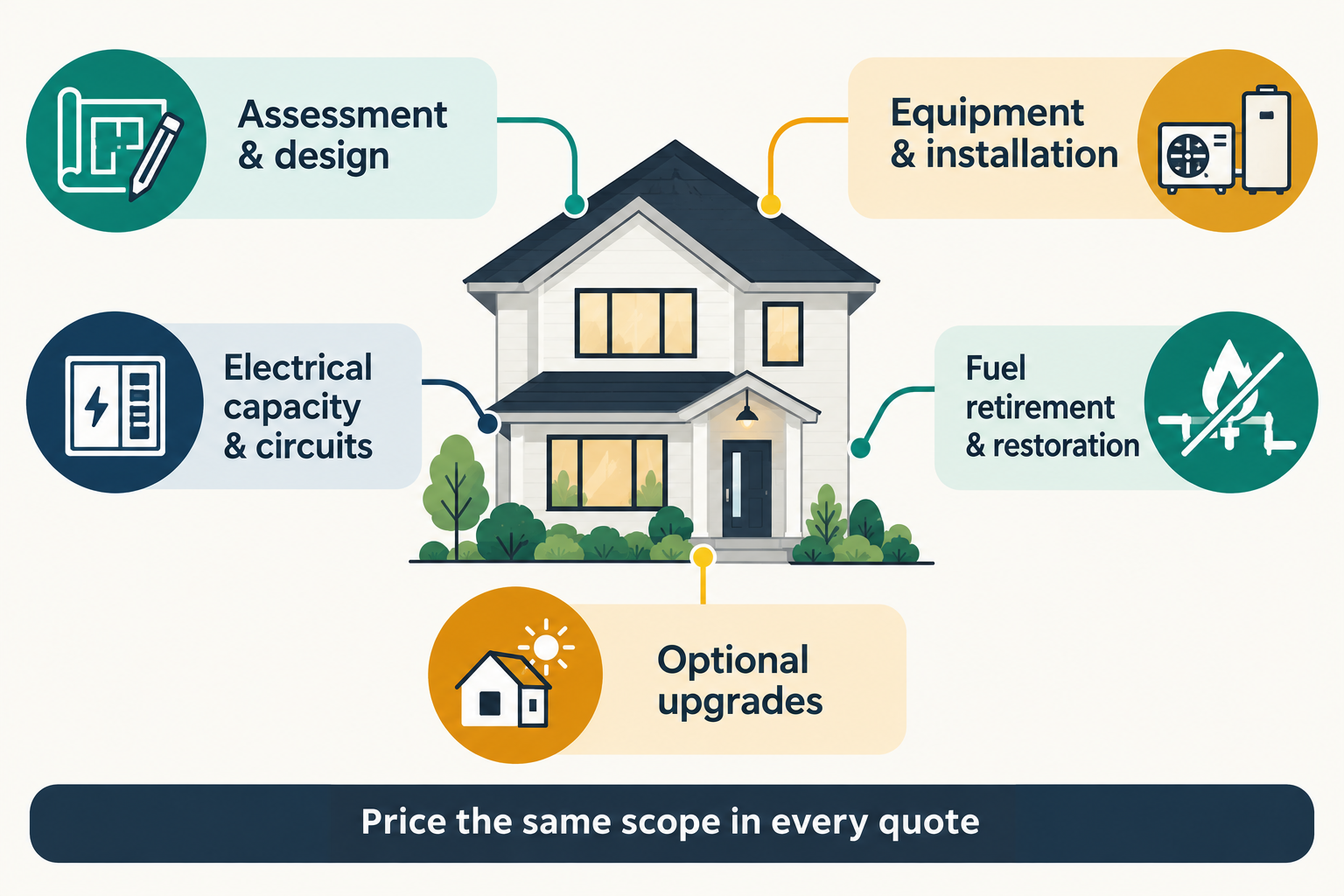
What the project may include
Start by listing the actual loads rather than using “all-electric” as a vague scope. A plan might include:
- heating and cooling;
- domestic water heating;
- cooking and clothes drying;
- future vehicle charging;
- electrical load assessment and panel or service work;
- circuits, pathways, and equipment-location changes;
- insulation or air-sealing where the building load makes equipment choice depend on it;
- gas, oil, or propane retirement and restoration.
Vehicle charging, solar, batteries, and standby generation may be related but are not automatically part of the package. Likewise, a heat-pump installation or water-heater replacement retains its detailed equipment scope in its own category. The whole-home budget should summarize those components without hiding their boundaries.
Why a single package range misleads
The largest cost driver is usually the starting condition. Replacing a gas range during a planned kitchen remodel is economically different from converting an oil-heated, poorly insulated house whose service, wiring, venting, and tank all need attention. Access, local labor, utility ownership, and the number of trades can matter as much as equipment selection.
Treat the budget as three scenarios:
- Limited conversion: one or two loads are changed, existing capacity is adequate, and no fuel service is retired yet.
- Coordinated conversion: heating and water heating change together, the service review identifies enabling work, and several trades share planning and mobilization.
- Infrastructure-heavy conversion: a service or utility upgrade, difficult wiring, enclosure work, fuel-system retirement, restoration, and cold-weather backup are all in play.
These are scope cases, not national price bands. A contractor should be able to tell you which case their quote assumes.
Cost layers to request separately
Ask for distinct lines for assessment and design, equipment, installation labor, electrical capacity, circuits and pathways, demolition and disposal, fuel retirement, permits or inspections where applicable, restoration, and contingency. Do not let an incentive or a “complete package” label conceal whether the quote includes the panel, service conductors, utility work, thermostat controls, duct changes, plumbing, or patching.
An electrical panel with spare breaker positions is not proof that the house has spare capacity. Capacity is assessed from the existing service, calculated demand, proposed equipment, and any controls that manage demand. The same distinction prevents overbuilding: a service upgrade may be unnecessary in one house and unavoidable in another.
Gross cost, net cost, and timing
Gross project cost is the amount required to perform the work. Net cost subtracts only incentives that are actually available, eligible, and obtainable for that property. In the US, federal Home Energy Rebates are administered through states, territories, and Tribes; status and eligibility must be checked locally. Canadian programs are separate and similarly time-sensitive. Do not place a rebate in the budget merely because a technology is generally eligible.
If a utility offers to advance money for a retrofit and recover it through a later bill charge, separate that obligation from a rebate and from the cost of electricity. The utility-funded retrofit guide explains how to compare the covered work, upfront contribution, recurring charge, savings assumptions, and transfer terms.
Phasing changes both total cost and risk. One mobilization can reduce repeated demolition, permits, and coordination, while a phased plan can avoid replacing sound equipment and make capital manageable. The right comparison includes financing, emergency-replacement risk, utility fixed charges, and the cost of returning later to work that could have been done while walls or ceilings were open.
Before requesting quotes
Prepare twelve months of utility bills, equipment ages and fuel types, panel and service information, known comfort problems, planned remodels, and the loads you may add later. Ask each bidder to identify assumptions, excluded work, capacity evidence, equipment boundaries, fuel-retirement responsibilities, and change-order triggers. Get the same scope normalized across proposals; an inexpensive equipment quote may be omitting the work that makes the equipment viable.
The most useful result is not a single “electrification average.” It is a staged budget that shows what is required now, what is optional, what can wait, and which unresolved property condition could change the total.
Build a quote-normalization sheet
Ask every bidder to price the same future state. Put assessment, equipment by end use, installation labor, electrical capacity, circuits and pathways, controls, plumbing or distribution changes, fuel retirement, disposal, permits, restoration, tax, and contingency in separate lines. Record whether each is included, an allowance, a unit price, or an exclusion.
This prevents a common comparison error. One proposal may include a heat pump and water heater but assume the existing panel and gas service remain. Another may include a service upgrade, tank removal, and wall repair. The second can look more expensive while being the only complete conversion. Ask each contractor to name the conditions behind its difficult-case price.
What makes a package economical
Bundling is most valuable when the same access, electrician, utility application, or restoration can serve multiple loads. It is less valuable when it forces an early replacement, adds an unnecessary premium product, or creates a large financing burden. A phased plan can still capture high-value enabling work such as capacity review, accessible pathways, and equipment-location decisions.
For a short ownership horizon, separate improvements that protect comfort or avoid urgent failure from measures whose return depends on many years of operation. For a long horizon, include repeat mobilization, future fuel charges, maintenance, and the cost of replacing a control or service arrangement.
Separate required work from attractive add-ons
An assessment, capacity review, equipment installation, fuel retirement, and code or utility work may be required for the selected future state. Better insulation, premium controls, EV charging, solar, storage, room remodeling, and cosmetic restoration may be valuable but are not automatically required. Put them in an options column. This keeps a “complete” package from inflating the base while also preventing a low bid from omitting necessary connections.
For each phase, identify the decision it unlocks. A service application may unlock unrestricted heating; a pathway may unlock a future water heater; fuel retirement may unlock cancellation of a fixed charge. If no future decision depends on a proposed item, challenge it before including it.
Before accepting an allowance
Require a quantity, unit price, approval threshold, and evidence for concealed work. “Electrical as needed,” “utility fees extra,” and “tank by owner” transfer material price risk to the homeowner. Keep an allowance for genuinely uncertain work, but do not treat an undefined allowance as a fixed budget. Revisit the total if the assessment changes the loads or sequence.
A bounded U.S. electrical-cost reference
A 2026 Lawrence Berkeley National Laboratory survey gives one limited way to understand the electrical part of a U.S. project, not the price of whole-home electrification. In its cross-sectional survey, single-family industry respondents reported a median panel replacement estimate of USD 3,500, with an interquartile range of USD 2,100–5,000 and 34 responses. For a service-rating increase, the reported customer-side equipment estimate had a USD 2,800 median (IQR USD 2,000–5,000; 22 responses); utility-side costs passed to the owner had a separate USD 3,500 median (IQR USD 1,650–7,000; 19 responses). These are stakeholder-reported U.S. estimates from different respondent subsets, not transaction data, contractor bids, Canadian prices, or a complete service-upgrade quote. Do not add the medians together and present the sum as a typical job.
Use the figures as a prompt to ask what a quote includes. Is it only the panel enclosure and breakers, the customer-owned service entrance, or also utility design and work? Is trenching, patching, meter coordination, or temporary service included? A quote materially below the survey observation may simply have a narrower scope; a quote above it may include work the survey category does not capture. The estimate alone cannot say which explanation applies.
For a whole-home plan, keep these electrical lines separate from heat-pump equipment and installation, water heating, branch circuits, gas or oil retirement, and finish restoration. This makes an early estimate useful without turning a small U.S. sample into a misleading national package range. Request the same service assumptions in each contractor proposal, and update the budget after the utility and load-review steps establish the actual work.
Keep uncertainty attached to the line that creates it
A useful early budget can show a firm amount, a defined allowance, or an unresolved dependency for each line. Do not apply one vague contingency percentage to a package that mixes quoted equipment with unknown utility work. Mark the evidence behind the number: contractor quote, program amount, utility estimate, model, or planning allowance. Give each allowance a trigger and a limit for approval.
For example, the equipment may be specified while panel condition is still unknown. Keep the equipment quote separate from an electrical allowance, and require the electrician to explain what finding would activate the work. If the utility has not reviewed the service request, treat its contribution and schedule as open. This lets the household compare a limited conversion with a coordinated conversion without pretending that both scopes have equal certainty.
When the investigation narrows an allowance, update only the affected line and note which assumptions changed. This makes a phased decision easier to revisit and avoids presenting an early planning total as a contractor commitment.