
A sewer camera inspection requested by a buyer and a sewer compliance requirement imposed by a local authority may look similar on an invoice, but they answer different questions. A buyer’s scope helps assess a buried-line risk. A compliance process may require a particular test, report, correction, permit, official review, and accepted record before a transaction can proceed. The requirement exists only where the property and sale meet a current local trigger; it is not a general rule for homes in the United States or Canada. The examples below are local U.S. programs; current Canadian sale-compliance requirements were not established in the available evidence.
If an authority, title company, or contractor says a sewer certificate is needed, first identify the authority and the exact written rule that applies to the parcel and transaction. The answer controls both the work and the closing schedule. A local fee or certificate example below is a way to understand budget components, not a quote for another property.
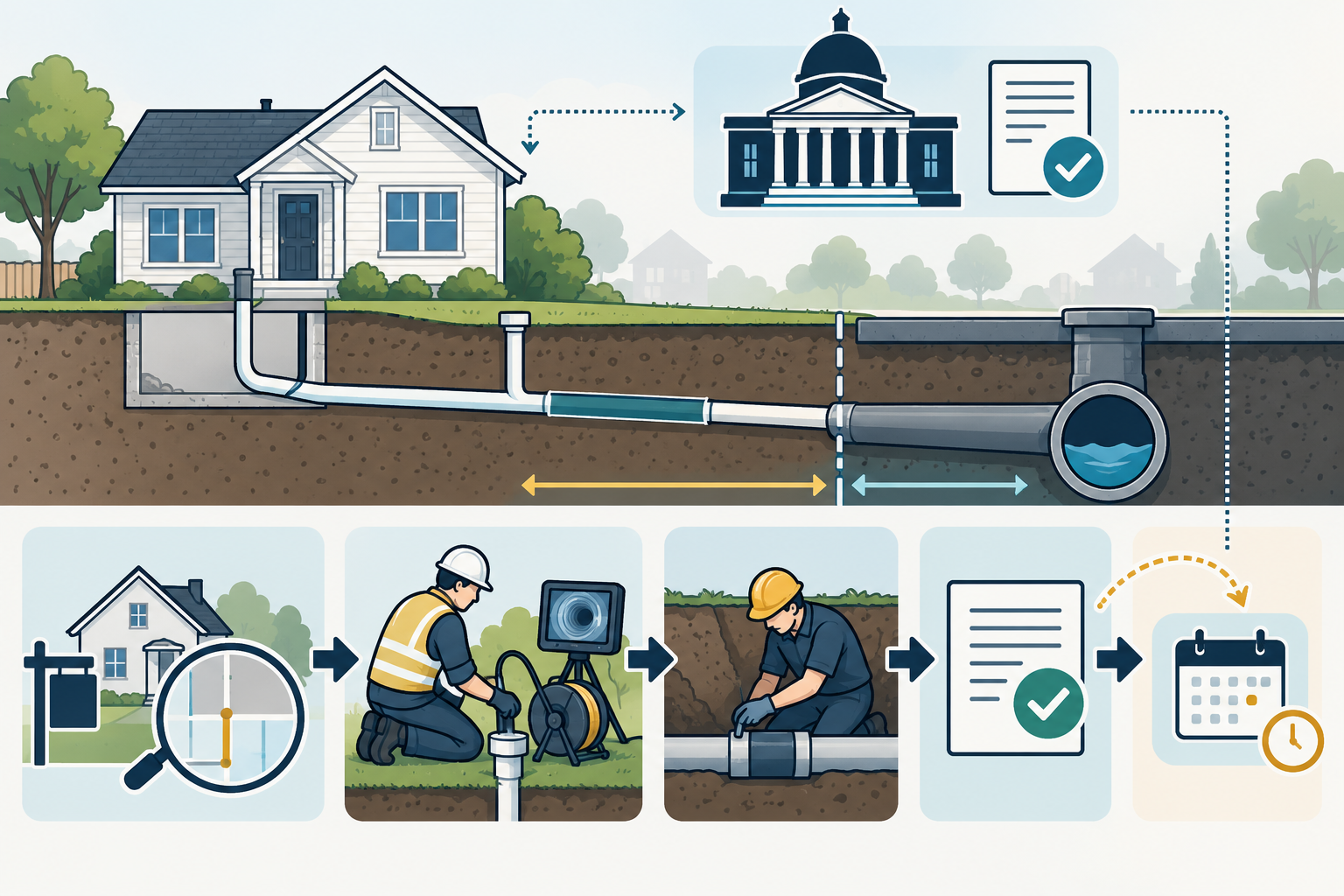
Confirm that this sale actually triggers a requirement
Start with the address, not a nearby city name. A property may lie outside city limits, within a separate sanitary district, or in a utility service area with its own program. Ask the authority to confirm the parcel’s service area, property class, transaction trigger, effective date, exemptions, inspection history, and records already on file. If the rule is in an ordinance or bylaw, request the section or the official program page rather than relying on a real-estate checklist or a contractor’s general statement.
A sale trigger may depend on when the property entered escrow, whether title is transferring, the number or type of dwelling units, or whether a valid report or certificate already exists. Other programs also trigger on additions, new units, a failed line, or unpermitted work. A rule for one trigger does not establish the requirement for another.
For example, Oro Loma Sanitary District says sales entering escrow on or after August 1, 2026, within its service area need a valid Sewer Lateral Compliance Certificate before title transfer. The District provides a parcel map and permit portal for checking service-area status and existing certificates. That is a current District rule, not a California-wide requirement. Berkeley has its own certificate process and states that a certificate is required before close of escrow for covered property transfers. Confirm the applicable authority and current version for your address.
Look for a record the authority will accept
Before paying for another inspection, ask whether a prior certificate, report, or repair record remains valid under the local program. Check the issuing authority’s records directly. A contractor invoice saying “repaired” may not substitute for an accepted report; a camera video may not substitute for a certificate; and a previous inspection may be too old or may cover a different pipe segment.
The required record can differ by city. San Mateo’s current page says it does not issue a separate Certificate of Compliance for replacements; its sewer lateral inspection report is the proof of compliance, and the page directs the seller to provide and submit the report or, if one is absent, a buyer to arrange a qualified inspection before closing. This is a useful reminder to ask what document the authority actually accepts. A record’s expiration date, where one applies, is not a guarantee of the line’s remaining service life.
Ventura’s current inspection page says a seller submits the local inspection report and video before escrow closes and discloses the result; if repairs are needed, the buyer and seller may agree who completes and pays for them. It describes repair timing generally as within six months after sale or within normal permit timelines. The page’s stated effective date is 2014, so confirm the current local rule and transaction agreement. Watsonville’s publicly posted version-3 form, last modified in 2023, describes a different City rule: a separate sanitary lateral and inspection confirmation at least every 15 years for sale, with a licensed local plumber’s form and video submitted for City review. Verify that form and ordinance are still current before scheduling work. Neither program sets a general US interval or sale standard.
A camera view may be only one part of compliance
A voluntary sewer scope usually produces a video and perhaps a written condition report. A compliance process can require additional steps: a specified inspection direction or form, a pressure or air/water test, professional qualifications, attendance by an authority representative, a permit, correction of defects, and an authority’s review. The homeowner should obtain the exact local deliverable list before hiring a provider.
Oro Loma’s sale program illustrates the difference. It requires professional CCTV inspection plus an air or water test, with a District representative present; the District reviews the footage and test results before deciding whether the lateral passes. Its $450 certificate charge is separate from the contractor’s inspection, testing, and repair prices. A camera-only bid should not be treated as a compliance package unless the authority confirms that it satisfies the actual requirement.
Ask whether the scope includes cleaning needed for a usable view, opening or locating access, the required test, video and report delivery, authority attendance or review, permit fees, and a repeat visit if the first inspection is incomplete. Confirm who schedules the authority and how much lead time the appointment needs. Do not attempt a pressure test or treat this article as a testing procedure; use the qualified professional and local program instructions.
Build the budget around the result
The final cost is not one standard “sewer certificate” price. It depends on the current records, service package, condition found, repair scope, authority fees, and time remaining before closing. Ask the contractor and authority to itemize their separate charges.
| Result | Cost items to clarify | Closing question |
|---|---|---|
| Existing accepted record or passing inspection | Record retrieval, any new inspection required by the rule, certificate or review fee | Does the authority confirm in writing that the current record satisfies this sale? |
| Failed inspection | Cleaning, additional diagnosis, defined repair or replacement, permits, restoration, test or video after repair, reinspection, final record | Which deficiencies must be corrected, and what evidence closes them? |
| Incomplete inspection | Alternate access, additional cleaning, another camera visit, test scheduling, and any delay charge | Which segment was not seen, and what does the authority require to resolve it? |
A repair proposal should identify the observed defect, route and endpoints, footage, method, access, private/public boundary, connection work, permits, restoration, and what remains after the work. If a line has a localized defect, do not assume the entire lateral must be replaced; if the required test fails, do not assume a camera image alone establishes the repair. Use the condition report to request a bounded scope and, where appropriate, a second estimate.
Keep required work separate from optional improvements. Cleaning may help obtain a clear view without repairing a defect. A camera locate may be needed to establish where to open the ground. Excavation can lead to pavement, sidewalk, driveway, or landscaping restoration. A public right-of-way repair may need a separate permit and final inspection. Ask which charges are fixed, quoted, estimated, or conditional on what the test reveals.
Treat an extension deposit as a separate cash requirement
Some authorities allow a delayed correction or report, but an extension is not automatic. Obtain written approval, the application deadline, post-transfer tasks, and the consequences for missed work before relying on extra time in a purchase agreement.
Oro Loma says an owner who cannot obtain a certificate before title transfer may request a time-extension certificate before escrow closes. Its page describes 30 additional days after transfer to submit an inspection report and then a 180-day repair deadline set by a Notice to Repair. The District does not accept a request after closing. These timelines apply to that program and depend on its conditions; they are not standard transaction extensions.
Berkeley describes a different possible six-month extension, subject to Public Works review. One route requires a $4,500 deposit and a signed extension agreement; another uses a signed licensed-contractor contract for testing or corrective work. The deposit is not an ordinary fee: the City describes a refund process after certification, while failure to complete the work within the extension can result in forfeiture, City-performed work, and an additional bill or lien for costs above the deposit. Confirm the current form, amount, refund conditions, and approval before including it in a closing plan.
A deposit can affect cash needed before work and the amount temporarily unavailable to the owner. Put it on a separate budget line from contractor charges and final fees. Do not count a possible refund as money available at closing until the authority explains timing and confirms eligibility.
Assign the remaining obligation in writing
A local rule determines what the authority requires and when; a purchase agreement or sale contract may separately allocate cost between buyer and seller. Do not infer the payer from common practice, the location of the defect, or the authority’s certificate process. Ask the authority who must submit the document, and ask the transaction professionals to record who will hire the contractor, pay each invoice, authorize changes, and complete any post-transfer work. Get legal advice for a disputed contract or responsibility question.
A shared or party lateral may require access or consent from another owner, a condominium or association decision, or review of an easement. Confirm who can authorize work and how any common-property expense is allocated. A required certificate does not automatically resolve who owns each pipe segment or who bears the repair bill. The responsibility guide and shared-sewer guide cover those separate questions.
Protect the transaction schedule
Work backward from the actual closing date. Allow time to confirm service-area status and prior records, book the qualified inspection and any authority representative, receive the report, obtain repair estimates, secure permits, complete work, arrange a new test, and obtain accepted records. Ask for realistic appointment and review times from the authority; do not assume a contractor can issue a certificate on its own.
If a defect is found late, get a written list of acceptable paths from the authority: complete repair and retest, approved extension, or another documented resolution. Share the schedule with the buyer or seller and transaction professionals. The fee and permit guide explains how local inspection charges and deposits differ from contractor work; the repair-assistance guide may help only if a current program accepts the known work and timing.
Keep the acceptance record
Retain the authority’s trigger confirmation, certificate or accepted report, test and camera records, permits, repair invoice, inspection result, any extension approval, and written allocation of remaining tasks. Record the parcel, applicable program, and dates so a later owner can distinguish a compliance record from a contractor warranty or a condition guarantee. A certificate may satisfy a local transaction rule without promising a particular service life.
The cost question is therefore specific: what does this authority require for this parcel and closing date, what happens if the line passes or fails, and which fees or deposits fall due before the transaction? Resolve those points with the authority and a qualified contractor before treating a camera inspection price as the full compliance budget.