
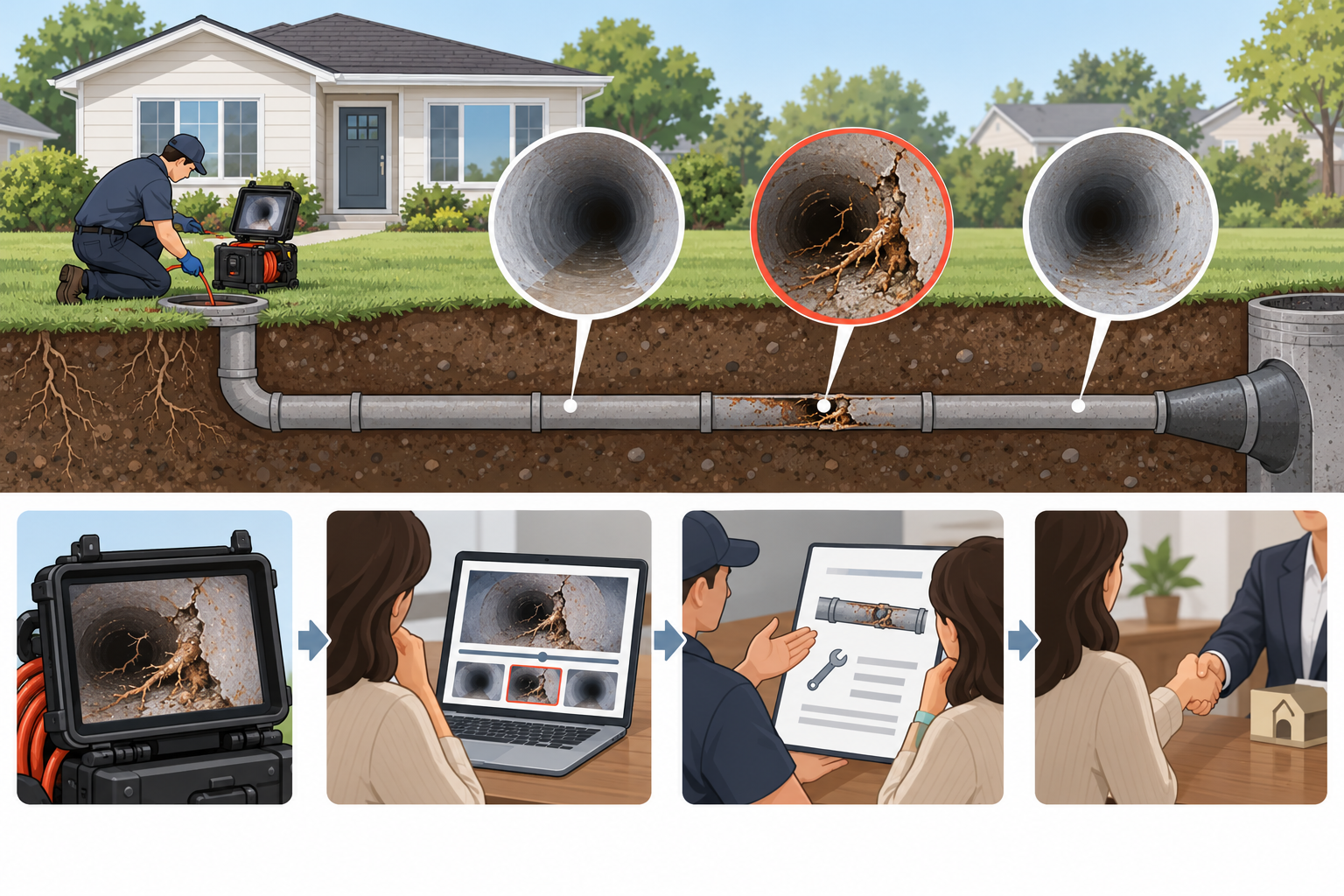
A sewer scope is a camera inspection of a buried building drain or private sewer lateral. It is usually a relatively small transaction expense compared with a damaged line, difficult access, or a repair obligation discovered after closing. Angi reports a broad 2026 US estimate of roughly $271 to $1,726 per visit, but the local quote may differ and may or may not include cleaning, recording, locating, or a written report.
Why a normal home inspection may not answer this question
Most of a sewer lateral is underground and cannot be assessed by looking at fixtures or running a few drains. A home can have normal indoor drainage while the buried line has roots, cracks, offsets, deposits, deformation, or a collapse outside the building. A sewer scope does not guarantee that every defect will be found, but it can convert an invisible risk into evidence about the observed route.
King County recommends knowing a side sewer’s route, age, and condition and specifically recommends inspection before buying a home in its jurisdiction. That is a local public-utility recommendation, not a universal real-estate requirement. Whether a scope is expected, contractually permitted, or available during a short inspection period depends on the transaction and market.
A buyer’s voluntary scope is not automatically the test or record a sewer authority requires for a sale. If an agent, seller, or municipal office says compliance is needed before closing, ask for the exact local rule and accepted deliverables. The separate home-sale compliance guide covers required testing, authority review, correction, extension, and transaction timing. A buyer should not assume that a camera visit alone resolves that obligation.
Properties where the scope has more decision value
The case for paying for a scope is stronger when the property has an older or undocumented sewer, mature trees near the route, a history of slow drains or backups, additions or remodeling that may have changed drainage, a long lateral, a shared or unusual connection, or no accessible cleanout. It is also stronger when the buyer could not comfortably absorb a large post-closing repair.
A newer home with complete records and a recently documented line may present less uncertainty, although age alone never proves condition. A scope is not a guarantee or an insurance policy; its value lies in improving the decision before the buyer becomes the owner.
What to request from the inspector
Ask for the complete video, the access point used, the direction of inspection, the approximate length viewed, distance markers, a written description of findings, and any portion that could not be inspected. If a defect is present, request its approximate location relative to the house, property line, street, or public main. Ask whether electronic locating or depth estimation is included or separately priced.
NASSCO describes building-sewer and drain inspection as typically proceeding from the building side toward the main, while a lateral inspection program may proceed in the opposite direction without entering the building. These are typical program distinctions, not a universal requirement. The important buyer question is whether the inspection covered the segment that creates the financial risk.
How to interpret a finding
A video is not a repair quote. A root, crack, offset, belly, or deposit may be localized or extensive. A camera may show a visible collapse, but the repair method still depends on length, location, access, alignment, connection details, and local requirements. A camera may also fail to see through a blockage or may not establish the condition of every connection.
Use a finding to decide whether to obtain a specialist estimate, request more investigation, or accept a documented risk. Do not turn a contractor’s verbal phrase such as “old pipe” into an automatic replacement allowance. Conversely, do not treat a clean-looking short video as proof that the entire route is sound if the scope was incomplete.
Build the repair budget in layers
If the inspection reveals a concern, ask for a written estimate that separates:
- additional cleaning or diagnostic work;
- locating and depth confirmation;
- spot repair, lining, bursting, or open-trench replacement;
- access, excavation, and public right-of-way work;
- permits, inspection, utility coordination, and connection work;
- driveway, landscaping, pavement, or interior restoration;
- temporary service arrangements and contingency assumptions.
The purpose is not to make the seller or buyer predict an exact final number from a video. It is to distinguish a manageable localized repair from a project whose access or public/private boundary could change the economics.
Responsibility can be as important as condition
Private sewer laterals connect properties to public systems, but responsibility boundaries vary. In some places the owner is responsible only to the property line; in others, responsibility extends toward the public main or under the street. Shared lines and easements can change the allocation again.
If a finding is near the street, ask the utility or municipality how it handles that segment before assuming the buyer owns the bill. A city example is not a legal answer for another city. Keep the video, report, route information, title documents, and any utility response together with the inspection record.
When the inspection cost is not enough
Request more information when the camera could not reach the suspected problem, the report lacks location data, a structural conclusion is based on a brief image, or proposed repairs from contractors materially conflict. A second opinion may be cheaper than accepting a full replacement proposal that has not established its scope.
Buyers should also separate sewer conveyance from other water problems. Basement dampness may involve foundation drainage or groundwater rather than sanitary sewer failure, while a sewer backup may be a private blockage or a municipal event. Those require different investigations and budgets.
A practical buyer checklist
- Is the inspection period long enough to arrange the scope and obtain a repair estimate?
- Which pipe segment will be inspected, and from which access points?
- Will the video and report be delivered to the buyer, not only described verbally?
- Are cleaning, locating, and a second visit included?
- Are findings measured and mapped well enough to discuss responsibility?
- Is the line shared, traversing, or subject to an easement?
- What repair option is being priced, and what alternatives remain?
- Which costs are contractor work and which may be municipal or restoration work?
The sewer scope is worth paying for when it can change a real decision: proceed, negotiate with documented information, request a credit or repair, budget for a near-term project, or walk away from an exposure the buyer cannot accept. Its value is not the video alone; it is the reduction in uncertainty before ownership changes.
When a finding changes the transaction budget
Treat a finding as a trigger for a better-defined estimate, not as a fixed deduction from the purchase price. A localized accessible repair, a long route beneath a driveway, and a shared connection may all produce the same seller-facing phrase—“sewer issue”—while carrying different cost and responsibility. Obtain a specialist scope when the finding could affect the decision materially.
If the inspection is incomplete, record that limitation in the buyer’s budget. An unviewed section is not evidence of failure, but it is also not evidence of condition. The buyer can then decide whether to obtain another access point, a locate, a utility response, or a qualified estimate within the available transaction time.
Fit the scope to the transaction window
Arrange the inspection early enough that the report can be reviewed and, if needed, a specialist can price a defined repair before the applicable contingency or inspection deadline. A camera visit booked at the end of the window may return a video without enough time to resolve a major finding. Ask the inspector when the recording and report will be delivered and whether a blocked or inaccessible segment could require another appointment.
Before the visit, ask the seller or inspector which cleanouts are available, whether prior videos or repair invoices exist, and whether the buyer may retain the recording. Clarify who pays for clearing if the camera cannot pass. If the inspector recommends opening the ground, request a separate written scope and approval before any excavation; the purpose of a sewer scope is to inform the transaction, not to authorize an undefined project.
Translate findings into a transaction allowance carefully
A seller-facing allowance should name the evidence and repair scope behind it. “Replace sewer line” is too broad if the camera shows one localized joint; “minor roots” is too reassuring if the camera stops before a long unviewed section. Ask contractors to state endpoints, length, method, access, permits, connections, restoration, and retained pipe. If the public/private transition is uncertain, contact the utility before assigning the full amount to either party.
The buyer can then separate known work from unresolved exposure. A defined accessible spot repair can be budgeted as a quoted project. A long route under a driveway may need a difficult-case allowance for restoration. An inaccessible segment may justify further investigation or a decision to accept that uncertainty. The same video can support different negotiating choices, but it does not establish a universal credit or guarantee that a seller must perform repairs.
If no structural defect is found, retain the report and record its limits rather than turning the result into a promise of remaining service life. Future landscaping, remodeling, roots, or a new blockage may change condition. The scope’s immediate value is evidence before purchase, not a permanent warranty on the buried line.